Abu Dhabi/Washington/Tehran, 19 August (H.S.): The situation in the Strait of Hormuz has become increasingly tense after nearly seven months of military confrontation and mounting regional uncertainty. Amid repeated attempts to broker an understanding between the United States and Iran, tensions have intensified following an alleged Iranian attack targeting maritime navigation near the United Arab Emirates (UAE). The development has heightened security concerns across the region, while Iran has expressed anger over the conduct of US-allied countries. Following the incident, US Secretary of State Marco Rubio spoke with UAE National Security Adviser Sheikh Tahnoun bin Zayed Al Nahyan about key regional security concerns.
According to reports, the UAE has taken a major step following the alleged ballistic missile attack by Iran. The country has suspended all trade, commercial exchanges and financial transactions with Iran with immediate effect. The measures have been introduced in view of growing regional instability and increasing threats to regional and international peace and security.
Afra Al Hameli, Director of Strategic Communications at the UAE Ministry of Foreign Affairs, announced the decision and said the measures would remain in force until further notice. Amid rising tensions in the Middle East, US President Donald Trump said there were currently no talks with Iran and described the Strait of Hormuz as US territory. Trump also posted an image portraying the strategic waterway as new American territory.
Iran has reiterated its conditions for reopening the Strait of Hormuz. Qatar's Foreign Ministry said mediators were awaiting a bilateral agreement between Iran and Oman concerning the strait before broader US-Iran negotiations could resume.
Following the incident involving the UAE, Secretary Rubio held a telephone conversation with Sheikh Tahnoun bin Zayed Al Nahyan and stressed the importance of maintaining freedom of navigation through the Strait of Hormuz. According to US State Department spokesperson Tommy Pigott, Rubio discussed major regional security issues with Sheikh Tahnoun. The two also exchanged views on the situation in Lebanon.
Meanwhile, Iranian Foreign Ministry spokesperson Esmail Baghaei rejected as baseless the UAE Defence Ministry's claim that Iran had launched two ballistic missiles towards the country. He said such allegations could damage good-neighbourly relations and undermine mutual trust among countries in the region.
Iran's military leadership has also warned Gulf countries against assisting US forces. In a statement reported by Iran's Fars news agency, Ali Abdollahi, the country's military chief of staff, questioned the presence of a large number of military aircraft, particularly aerial refuelling aircraft, at bases in the region, saying it would be difficult to believe that such deployments could take place without the knowledge of host countries.
Against this backdrop, Iranian Parliament Speaker and chief negotiator Mohammad Bagher Ghalibaf said his visit to Iraq was aimed at strengthening a new regional framework without foreign interference. He said Islamic countries in the region should coordinate closely on deeper security ties while developing sustainable economic cooperation.
The Islamic Republic of Iran is fully prepared to realise this regional model, Ghalibaf said.
Iran's Oil Ministry has meanwhile released an unexpected figure amid the continuing military tensions around the Strait of Hormuz. The ministry said Iran earned $7.5 billion in foreign currency from oil exports during the first four months of this year. The amount has reportedly been transferred to the Central Bank of Iran. According to the ministry, the earnings were 1.5 times higher than those recorded during the corresponding period last year. Tehran expects the revenue to help meet the government's foreign-exchange-related expenditure through the end of December.
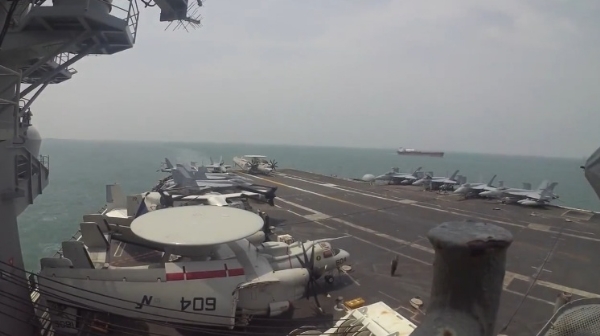
The Strait of Hormuz has once again drawn global attention. The US military has released footage of its aircraft carrier USS George Washington passing through the Strait of Malacca between Malaysia and Indonesia. According to the military, the time-lapse footage was recorded on August 13 and showed the warship's flight deck during the transit.
The USS George Washington is expected to reach the Middle East and replace the USS Abraham Lincoln, which has remained deployed at sea for an extended period amid the conflict involving Iran. Separate footage released by the US military showed aircraft conducting night operations from the George Washington in the Indian Ocean on Tuesday.
The deployment of the George Washington to the Middle East would leave the United States without an aircraft carrier in the Pacific region, further underscoring the strategic significance of the ongoing military movements as tensions surrounding the Strait of Hormuz continue to escalate.
---------------
Hindusthan Samachar / Jun Sarkar

18 Aug 2026