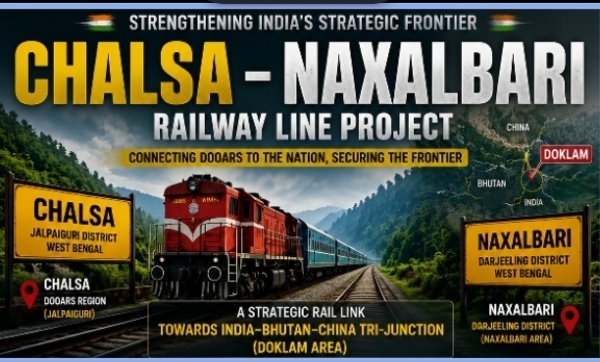
Nine years after the 2017 Doklam military standoff underscored the critical importance of rapid mobilisation and robust infrastructure in the eastern Himalayas, India is renewing its focus on a strategically significant railway project in North Bengal. The proposed Chalsa–Naxalbari railway line is being viewed not merely as a connectivity initiative, but as part of a broader strategy to strengthen border infrastructure, improve military logistics and enhance the resilience of the strategically vital Siliguri Corridor.
The Siliguri Corridor is one of India’s most sensitive geographical zones. The narrow land bridge connects mainland India with the northeastern states and lies close to the India–China–Bhutan tri-junction and the Doklam plateau. Its strategic importance became particularly evident during the 2017 Doklam standoff, when Indian and Chinese troops remained locked in a 73-day face-off after China attempted to extend a road towards the disputed area in Bhutan.
The Chalsa–Naxalbari railway project dates back more than a decade. Originally sanctioned during 2011–12, the project faced prolonged delays because of land acquisition difficulties and administrative hurdles. The West Bengal government’s recent move to expedite the acquisition of nearly 380 hectares of land has revived prospects for the approximately 20-kilometre railway stretch. Once developed, the line could improve connectivity across North Bengal and strengthen access towards strategically important areas surrounding the Siliguri region and the eastern Himalayan frontier.
From a defence perspective, the proposed railway link could significantly enhance India’s strategic mobility. Military logistics in several border areas continue to depend heavily on road networks, which remain vulnerable to landslides, extreme weather and difficult terrain. A rail connection would provide an additional and potentially more reliable logistics backbone, enabling the faster movement of troops, equipment, fuel and essential supplies during security contingencies, humanitarian emergencies and natural disasters.
The project also needs to be viewed against the backdrop of China’s rapid expansion of infrastructure along the Tibetan frontier. Over the past several years, China has strengthened its network of roads, railways, bridges and military facilities across Tibet, improving the movement of personnel and resources towards the Line of Actual Control. India, in response, has accelerated infrastructure development in strategically important areas through tunnels, bridges, highways, advanced landing grounds and improved connectivity across Arunachal Pradesh, Sikkim and Ladakh. The Chalsa–Naxalbari railway project fits into this wider effort to enhance strategic mobility through infrastructure.
However, the significance of the railway extends beyond defence. Improved connectivity could provide a substantial economic boost to North Bengal and the wider Northeast by facilitating trade, tourism, agriculture and local industries. The Dooars region, with its tea gardens, forests and growing tourism sector, could benefit from faster and more efficient transportation links. Better rail connectivity could also provide communities in remote areas with improved access to markets, healthcare, education and employment opportunities.
The project assumes particular importance for the resilience of the Siliguri Corridor. In the event of a future security crisis, maintaining uninterrupted connectivity between mainland India and the Northeast would be critical. A stronger railway network could support military mobilisation while simultaneously facilitating civilian movement, disaster-relief operations and emergency supply chains. This dual-use capability would make the region better prepared for both security contingencies and natural disasters.
India’s approach to border infrastructure has increasingly evolved from a predominantly defensive outlook towards a broader model that combines national security, economic development and regional connectivity. In this framework, infrastructure is no longer viewed simply as a means of reaching remote areas; it is increasingly regarded as an instrument of strategic resilience and economic integration.
As strategic competition intensifies across the Himalayan region, connectivity will remain a decisive factor in maintaining the balance of power. The proposed Chalsa-Naxalbari rail link could therefore become an important infrastructure multiplier for North Bengal, strengthening India’s logistical preparedness while opening new opportunities for trade, tourism and regional development.
Ultimately, the project represents the convergence of security and development. A railway line built for connectivity can simultaneously strengthen military logistics, support local economies and reinforce the resilience of one of India’s most strategically sensitive corridors. In the eastern Himalayas, where geography and security are closely intertwined, such infrastructure could play a crucial role in shaping India’s strategic preparedness for years to come.
Hindusthan Samachar / Satya Prakash Singh