
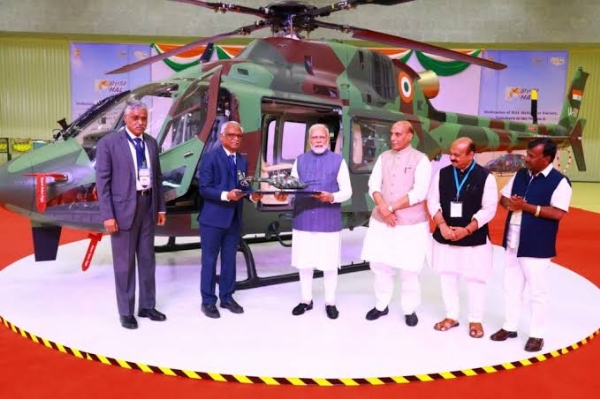
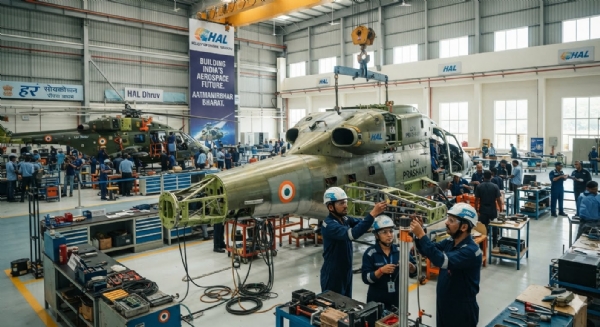
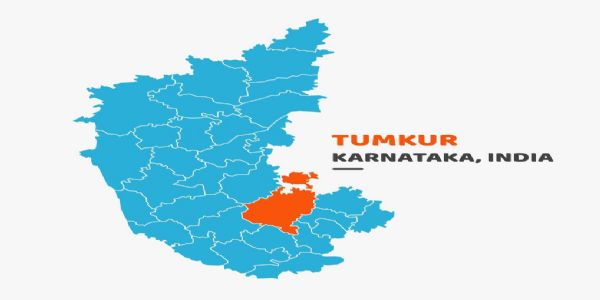
New Delhi, 08 July (H.S.): For decades, Bengaluru has been recognised as the heart of India's aerospace and defence industry. Less than 100 kilometres away, however, another city is quietly emerging as a key pillar of the country's aviation ambitions. Tumakuru, once known primarily for agriculture and traditional industries, is rapidly transforming into an integrated aerospace manufacturing hub that could strengthen India's position in the global aviation and defence supply chain.
The transformation reflects a broader shift in India's industrial strategy. As geopolitical tensions, supply-chain disruptions and rising defence requirements encourage countries to expand domestic manufacturing capabilities, India is investing in indigenous aerospace production to reduce import dependence while building an internationally competitive aviation ecosystem. Tumakuru is becoming one of the most visible symbols of that transition.
At the centre of this transformation is Hindustan Aeronautics Limited's (HAL) Helicopter Manufacturing Complex. In 2026, the facility entered a new phase with the inauguration of a dedicated structure assembly line for the Prachand Light Combat Helicopter (LCH), alongside the commissioning of an advanced Automated Storage and Retrieval System that streamlines production and improves manufacturing efficiency.
The expansion comes as India's armed forces continue to increase procurement of indigenous helicopter platforms. HAL is scaling production from an initial capacity of around 30 helicopters annually to a long-term target of 60 to 100 helicopters a year, making Tumakuru one of India's fastest-growing aerospace manufacturing centres.
Yet the story is no longer about a single factory. Around HAL, an integrated aerospace ecosystem is beginning to take shape. More than 500 Micro, Small and Medium Enterprises (MSMEs), together with Tier-1 and Tier-2 suppliers, have become part of HAL's manufacturing network, producing precision-engineered components, avionics, composite structures and specialised systems. The growing supplier base is creating a regional manufacturing cluster capable of supporting both civilian and military aviation programmes.
The city's long-term significance is expected to grow further with future indigenous helicopter programmes, including the Indian Multirole Helicopter (IMRH) and the Deck-Based Multi Role Helicopter (DBMRH). These next-generation platforms are expected to replace ageing imported fleets while expanding India's capability to design, manufacture and support advanced rotary-wing aircraft domestically.
Supporting this industrial expansion is Karnataka's proposed HAL Aerospace Renaissance Masterplan (2026-2036), which aims to develop the Bengaluru-Tumakuru corridor into a globally competitive aerospace innovation district. The vision extends beyond aircraft assembly to encompass research, testing, component manufacturing, maintenance, skill development and advanced engineering.
The emergence of the Tumakuru Industrial Township under the Chennai-Bengaluru Industrial Corridor further strengthens this vision by creating dedicated infrastructure for aerospace, defence, electronics and precision engineering industries. Together, these projects are expected to improve logistics, encourage private investment and accelerate the development of a high-value manufacturing ecosystem.
The implications extend far beyond Karnataka. For decades, India depended heavily on imported helicopters and defence platforms. As indigenous production expands, Tumakuru could help reduce strategic dependence on overseas suppliers while strengthening the country's technological capabilities in aerospace manufacturing.
The economic impact could be equally significant. Aerospace manufacturing generates some of the highest-value industrial employment, requiring expertise in robotics, avionics, precision engineering, advanced materials and digital manufacturing. As the ecosystem matures, Tumakuru is expected to attract investment across research, maintenance, component manufacturing and emerging aerospace technologies, creating opportunities for thousands of highly skilled professionals.
The city also has the potential to strengthen India's role in global aerospace supply chains. As international manufacturers seek diversified production bases, Tumakuru's integrated manufacturing ecosystem, expanding supplier network and growing indigenous capabilities could position India as a more competitive destination for aerospace partnerships, exports and technology collaboration.
Beyond defence manufacturing, Tumakuru reflects a larger transformation taking place across India's industrial landscape. The country is gradually moving from assembling imported technologies to designing, manufacturing and exporting sophisticated engineering products. That transition is essential if India is to achieve its ambition of becoming a global manufacturing and technology power.
If Bengaluru established India's reputation in aerospace research and design, Tumakuru is now helping build its manufacturing future. As helicopter production scales up, indigenous programmes mature and the surrounding industrial ecosystem expands, the city could play a defining role in India's evolution from one of the world's largest defence importers to a globally recognised aerospace manufacturing nation.
---------------
Hindusthan Samachar / Indrani Sarkar

08 Jul 2026
Patience Is a Nation's Greatest Strength, Says PM Modi While Sharing Ancient Sanskrit Verse

07 Jul 2026