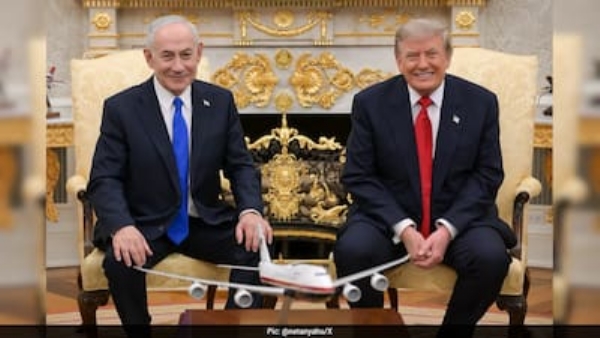
Washington, 29 July (H.S.): Israeli Prime Minister Benjamin Netanyahu and US President Donald Trump held their first face-to-face meeting at the White House since the outbreak of the Iran conflict, reaffirming their shared commitment to preventing Tehran from acquiring nuclear weapons while seeking to project unity amid recent reports of tensions between the two allies.
The closed-door meeting, which lasted about 90 minutes, was described by the White House as positive and productive. Speaking after the talks, Netanyahu called it one of the best conversations he had ever had with a US president, saying both leaders remained aligned on their common objective of ensuring that Iran does not develop nuclear weapons.
The meeting comes at a critical juncture in the Middle East, with the United States attempting to revive diplomatic engagement with Iran following months of military escalation. The conflict, which intensified after coordinated US-Israeli strikes in late February, has recently entered a temporary lull as Washington seeks to create space for negotiations.
Although Israel has not participated in the latest round of direct hostilities between the United States and Iran following the collapse of an April ceasefire, regional tensions remain high. On Tuesday, Yemen's Iran-backed Houthi movement claimed responsibility for launching ballistic missiles at a Saudi oil tanker in the Red Sea, alleging the vessel had violated its self-declared maritime blockade. Saudi Arabia later reported intercepting drones targeting oil facilities in the country's eastern region and accused pro-Iran militias in Iraq of carrying out the attacks.
The White House meeting also served to dispel speculation about strained relations between Trump and Netanyahu. Their relationship came under public scrutiny earlier this year after disagreements emerged over the handling of the Iran ceasefire, with Trump openly criticising the Israeli leader during the negotiations. Netanyahu, however, has consistently characterised those exchanges as tactical differences rather than fundamental disagreements over strategic objectives.
Tuesday's talks marked the eighth meeting between Trump and Netanyahu since the US President returned to office in early 2025. The discussions also focused on the implementation of the US-backed Israel-Lebanon framework agreement signed last month, which continues to face challenges on the ground.
The leaders additionally reviewed the humanitarian and security situation in Gaza, where reconstruction efforts remain stalled despite ongoing international diplomatic initiatives. Nearly three years after the Israel-Hamas conflict began, humanitarian conditions in the Palestinian enclave continue to deteriorate, while Israeli military operations against suspected militant targets persist.
Israeli officials described the visit as taking place at a pivotal moment for regional security. Israel's Ambassador to the United Nations, Danny Danon, accused Iran of continuing to support militant groups and disrupting stability across the Middle East, including through threats to maritime security around the strategically important Strait of Hormuz.
Political analysts believe the visit was aimed as much at sending a diplomatic message as discussing policy. According to regional affairs experts, both Washington and Jerusalem sought to demonstrate that despite earlier public disagreements, their strategic partnership remains intact and that there is no significant rift between the two governments over Iran or broader Middle East security.
The meeting comes as both leaders prepare for important political tests later this year, with Israel expected to hold national elections and the United States heading into congressional midterm elections. Their discussions are expected to shape the next phase of coordination on Iran, regional security, and ongoing efforts to stabilise the Middle East.
---------------
Hindusthan Samachar / Jun Sarkar