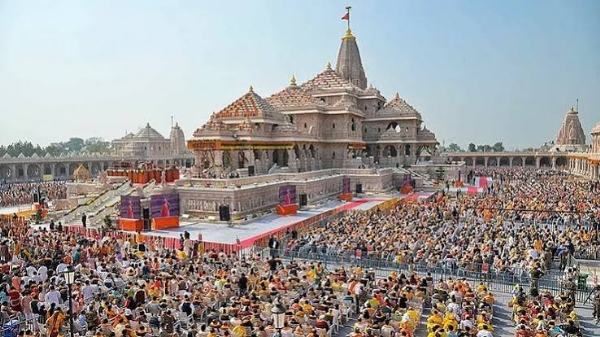
Lucknow, 02 July (HS): The Ram Mandir has been the Bharatiya
Janata Party's (BJP) most significant ideological and political achievement in
Uttar Pradesh over the last decade. The temple's dedication in January 2024
brought to a close a decades-long movement affiliated with the party's primary
Hindutva objective. Less than a year before the 2027 Uttar Pradesh assembly
elections, the alleged theft of Ram Temple funds has sparked a new political
debate over accountability, transparency, and the handling of devotee
offerings.
The BJP believes that the incident will not disrupt its
election preparations and that it has responded quickly by conducting
inquiries. Meanwhile, the opposition is attempting to use the situation to
launch a political campaign against the ruling party.
Why Is Ram Mandir Politically Significant? Few political topics have had a
greater impact on Uttar Pradesh politics than Ayodhya. According to the BJP,
the Ram Mandir is more than just an infrastructural project; it represents the
climax of a 500-year fight. The party has also created a larger government
narrative centered on Ayodhya's transformation, the Kashi Vishwanath Corridor,
the Mahakumbh, and religious tourism. Because of this symbolism, claims
concerning devotee gifts always have political weight, even if the alleged
irregularities are post-consecration offerings rather than cash raised to build
the temple itself.
What Is The Donation Row? The dispute revolves around claims
that a group of accused individuals misused funds and jewels donated by
followers to the Ram Temple. The Uttar Pradesh government formed a Special
Investigation Team (SIT), many arrests were made, and significant quantities of
cash were purportedly confiscated in connection with the investigation.
According to sources, the Ayodhya police are likely to request an Enforcement
Directorate (ED) investigation, and roughly Rs 62 lakh was confiscated during
raids. Two trust officers, including then-general secretary Champat Rai,
resigned for moral reasons. The BJP claims that the speed of the probe proves
that no one is being protected.
Shot in the arm for the opposition: The Samajwadi Party, Congress, and Bahujan
Samaj Party are aiming to keep the debate alive ahead of polls, making it one
of the first big political flashpoints before the 2027 campaign. Samajwadi
Party chairman Akhilesh Yadav termed the alleged misappropriation an insult to
Sanatan Dharma and stated that an SP administration will transform Ayodhya into
an exemplary Siyaram Dham.
The Congress has organized rallies across Uttar Pradesh, accusing the BJP
administration of failing to ensure transparency in the handling of devotee
donations. Mayawati, the BSP president, has also questioned how the situation
is being handled, adding to the Opposition's concerted onslaught. For the
opposition, the political calculus is significant: rather than opposing the Ram
Mandir, parties are seeking to explain that they are safeguarding devotees'
religion and demanding responsibility.
How Is the BJP Responding? Rather than allowing the argument
to focus exclusively on theft, the BJP attempted to portray the probe itself as
proof of transparency. Chief Minister Yogi Adityanath has frequently stated
that the guilty will not be spared, while encouraging the opposition not to
politicise followers' religion. Everything will become clearer. But do not put
Ram worshipers to the test; instead, refrain from messing with their faith. If
there are no facts or proof, cease making allegations. If there is proof, bring
it to the SIT. The chief minister sought to redirect the political debate back
to the BJP's wider Hindutva agenda by pushing Akhilesh Yadav to support the
Shri Krishna Janmabhoomi agitation in Mathura.
BJP officials agree that the subject, which includes devotee offerings, is
emotionally charged. The party feels that taking action against individuals
involved is the most effective method to limit political damage before
elections.
Is the BJP attempting to minimize its losses? The timing has
unavoidably fueled political conjecture. Nitin Nabin, the BJP's national
president, is in Uttar Pradesh for closed-door 'Mission UP' discussions with
general secretary (organisation) BL Santhosh and other state officials. Opposition
parties have connected the visit to the issue over the Ram Mandir. The BJP
opposes the idea. The BJP national president's travel is thoroughly planned
ahead of time. He recently travelled to Punjab and Uttarakhand. He also spent a
lot of time in Telangana setting goals. Lucknow was scheduled. The Opposition's
outrage over the Ram Mandir contribution problem, which is being investigated
thoroughly, is coincidental, according to an Uttar Pradesh BJP leader.
According to party sources, talks were mostly focused on
'Mission UP', namely boosting organization in the 57 assembly seats the BJP
lost in 2022 compared to 2017, rather than the funding problem. According to
sources, the new state team led by Pankaj Chaudhary is set to be given explicit
organizational aims for 2027.
Will Ram Mandir Still Help the BJP? Political analysts
believe the answer is likely yes, but in a different fashion than before. The
political problem for the BJP is to ensure that complaints regarding temple
governance do not overwhelm the bigger significance associated with Ayodhya. The
party appears to be counting on two things: that the probe will reveal
responsibility rather than a cover-up, and that voters will continue to discern
between suspected misconduct by individuals and the larger Ram Mandir project
itself.
What factors might impact the 2027 narrative? As the
campaign progresses, Ayodhya is anticipated to remain crucial to political
discourse, but the discussion may change.
Transparency, governance, and accountability are likely to remain the
Opposition's priorities. For the BJP, the emphasis is anticipated to stay on
the Ram Mandir as a significant civilisational achievement, while emphasizing
speedy action against suspected malfeasance and maintaining the wider electoral
narrative focused on governance, welfare, and Hinduism.
The outcome of the SIT inquiry and any future legal procedures may ultimately
determine if the contribution problem becomes a long-term electoral concern
rather just political bluster.
Hindusthan Samachar / Abhishek Awasthi
02 Jul 2026