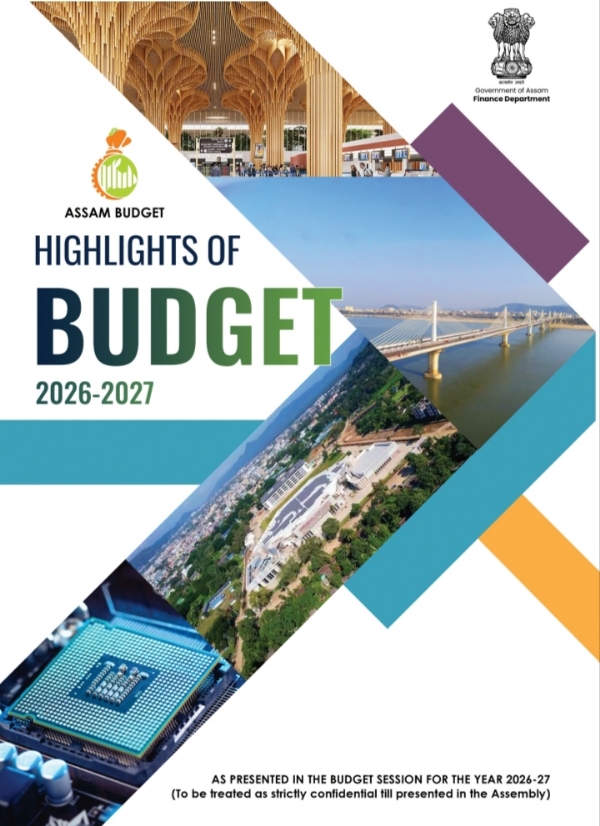
Guwahati, 10 July (HS): Assam's economy has witnessed a significant transformation over the past decade, with the State Budget for 2025-26 expanding to nearly ₹2 lakh crore and per capita income rising more than threefold, according to the 2026-27 Budget presented in the Assembly on Friday by Finance Minister Jayant Mallabarua.
The budget document states that the size of the State Budget has increased almost three times to ₹2,00,782 crore in 2025-26. Budget utilisation has also improved sharply from 58% to a record 85%, reflecting stronger implementation capacity and more efficient use of public resources.
The state's own tax revenue has grown from ₹12,848 crore in 2015-16 to ₹39,294 crore in 2025-26, driven by improved tax compliance, technology-enabled governance and sustained economic growth. The share of own-source revenue in total receipts has risen from 30% to 36%, with the government targeting 50% by 2031 to strengthen fiscal self-reliance.
Capital expenditure has recorded a major jump, increasing from ₹2,951 crore in 2015-16 to ₹26,531 crore in 2025-26. The government has committed to maintaining at least 10% annual growth in capital spending, with a focus on productive and asset-creating investments.
Recognising Assam's improved fiscal performance, the 16th Finance Commission has enhanced the state's share in tax devolution from 3.128% to 3.258%. As a result, Assam is expected to receive nearly ₹50,000 crore in central transfers during the current financial year.
The Budget also highlights the expansion of externally aided projects (EAPs). The portfolio has grown from nine projects worth about ₹7,500 crore during the 14th Finance Commission period to 21 projects valued at nearly ₹53,000 crore under the 15th Finance Commission. Total disbursements have increased from around ₹3,748 crore to over ₹14,400 crore, while annual disbursements now exceed ₹6,000 crore.
Despite higher development expenditure, Assam has maintained fiscal discipline. The debt-to-GSDP ratio stood at 24.81% in 2025-26, well below the 32% limit prescribed under the Fiscal Responsibility and Budget Management (FRBM) framework, placing the state among India's fiscally prudent states.
Institutional credit flow has also strengthened, with the credit-deposit ratio improving from 41.10% in March 2016 to 73.52% in March 2026, indicating that a larger share of deposits mobilised within the state is now being channelled into productive economic activities.
Reflecting the broader impact of economic growth, the Budget notes that Assam's per capita income has more than tripled over the past decade, rising from ₹60,817 in 2015-16 to ₹1,85,429 in 2025-26, underscoring a more inclusive and broad-based growth trajectory.----------
Hindusthan Samachar / Sriprakash


10 Jul 2026
No role for political parties in feeding patients at Medical colleges ,G.Sudhakaran MLA
No role for political parties in feeding patients at Medical colleges ,G.Sudhakaran MLA..