New Delhi, 30 June (H.S.): Indian scientists have made a significant breakthrough in understanding the behaviour of hazardous solar eruptions, a discovery that could substantially improve the accuracy of future space weather forecasting.
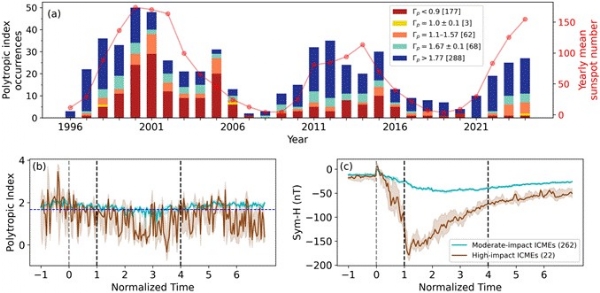
The research was conducted by scientists at the Indian Institute of Astrophysics, who analysed nearly 30 years of space data spanning the period from 1995 to 2024.
The study explains that Interplanetary Coronal Mass Ejections (ICMEs) released by the Sun can affect satellites, Global Positioning System (GPS) services, radio communications, and power grids after reaching the vicinity of Earth. At the same time, these solar eruptions are also responsible for producing spectacular auroras over the Earth's polar regions.
According to the research, it was previously believed that these solar eruptions continuously cooled as they travelled through space. However, the new study suggests that this assumption is not entirely accurate.
The scientists found that nearly 45 percent of ICMEs remain in a heated state while travelling through interplanetary space.
The study also revealed that solar storms exhibiting such heating signatures are more frequently observed during periods of heightened solar activity. In addition, variations in their behaviour were recorded across different solar cycles.
According to the researchers, the solar storms that have a greater impact on Earth are often those that remain in a heated state and exhibit stronger magnetic properties.
The study is based on long-term observations obtained from NASA's OMNI database and satellites positioned at the L1 Lagrange Point. The findings have been published in the international peer-reviewed journal Monthly Notices of the Royal Astronomical Society (MNRAS).
Experts believe the research will strengthen early detection and warning systems for solar storms, helping improve the protection of satellites, communication networks, navigation systems, and power infrastructure against the effects of severe space weather.
---------------
Hindusthan Samachar / Jun Sarkar

30 Jun 2026
India, Seychelles Exchange MoU and Five-Year Action Plan to Deepen Agricultural Research Partnership
30 Jun 2026