New Delhi, 30 June (H.S.): Union Minister for Health and Family Welfare Jagat Prakash Nadda on Tuesday said that a developed India can only be built on the foundation of a healthy India.
He said preventive healthcare is now being given greater priority so that people can be protected from serious illnesses before they develop. A healthy India, he said, is the cornerstone of a developed nation, and the government is working consistently toward that goal.
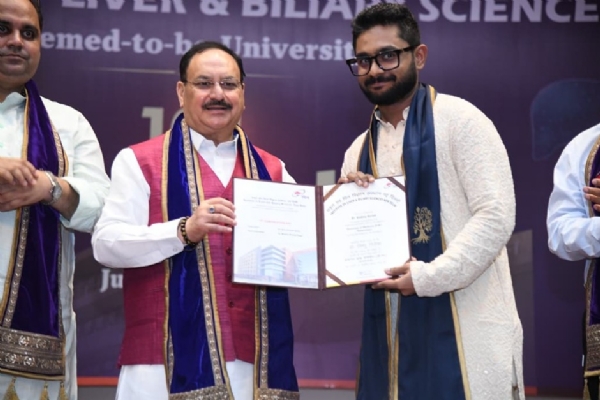
Nadda was addressing the 10th Convocation Ceremony of the Institute of Liver and Biliary Sciences (ILBS) in New Delhi.
Speaking on the occasion, he said that under the leadership of Prime Minister Narendra Modi, the government has focused equally on strengthening both the hardware and the software of the country's healthcare and medical education systems. According to him, hardware refers to the expansion of hospitals, medical colleges, and modern healthcare infrastructure, while software encompasses better policies, quality training, and an academic environment that enables doctors and researchers to excel.
The Union Minister said that the number of medical colleges in the country has increased from 387 to 818 over the past few years. Similarly, MBBS seats have risen from around 50,000 to more than 120,000, while postgraduate medical seats have increased from 30,000 to over 80,000. He added that the government aims to create another 75,000 medical seats in the coming years to further strengthen the availability of doctors across the country.
In his address, Nadda also said that India now has 23 All India Institutes of Medical Sciences (AIIMS), many of which have been established in recent years. He said this expansion has provided a significant boost to super-speciality healthcare and medical education across the country.
Highlighting the importance of primary healthcare, the Minister described Ayushman Arogya Mandirs as playing a crucial role in delivering healthcare services. More than 185,000 such centres are currently operational nationwide, providing primary healthcare to millions of people. He said these centres are conducting large-scale screening for diseases such as hypertension, diabetes, and cancer, enabling early diagnosis and making treatment more effective.
Nadda reiterated that preventive healthcare has become a key focus of the government's health strategy to ensure people remain protected from serious diseases. He emphasised that a healthy India remains the foundation of a developed India and that the government continues to work steadily in that direction.
Praising the Institute of Liver and Biliary Sciences, he said the institution has been playing a significant role in the treatment of liver diseases, medical research, and creating awareness about conditions such as fatty liver disease. He added that ILBS has established a strong reputation not only in India but also internationally.
Addressing the graduating students, Nadda said that earning a super-speciality medical qualification is not merely an academic achievement but also carries a profound responsibility toward society. He urged the new graduates to uphold the highest standards of medical ethics, compassion, and public service throughout their careers.
He said that the responsibility of a doctor extends beyond providing treatment and includes treating patients with empathy and humanity. Concluding his address, he wished the graduates success in their future endeavours and called upon them to contribute actively to strengthening India's healthcare system.
---------------
Hindusthan Samachar / Jun Sarkar


30 Jun 2026
India, Seychelles Exchange MoU and Five-Year Action Plan to Deepen Agricultural Research Partnership
30 Jun 2026