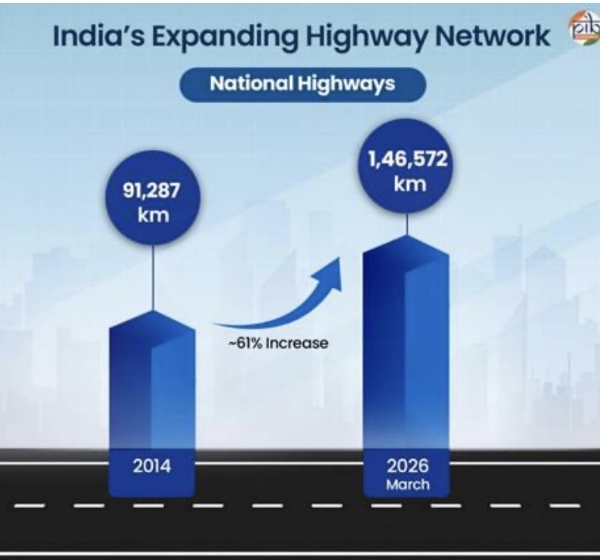
New Delhi, 14 June (H.S.): India has witnessed unprecedented growth in infrastructure development and the expansion of its national highway network over the past 12 years, with the total highway length increasing by 61 percent from approximately 91,287 kilometres in 2014 to more than 146,572 kilometres in the financial year 2025-26, according to the Union Ministry of Road Transport and Highways.
The ministry said on Sunday that the rapid expansion of national highways and the creation of world-class infrastructure have significantly accelerated the country’s economic growth while helping reduce logistics and freight transportation costs.
According to the ministry, the average pace of highway construction has risen sharply from 11.6 kilometres per day in 2013-14 to nearly 34 kilometres per day in 2025, reflecting a substantial increase in execution capacity and infrastructure investment.
The ministry further cited a study conducted by the Indian Institute of Management (IIM) Bangalore, which found that improved highway connectivity has enhanced access to manufacturing facilities and industrial centres, leading to a considerable reduction in transportation costs and greater economic efficiency.
As part of the flagship Bharatmala Pariyojana, the government aims to develop 34,800 kilometres of national highway corridors across the country. Of this target, construction of 22,590 kilometres had been completed by March 2026.
The ministry highlighted that the approximately 1,386-kilometre-long Delhi-Mumbai Expressway will become the longest access-controlled expressway in India once fully completed. Prime Minister Narendra Modi recently inaugurated the Kim–Ankleshwar (36 km) and Gandeva–Ankleshwar (27.5 km) sections of the Gujarat stretch of the expressway on June 5.
The nearly 82-kilometre-long Delhi-Meerut Expressway has also significantly reduced travel time between the two cities, improving regional connectivity and commuter convenience.
The ministry noted that the Delhi section of the Dwarka Expressway was inaugurated by the Prime Minister in August 2025, while the Haryana section was opened in March 2024. In southern India, the 118-kilometre Bengaluru-Mysuru Expressway has reduced travel time between the two cities from around three hours to just 75 minutes.
The ministry also highlighted the Delhi-Dehradun Economic Corridor, a 213-kilometre project built at a cost of approximately ₹12,000 crore, which was inaugurated on April 14, 2026. As part of the project, a 12-kilometre elevated wildlife corridor—described as the longest in Asia—was constructed to protect the ecologically sensitive areas of the Rajaji National Park while ensuring seamless transportation connectivity.
The Centre said that continued investment in modern road infrastructure is strengthening economic integration, improving connectivity across regions, and supporting India's long-term growth ambitions.
---------------
Hindusthan Samachar / Jun Sarkar


14 Jun 2026