New Delhi, 14 June (H.S.):
Delhi Chief Minister Rekha Gupta on Sunday said that citizens must bring about a significant change in their habits and behaviour towards rivers if long-term environmental conservation goals are to be achieved.
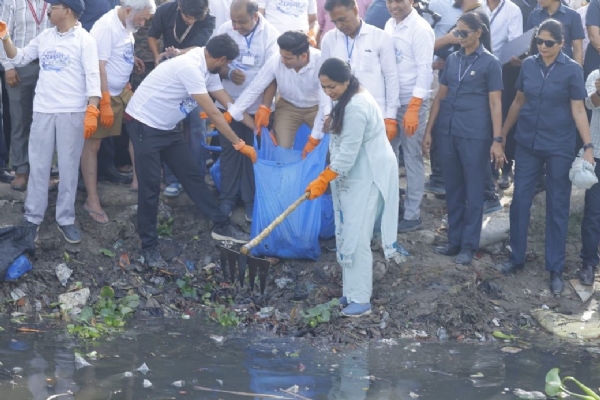
Under her leadership, the Delhi Government conducted a large-scale Mega Cleaning Drive as part of the “Yamuna Bank Cleanliness Campaign 2026.” The initiative covered 28 major ghats and riverbank locations along the Yamuna across the national capital, with the objective of promoting a cleaner and pollution-free environment.
The Chief Minister personally led the campaign from Geeta Colony Ghat, where she joined volunteers and members of the public in cleaning the riverbank. Participating in the cleanliness drive, she removed waste from the Yamuna’s banks and contributed through voluntary community service.
During the operation, large quantities of plastic waste, single-use polythene bags, broken idols, religious garments and worship materials wrapped in plastic were recovered from various locations along the river.
Expressing concern over the findings, Gupta said the situation highlighted the urgent need for public awareness and behavioural change.
“Yamuna is not merely a river; it is a source of faith, culture and livelihood for millions of people. If we continue to pollute it, the very purpose of our religious practices and devotion remains incomplete. The government will perform its responsibilities with full commitment, but citizens must also come forward and fulfil their duty to keep the river clean,” she said.
The Chief Minister administered a collective pledge to citizens and volunteers present at the event. Participants vowed not to immerse worship materials, flowers, garlands or idols directly into the river. They also committed to eliminating the use of polythene and single-use plastics, refraining from dumping old clothes or other waste into the Yamuna, and encouraging others to adopt environmentally responsible practices.
Gupta said the Delhi Government, inspired by Prime Minister Narendra Modi’s vision of a cleaner India and environmental protection, has approved projects worth more than ₹1,000 crore aimed at improving water quality and reducing pollution.
Among the major initiatives, 12 new Sewage Treatment Plants (STPs) are being established in the Najafgarh region under the AMRUT scheme at an estimated cost of ₹860 crore. These facilities are expected to prevent untreated wastewater from the Najafgarh Drain from entering the Yamuna.
The government is also undertaking the modernisation of the Keshopur Sewage Treatment Plant and implementing extensive measures to promote water conservation and rainwater harvesting across the city.
The Chief Minister clarified that the cleanliness campaign would not be limited to a single day. She said the Delhi Government would continue organising similar drives regularly to ensure sustained public participation and restore the Yamuna’s clean, uninterrupted and ecologically healthy flow.
The campaign covered major riverbank locations on both sides of the Yamuna, including Geeta Colony Ghat, Nizamuddin Ghat, Old Iron Bridge Ghat, the eastern and western banks near Signature Bridge, Kudesia Ghat, Nigambodh Ghat, Sonia Vihar Ghats, Kalindi Kunj Ghat, ITO Ghat, Mayur Vihar Yamuna Khadar, Sarai Kale Khan, Chilla Village, Gandhi Nagar, Ram Ghat, Kali Ghat, Shyam Ghat, Sur Ghat, Vasudev Ghat and Yamuna Bank.
Spread across nearly 22 kilometres of riverfront, the campaign witnessed the participation of thousands of volunteers, public representatives and government officials from more than 500 social and religious organisations, making it one of the largest community-led cleanliness initiatives undertaken along the Yamuna in recent years.
---------------
Hindusthan Samachar / Jun Sarkar
14 Jun 2026