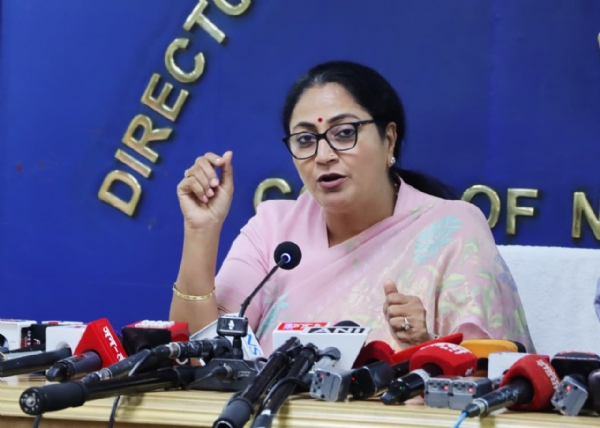
New Delhi, May 28 (H.S.): Delhi Chief Minister Rekha Gupta on Thursday said that the Central and Delhi governments are jointly undertaking large-scale modern road and connectivity projects to transform Delhi-NCR into a congestion-free, safe and future-ready transportation network. Under these initiatives, the region’s transport infrastructure is being modernised and streamlined through new expressways, tunnels, elevated corridors and connecting roads.
A high-level meeting regarding major road and connectivity projects in Delhi-NCR was recently held with Union Minister for Road Transport and Highways Nitin Gadkari. Following the meeting, the Union Minister informed the Chief Minister that several new expressway, tunnel, elevated corridor and connectivity projects are being launched to decongest Delhi, reduce traffic pressure and ensure better regional connectivity.
In a statement issued on Thursday, the Chief Minister said that under the Urban Extension Road-2 (UER-2) Extension and Delhi-Dehradun Expressway connectivity project, a nearly 17-kilometre-long six-lane corridor will be constructed at an estimated cost of around ₹3,500 crore. This connecting link project will connect the Delhi-Dehradun Expressway near Tronica City with UER-2. It is expected to reduce traffic congestion around IGI Airport, Barapula Nala, Mukarba Chowk, Singhu Border and the Ashram-Badarpur route. Additionally, Dwarka, Rohini, Punjabi Bagh and Gurugram will receive direct connectivity to the Dehradun Expressway. The project is currently in the alignment finalisation stage, with construction targeted to begin by December 2026.
She further stated that under the Delhi-Dehradun Expressway to Noida-Faridabad Connectivity Corridor project, an approximately 65-kilometre-long six-lane route will be developed at a cost of around ₹7,500 crore. This project will interconnect the Delhi-Dehradun Expressway, Delhi-Meerut Expressway, DND, Faridabad and the Yamuna Expressway. It will provide faster connectivity to Loni, Baghpat, Ghaziabad, Noida and Faridabad. The corridor is also expected to reduce traffic pressure on Kalindi Kunj, Sarai Kale Khan and the Outer Ring Road while creating an alternative controlled-access route for inter-city and freight traffic. Work on this project is also targeted to commence by December 2026.
The Chief Minister informed that under the project connecting the Delhi-Amritsar-Katra corridor with UER-2, traffic coming from the Delhi-Katra Expressway will receive direct connectivity to Delhi, Gurugram and IGI Airport through UER-2 and the Dwarka Expressway. The project aims to channel traffic from the Delhi-Katra Expressway onto UER-2. The proposed six-lane corridor, approximately 17 kilometres long and costing around ₹1,500 crore, will enable better diversion of heavy vehicles, reduce congestion across Delhi-NCR and improve freight transportation efficiency. Work on the project is expected to begin by March 2027.
She also said that another project involves the development of service roads alongside the existing UER-2 corridor, which will accelerate connectivity and planned urban expansion in outer Delhi. Under this approximately 26-kilometre-long project, estimated at ₹6,500 crore, secondary service roads will be developed on both sides of UER-2. Approval has already been granted for the construction of a 19-kilometre-long two-lane secondary service road at a cost of ₹121 crore.
The Chief Minister stated that the Shiv Murti–Nelson Mandela Marg Tunnel Project will provide a new dimension to Delhi’s urban transportation system. This approximately 8-kilometre-long six-lane underground tunnel, estimated at ₹7,000 crore, will offer signal-free connectivity from the Dwarka Expressway to Vasant Kunj. It is expected to reduce traffic congestion in Mahipalpur, Rangpuri and Dhaula Kuan areas, while also easing traffic pressure on Rao Tula Ram Marg leading to the airport. The project will strengthen direct connectivity between Gurugram and South Delhi. It has already received approval from the Public-Private Partnership Appraisal Committee (PPPAC) of the Central Government, and work will commence after Cabinet approval.
She added that the nearly 20-kilometre-long six-lane AIIMS–Mahipalpur–Gurugram Elevated Corridor project, estimated at ₹5,000 crore, will reduce traffic pressure between Delhi and Gurugram. The project will provide signal-free connectivity between AIIMS, INA, Hauz Khas, Vasant Kunj, Mahipalpur and Gurugram, while easing congestion on Dhaula Kuan, Mehrauli-Gurugram Road and Rao Tula Ram Marg. It will also reduce traffic load on the Delhi-Gurugram Highway and offer better diversion routes for vehicles travelling from Gurugram to Noida, Greater Noida and Ghaziabad. Connectivity for Aerocity, Rangpuri, Chhatarpur and Ghitorni will also be strengthened. Work on this project is targeted to begin by April 2027.
The Chief Minister further stated that the Kalindi Kunj Interchange project near Okhla Barrage will improve traffic flow on the Delhi-Noida-Faridabad route. Under this approximately 500-metre-long six-lane project, estimated at ₹300 crore, an interchange and flyovers will be constructed. Based on the feasibility report prepared by the Central Road Research Institute (CRRI), the project aims to decongest Kalindi Kunj and provide signal-free connectivity between Noida, Jasola, Sarita Vihar and Faridabad. She added that the land acquisition process for the project has already commenced and construction is expected to begin by October 2026.
---------------
Hindusthan Samachar / Jun Sarkar