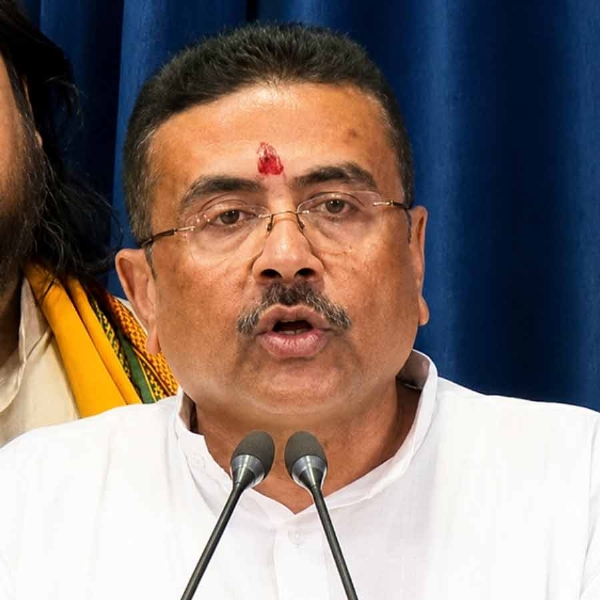
Kolkata, 26 May (H.S.) : Just 22 days after the political changeover in West Bengal, the new BJP government led by Chief Minister Suvendu Adhikari has begun an aggressive administrative and symbolic overhaul across Kolkata and adjoining urban areas.
From removing the controversial ‘Biswa Bangla’ branding introduced during the previous Trinamool Congress regime to launching massive anti-encroachment drives at major railway stations, the new administration has moved swiftly to project what it calls a policy of “zero tolerance” towards illegal structures and political symbolism associated with the former government.
-----
Biswa Bangla Logo Removed From Government Spaces
One of the most visible changes has been the gradual removal of the ‘Biswa Bangla’ logo from government buildings, offices and official documents. During the 15-year Trinamool Congress rule under former Chief Minister Mamata Banerjee, the stylised green ‘B’ logo had become synonymous with the state government’s branding. Critics had often alleged that the logo overshadowed the national emblem, the Ashoka Pillar.
The new government has now started restoring the prominence of the Ashoka emblem across official establishments. At several administrative buildings, the old branding is being replaced with new state insignia featuring the Ashoka Pillar in saffron, accompanied by blue-themed “Government of West Bengal” signage.
------
Iconic Football Sculpture Removed From Salt Lake Stadium
Another major symbolic decision was the removal of the controversial football sculpture outside the Vivekananda Yuba Bharati Krirangan, popularly known as Salt Lake Stadium.
The sculpture, conceptualised during the previous regime, featured a globe placed over a stylised human body structure with the Biswa Bangla logo and football motifs. Installed during the 2017 FIFA U-17 World Cup, the structure had long drawn criticism from football fans and sections of the public, many of whom described it as aesthetically unappealing.
The BJP government removed the installation soon after assuming office. The move triggered sharp criticism from Mamata Banerjee, who publicly expressed disappointment and said the logo and structure had been personally conceptualised by her.
------
Massive Anti-Hawker Drives at Howrah and Sealdah
Perhaps the most dramatic visible change has come through large-scale eviction drives at Howrah Railway Station and Sealdah Railway Station.
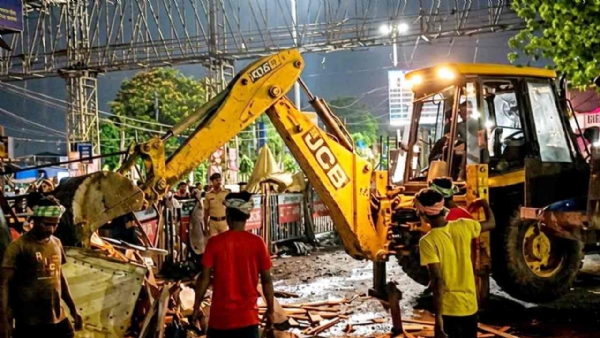
For years, large portions of platforms, station premises and adjoining roads remained occupied by informal vendors and temporary stalls. Within days of taking office, the new administration launched coordinated demolition operations using bulldozers to clear encroachments.
Officials estimate that more than 500 illegal stalls and temporary structures have been removed across the two stations. Sealdah’s once-congested south section platforms now appear noticeably cleaner and less crowded. Regular commuters have acknowledged that movement inside the station premises has become significantly easier after the eviction drives.
Similar operations were also carried out outside station premises, where large stretches of pavements and access roads had allegedly been occupied illegally for years.
However, many affected hawkers alleged that the drives were sudden and left them without rehabilitation or adequate notice.
-------
Crackdown on Illegal Structures Across Kolkata
The government’s anti-encroachment campaign has extended beyond railway stations. Several allegedly illegal roadside shops and constructions near Chinar Park and other parts of Kolkata have also been demolished in recent weeks.
Officials have repeatedly emphasised that the administration will not tolerate illegal occupation of public roads, footpaths or civic spaces.
------
Controversial Public Sculptures Demolished
In south Kolkata’s Garia area, the government demolished a series of controversial sculptures installed near a public toilet outside the Garia crematorium. The sculptures depicted nude children in various poses, including bathing and urinating, and had sparked criticism from residents for years.
Though objections had been raised earlier, locals claimed few dared to protest openly because the installation plaque stated that the project had been created under the inspiration of Mamata Banerjee and inaugurated by former minister Aroop Biswas.
After the change in government, the new administration ordered the demolition of the sculptures, calling them “distasteful” and inappropriate for a public space. Urban Development Minister Agnimitra Paul also announced that expenditures related to such projects would be reviewed.
-------
Illegal Clock Tower Faces Action
Another high-profile target has been the controversial 56-foot clock tower near Garia Mitali Sangha. The structure, inaugurated three years ago during the previous regime, had already been declared illegal by the Calcutta High Court in 2025 following a public interest litigation.
Despite the court order, demolition was allegedly delayed because of strong political resistance from local Trinamool leaders and supporters. Following the change in power, the administration has now initiated steps to act on the court directive.
------
BJP Government Pushes ‘Administrative Reset’
Political observers believe the rapid pace of visible administrative action is part of a broader attempt by the BJP government to establish a clear contrast with the previous regime.
By targeting controversial symbols, illegal structures and encroachments within the first few weeks in office, the new administration appears keen to send a strong political and governance message, that the era of political protection for illegal occupation and disputed civic projects is over.
At the same time, critics argue that several of these actions carry strong political undertones and are aimed at erasing symbols associated with the former Trinamool government.
Even so, within just 22 days, Kolkata’s civic and political landscape has already begun undergoing one of its fastest and most visible transformations in recent memory.
Hindusthan Samachar / Satya Prakash Singh
26 May 2026