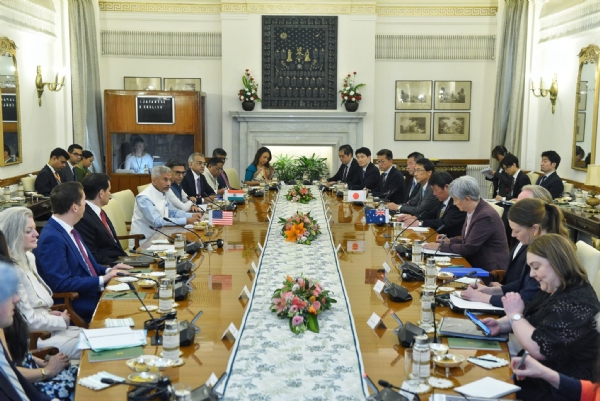
New Delhi, May 26 (H.S.): Significant decisions concerning maritime surveillance in the Indo-Pacific region, energy security, and the extraction, processing, and supply chain of critical and rare minerals were taken during the meeting of the Foreign Ministers of the Quad — the quadrilateral strategic alliance comprising Australia, the United States, Japan, and India — held here today.
Hosted by India’s External Affairs Minister Dr. S. Jaishankar, the highly significant and productive meeting of the Quad Foreign Ministers was attended by US Secretary of State Marco Rubio, Australian Foreign Minister Penny Wong, and Japanese Foreign Minister Toshimitsu Motegi. During the meeting, a comprehensive review of the progress made under various Quad initiatives, including three major new initiatives, was undertaken. The ministers also exchanged views on advancing cooperation in priority areas and discussed other global issues of mutual interest, including developments in the Indo-Pacific region.
Following the meeting, External Affairs Minister Jaishankar shared the outcomes of the strategic discussions and stated that the successful meeting reflected how, in today’s world filled with both challenges and opportunities, the cooperation among Quad nations has become increasingly close and significant. A detailed account of the decisions, initiatives, and strategic collaborations discussed during the meeting was provided in the joint statement and factsheet issued afterwards.
Under one of the three major initiatives, the Quad partners launched the “Indo-Pacific Maritime Surveillance Coalition Initiative” for the first time in order to leverage the maritime surveillance capabilities of Quad nations in the Indo-Pacific region. The initiative aims to enhance information-sharing and maritime domain awareness capabilities, with an initial focus on the Indian Ocean region. This capability will also be strengthened through expert exchanges and tabletop exercises.
Secondly, the Quad nations announced the new “Quad Critical Minerals Initiative Framework.” This framework will guide Quad countries in leveraging economic policy instruments and coordinating investments to strengthen critical minerals supply chains, including mining, processing, and recycling.
Under the third initiative, the Quad countries announced the “Quad Indo-Pacific Energy Security Initiative,” aimed at strengthening regional energy resilience. Each country will utilise the unique resources and capabilities of its respective energy sector. Through this initiative, Quad partners will work towards identifying areas of cooperation in technology management, policy coordination, international market analysis, and emergency response exercises.
Detailed information regarding all these initiatives and other strategic collaborations was included in the joint statement and factsheet released after the meeting. The gathering is being viewed as a major step towards promoting stability, security, and economic growth in the Indo-Pacific region.
During the occasion, External Affairs Minister Dr. S. Jaishankar and US Secretary of State Marco Rubio signed the India-US bilateral framework aimed at securing the supply of critical minerals and rare earth mining and processing. Dr. Jaishankar described the agreement as a highly timely and significant step, stating that it would strengthen a robust and diversified supply chain while assisting both countries in collaboration, mobilisation of financing, and effective management of critical and rare minerals.
US Secretary of State Marco Rubio described the strategic alliance between the United States and India as essential to the national interests of both nations and said that it represented a concrete example of the successful strategic partnership between the two countries. He remarked, “We are two nations whose strategic interests lie in ensuring reliable and long-term access to critical minerals and supply chains that are vital for our innovative economies.”
Rubio stated that the foundation for this framework was laid on February 4, when Dr. Jaishankar participated in the Critical Minerals Forum held in Washington. He added that the process accelerated further after India signed the “Pax Silica” agreement. He emphasised that both countries share a strategic interest in ensuring that dynamic and innovative economies like theirs are not dependent on monopolistic control by a single source for critical industrial inputs, which could potentially be weaponised against their sovereign national interests.
Marco Rubio further stated, “I am very pleased today that the work carried out by our teams ahead of this meeting has produced tangible and achievable outcomes that we can announce before our respective nations and the entire world.” On maritime security, he highlighted two major announcements. The first was the launch of the “Indo-Pacific Maritime Surveillance Cooperation Initiative,” which will utilise the maritime surveillance capabilities of all Quad members to improve information-sharing across the Indo-Pacific region. Linked to this is the expansion of the “Indo-Pacific Maritime Domain Awareness Initiative,” which provides and will continue to provide near real-time commercial maritime awareness data to countries across the Indo-Pacific region.
Japanese Foreign Minister Toshimitsu Motegi stated, “Through open exchanges of views today, we were able to align our strategic thinking regarding regional developments and agreed that we strongly oppose any unilateral attempts to alter the status quo through force or coercion.” He added that the ministers also expressed deep concern regarding restrictions imposed on the export of critical minerals and other strategic resources.
Motegi said the ministers discussed the situation in North Korea, including nuclear and missile issues as well as cyber activities, and reaffirmed their commitment to the complete denuclearisation of North Korea. Referring to the situation in Iran, he noted that it has a significant impact on the Indo-Pacific region, particularly from the perspective of energy supplies. He stressed the importance of ensuring free and secure navigation through the Strait of Hormuz and highlighted the need for diplomatic efforts to restore stability in the Middle East.
The Japanese Foreign Minister further stated that the “Energy Security Initiative” aimed at ensuring stable energy supplies in the Indo-Pacific region was both timely and appropriate. He said Japan intended to integrate this initiative with “Power Asia,” a cooperative framework promoted by Japan for the procurement of crude oil and petroleum products.
He also remarked that the newly launched “Critical Minerals Initiative Framework” represented an extremely important step towards strengthening critical mineral supply chains and assured that concrete cooperation would move forward in this direction.
Australian Foreign Minister Penny Wong underlined the significance of the Quad meetings and stated, “In all our meetings, our focus has been on maintaining momentum and ensuring that we deliver tangible outcomes. Our responsibility is to provide real alternatives, especially at a time when the strategic environment in our Indo-Pacific region is deteriorating.”
She pointed out that the region was facing a severe economic crisis and warned of the consequences for regional energy security if Iran were to close the Strait of Hormuz. Wong praised US Secretary of State Rubio’s diplomatic efforts towards restoring freedom of navigation and stated, “We recognise the importance of upholding the principle of freedom of navigation and oppose any proposal to impose tolls.”
Penny Wong further announced that the Quad was advancing several new initiatives, including an Energy Security Initiative. She also stated, “Today, we are announcing the Quad’s strongest commitment yet towards the Pacific through the ‘Quad Ports of the Future Partnership’, under which a pilot port infrastructure project will be launched in Fiji.”
She added that Quad nations would also focus on ensuring a more transparent and secure maritime region in the Indo-Pacific. Through the “Indo-Pacific Maritime Surveillance Coalition Initiative,” Quad countries will coordinate maritime surveillance efforts initially in the Indian Ocean and during the Malabar naval exercises. The “Maritime Domain Awareness Initiative” is also being expanded into the Indian Ocean region.
According to Wong, this expansion will enable partner nations to access near real-time satellite tracking data to combat illegal fishing and smuggling, while also improving humanitarian assistance during natural disasters. She further stated that Quad nations are working together to strengthen cooperation against fraud, particularly in Southeast Asia, by enhancing law enforcement capabilities and deepening cyber cooperation.
---------------
Hindusthan Samachar / Jun Sarkar

26 May 2026