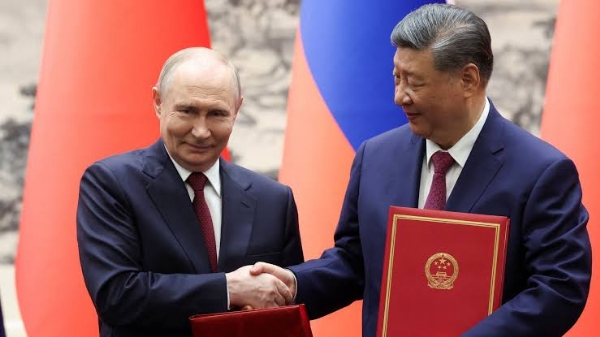
Beijing (China), May 20 (H.S.): Russian President Vladimir Putin and Chinese President Xi Jinping on Wednesday signed a landmark joint declaration in Beijing, pledging to advance the creation of a “multipolar world” — a move widely viewed as a geopolitical message to the United States.
The declaration was signed during Putin’s official visit to China. The development came shortly after former U.S. President Donald Trump’s return from Beijing, adding to its political significance.
According to reports by Chinese state news agency Xinhua News Agency, Russian state agency TASS, and *The Moscow Times*, the two leaders signed 20 agreements, followed by the issuance of a joint declaration. However, details of most agreements were not disclosed in the statement.
Putin said Russia would expand bilateral cooperation and actively engage in international platforms where both sides are working together to establish a strong foundation for a multipolar global order.
Xi Jinping described China–Russia relations as a model for ties between major powers, while indirectly warning against “unilateralism and hegemonic tendencies.” He said such trends should not be allowed to dominate global affairs unchecked.
Putin reiterated that Russia and China remain committed to pursuing an independent and sovereign foreign policy. Xi, during talks with Putin, stressed the urgent need for a comprehensive ceasefire in the Middle East.
Both leaders agreed to deepen strategic coordination and strengthen good-neighbourly relations and friendly cooperation. They jointly addressed the media at Beijing’s Great Hall of the People.
Xi noted that this year marks the 30th anniversary of the establishment of the China–Russia strategic partnership and the 25th anniversary of the signing of the Treaty of Good-Neighbourliness and Friendly Cooperation. He said relations have entered a new stage of “even greater achievements and accelerated development.”
Putin said Moscow and Beijing will continue to align positions in multilateral forums such as the G20, the World Trade Organization, and the World Bank. He also expressed intent to further strengthen coordination between China’s Belt and Road Initiative and Russia’s development strategies.
Xi further announced that China has extended its visa-free policy for Russian citizens until December 31, 2027.
What is a “Multipolar World”?
A multipolar world refers to a global order in which political, economic, and military power is not concentrated in the hands of one or two countries, but is distributed among several major powers or blocs. After the collapse of the Soviet Union, the United States emerged as the world’s sole superpower. However, over recent decades, the global system has gradually evolved toward multiple centers of power.
In such a structure, countries like the United States, China, and Russia, along with major European powers, play significant roles in shaping global politics and trade. Proponents argue that multipolarity prevents unilateral dominance by any single country and allows states greater flexibility in pursuing independent foreign policies, with multiple powers jointly influencing global governance and economic frameworks.
---------------
Hindusthan Samachar / Jun Sarkar
20 May 2026
Russia and China Pledge to Build ‘Multipolar World’ in Joint Declaration, Signal Challenge to US Dominance
20 May 2026