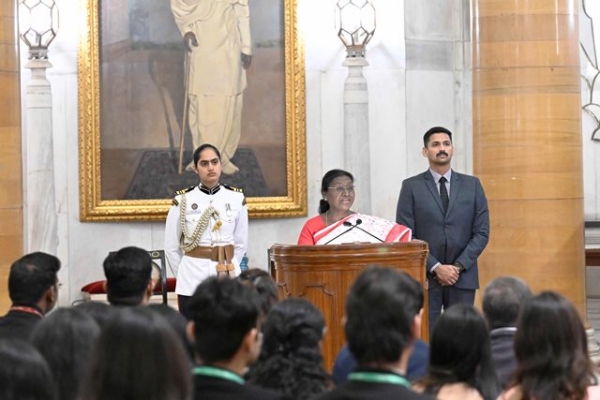
New Delhi, May 20 (H.S.): President Droupadi Murmu on Wednesday said that administrative officers must maintain a balance between compassion and rationality, advising them to remain sensitive but not emotional in the discharge of their duties.
A group of 2024-batch Indian Administrative Service (IAS) officers, currently serving as Assistant Secretaries in various Central ministries and departments, called on the President at the Rashtrapati Bhavan.
Addressing the officers during the interaction, President Murmu said that the All India Services, particularly the IAS, have played a significant role in the country’s development. She added that as India enters a new phase of growth and transformation, expectations from civil servants have also increased substantially.
She stated that young officers would receive opportunities to work across diverse sectors and, on many occasions, would be required to lead teams of experts. In such circumstances, she emphasised that both the pace and scope of their learning should be extensive, while their ability to adapt to different situations and domains must be exceptional.
The President said that the impartiality of officers would reflect their commitment to justice, while their sensitivity would demonstrate dedication towards inclusivity. She noted that transparency and consistent performance would build their credibility, whereas integrity reflected in both personal and professional conduct would provide them with the moral courage required to take decisive steps in the public interest.
President Murmu further observed that ethics and good governance are “two sides of the same coin.” She stressed that officers must not only remain honest and ethical but must also deliver tangible results. According to her, avoiding decision-making cannot be considered ethical conduct; rather, true ethics lies in taking correct decisions in accordance with public interest and established systems.
She remarked that just as delayed justice is considered denial of justice, delays in administrative decision making similarly deprive people of their legitimate rights.
The President stated that the fundamental objective of democracy is to fulfil the aspirations of citizens, and these aspirations are expressed through their elected representatives. Therefore, she said, it is the duty of administrative officers to prioritise issues raised by public representatives in the larger public interest.
She further said that in order to achieve the goal of a developed India and lead society towards the highest levels of progress, officers would at times have to work against adverse circumstances and challenges. The President urged the officers to keep the people of the country including the underprivileged and marginalised sections of society at the centre of their thoughts and actions.
---------------
Hindusthan Samachar / Jun Sarkar