New Delhi, May 19 (H.S.): National Human Rights Commission (NHRC) Chairperson Justice V. Ramasubramanian on Tuesday said that human rights institutions must function strictly within the framework of the law — particularly the Protection of Human Rights Act — and adhere to their defined jurisdiction in order to avoid unnecessary litigation.
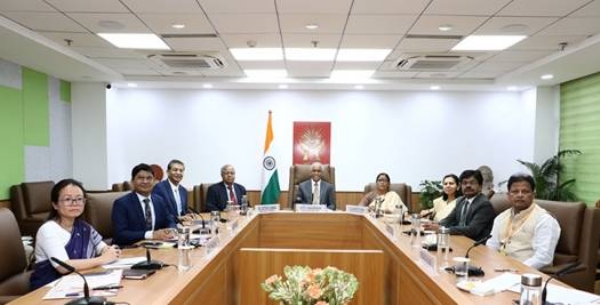
Justice Ramasubramanian made these remarks while addressing a one-day national conference held in virtual mode at the NHRC headquarters in New Delhi with State Human Rights Commissions (SHRCs), special rapporteurs, and special monitors. The primary objective of the conference was to bridge the gap between policy objectives and ground-level implementation, while developing a coordinated approach for the protection of human rights.
He stated, “Human rights institutions must work strictly within the definitions and jurisdiction provided under the Protection of Human Rights Act. When jurisdictional boundaries are clearly defined, unnecessary litigation can be avoided, enabling commissions to function more effectively and efficiently.”
Justice Ramasubramanian also urged all State Human Rights Commissions to digitise their operations and integrate with NHRC’s unified HRCNet portal in order to prevent duplication of cases and improve coordination.
NHRC member Justice (Dr.) Bidyut Ranjan Sarangi described the dialogue as an important initiative towards strengthening coordination between the two forums.
Another NHRC member, Vijaya Bharathi Sayani, urged SHRCs to increase engagement with affected communities and intensify field visits at the grassroots level. She also appreciated the Karnataka government’s initiative of publicly displaying contact details for public assistance.
Delivering the inaugural address, NHRC Secretary General Bharat Lal said that human rights constitute a complex subject requiring collective action. He presented an analysis of 428,000 complaints received through the online system over the past five years, covering multiple categories.
According to the data, police-related violations accounted for 18 per cent of complaints, organised exploitation by mafias for 17.4 per cent, service-related issues such as non-payment of pensions and salaries for 6 per cent, violations of women’s rights for 5.8 per cent, prison and custodial conditions for 3.5 per cent, labour rights violations for 2.2 per cent, violations in health and educational institutions for 2 per cent each, and child rights violations for 1.7 per cent.
He also stressed the need for proactive monitoring of custodial deaths, abuse in shelter homes, deaths caused by manual scavenging, and the deplorable conditions prevailing in mental health institutions.
Under the digital governance initiative, 23 State Human Rights Commissions across the country have already been integrated with the HRCNet portal. However, SHRCs in Andhra Pradesh, Gujarat, Jharkhand and Nagaland are yet to join the platform. Meanwhile, although the Madhya Pradesh and Rajasthan commissions have integrated with the portal, they are yet to begin online processing of complaints.
During the conference, representatives and special rapporteurs from several states — including Himachal Pradesh, Haryana, Rajasthan, Uttar Pradesh, Odisha, Assam, Chhattisgarh, Telangana, Goa and Karnataka — offered a number of significant recommendations.
Participants recommended strengthening SHRCs through improved staffing and infrastructure support from state governments. They also advocated prison reforms aimed at reducing overcrowding, improving living conditions, and standardising wages for prisoners.
It was further recommended that NHRC guidelines be strictly enforced to prevent misuse of human rights forums by vested interests and fraudulent organisations.
Instead of focusing solely on punitive action after human rights violations occur, the conference emphasised the need for preventive interventions through regular training of police personnel, correctional staff and CAPF personnel.
Regular and coordinated field visits were also recommended for prisons, mental health institutions, de-addiction centres, shelter homes and old-age homes.
The conference stressed the need to ensure proper rehabilitation of children rescued from bonded labour and child labour through coordinated efforts by district administrations and police authorities.
Special emphasis was also laid on protecting the rights and rehabilitation of intersex infants, persons with disabilities, leprosy patients and transgender individuals.
Participants recommended the use of scientific and real-time environmental monitoring systems to address pollution, water contamination and climate-related concerns.
They further called for stronger occupational safety measures, insurance coverage and preventive mechanisms against diseases such as silicosis for vulnerable groups including landfill workers, mine labourers and truck drivers.
---------------
Hindusthan Samachar / Jun Sarkar