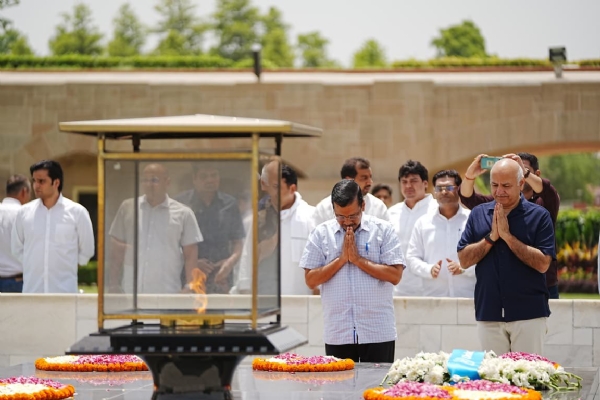
New Delhi, 28 April (H.S.): Aam Aadmi Party national convenor Arvind Kejriwal has ruled out further conventional participation in ongoing court proceedings related to the Delhi excise policy matter, declaring that his only remaining option is “satyagraha” in the Gandhian sense. On Tuesday, Kejriwal, along with Punjab party coordinator Manish Sisodia and other AAP leaders, visited Raj Ghat to pay homage to Mahatma Gandhi and publicly reaffirm his resolve to pursue a principled stand rather than appear before the judge handling the case.
In a letter addressed to Justice Swarna Kanta Sharma of the Delhi High Court, Kejriwal wrote that his “conscience” will not allow him to take part any further in the proceedings. Citing a “deep sense of doubt” about receiving fair justice, he explained that the decision was not directed at any individual, but at the perceived erosion of visible impartiality in the process.
He told reporters after the Raj Ghat visit:
“Judiciary granted me bail and effectively acquitted me in this matter. The reason I am moving freely today is because of our judicial system itself. But certain circumstances have arisen that compel us to adopt this path of satyagraha. I have clearly stated in my letter to Justice Swarna Kanta Sharma that, in the present situation, my inner conscience does not permit me to continue participating in the case before her—heither in person nor through a lawyer.”
He reiterated his faith in the Constitution and the judiciary but emphasised that once a citizen’s trust in the fairness of a particular bench falters, merely going through the motions of formal participation would be “inconsistent” with his moral position.
“Satyagraha” framed as a moral rather than legal step
By invoking the term “satyagraha”, Kejriwal sought to frame his non‑appearance as a moral‑political protest grounded in Gandhi’s idea of non‑cooperation with a process perceived as unjust, rather than a straightforward legal defence move. He made it clear that the option to challenge any adverse order before the Supreme Court remains preserved, signalling that the route of constitutional remedy will still be exhausted even as he refuses to participate further before the current bench.
Government and opposition figures have sharply divergent reactions: allies praise the move as a civil‑disobedience‑style stand against alleged judicial bias, while critics dismiss it as theatrics aimed at political mobilisation. However, the gesture at Gandhi’s memorial, coming after a high‑profile bail‑grant, has turned the courtroom‑bail‑debate into a broader symbolic contest about trust in institutions and the legitimacy of political protest within a constitutional framework.
---------------
Hindusthan Samachar / Jun Sarkar