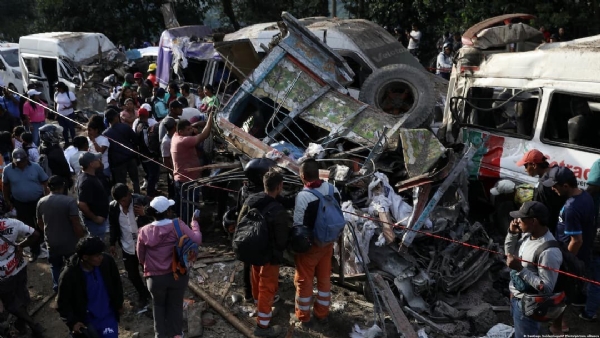
Bogota,Colombia, 27 April (H.S.): A deadly bomb attack on a busy highway in southwestern Colombia has killed at least 19 people, including five children, and left more than 38 others injured, just weeks before the country’s presidential election. The explosion occurred on the Pan‑American Highway in the Cauca region, in the El Túnel area of Cajibío, on Saturday, turning a routine road into a scene of carnage and shocking the nation ahead of the vote scheduled for May 31.
Local officials told Colombian media that the blast was caused by an explosive device on the highway, which detonated in the middle of the carriageway, creating a large crater and destroying several vehicles in the immediate vicinity. The area is a key stretch of the Pan‑American Highway connecting cities such as Popayán and Cali, and the road was crowded with minibuses and passenger cars when the bomb went off.
Video footage shared on social media shows a deep hole in the asphalt, wrecked vehicles, scattered debris and bodies lying on the road, underscoring the severity of the attack. Authorities in Cauca have described the incident as a terrorist bombing targeting civilians, and the scale of the devastation has prompted warnings of a possible “escalation” in violence in the lead‑up to the election.
Cauca Governor Octavio Guzmán posted on X that the bomb was deliberately placed on the highway to hit ordinary civilians, including passengers travelling for work or family visits. He said the defence minister, Pedro Sánchez, rushed to the scene after the explosion and that officials are setting up a national security council to coordinate a high‑level response and prevent further attacks.
Military and police commanders have reported that explosions or related incidents have also been registered in nearby localities such as El Tambo, Caño Limón, Guachene, Mercaderes and Miranda, prompting the Commander General of the Colombian Armed Forces, Hugo Alejandro López Barreto, to label the sequence of blasts as a “dangerous wave of attacks.”
The Cauca department, a historically conflict‑ridden region known for coca cultivation and armed‑group presence, has seen a spike in violence as the election nears.
Colombian President Gustavo Petro has pointed the finger at dissident factions of the former FARC (Revolutionary Armed Forces of Colombia), blaming them for the bombing and identifying the alleged leader José Iván Velásquez Guzmán, also known by aliases such as “Iván Mordisco” (Néstor Gregorio Vera Fernández), as the mastermind. Petro reiterated that these dissidents, who rejected the 2016 peace deal, are now using road‑side bombs and other insurgent tactics to destabilize the country and undermine public confidence in the democratic process.
The attack has intensified debate about security ahead of the May 31 presidential vote, with opposition voices warning that the government’s peace‑oriented policies have not fully disarmed or demobilised rebel groups, while Petro’s allies stress that the state is now mobilising all security and intelligence resources to prevent further terrorist strikes. For many Colombians, the images from Cajibío’s El Túnel have become a grim reminder that the country’s long‑standing struggle with armed violence is far from over.
---------------
Hindusthan Samachar / Jun Sarkar

27 Apr 2026