Kolkata, 24 April (H.S.):
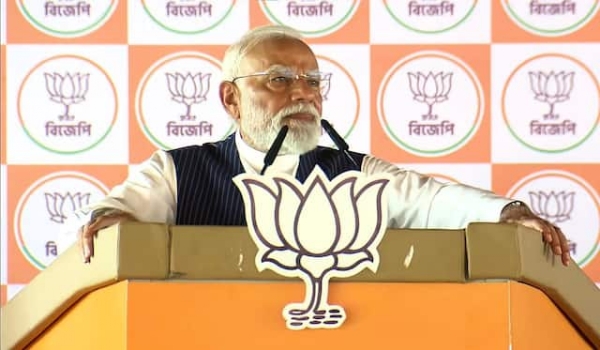
Ahead of the second‑phase polling in the West Bengal Assembly elections, Prime Minister Narendra Modi has told crowds in Dum Dum and Jadavpur that the results of the first‑phase voting have reinforced a “wave of change” in the state and that there is a clear swing in favour of the Bharatiya Janata Party (BJP).
Addressing two large public meetings on Friday, the Prime Minister launched a sharp attack on the ruling Trinamool Congress (TMC), accusing it of weakening democracy, misgoverning the state and failing its people for over 15 years.
Speaking first in Dum Dum, PM Modi argued that the high turnout in the first phase had “sealed” the demand for change and demonstrated strong public support for the BJP. He described the results so far as a “victory trumpet” heralding a decisive shift in Bengal’s political landscape.
Accusing the TMC of “crushing the temple of democracy,” he claimed that the people of Bengal had now used the ballot to rebuild democratic institutions and urged voters in the second phase to further strengthen this mandate.
In the Dum Dum gathering, PM Modi made women’s safety a central theme, labelling the TMC a “women‑hostile party” and contrasting it with the BJP’s model of “women‑led development.” He told women in the audience that the BJP would stand by every daughter of Bengal and prevent her dreams from being shattered, promising that a BJP‑led government would introduce multiple schemes to empower women, provide jobs and ensure their security. He added that past cases of injustice against women would be re‑examined and action taken against the guilty.
The Prime Minister framed the 21st‑century story of Bengal as one to be “written by women’s power,” arguing that women in the state now want transformation, not continuity. He also highlighted the absence of the Ayushman Bharat scheme in West Bengal, asserting that poor and middle‑income families are being denied access to free medical treatment of up to ₹5 lakh that other states enjoy.
Stressing the need for a “double‑engine government,” he said that when the Centre and the state work in tandem, the pace of development multiplies many‑fold.
Addressing local issues in Dum Dum, he cited persistent waterlogging, obsolete drainage systems, traffic congestion and an unstructured urban fabric, and pledged that the BJP would build a modern, planned, and better‑connected Dum Dum.
Turning to Jadavpur,PM Modi claimed that over the past 15 years the TMC had “looted” Bengal, linking the party to scandals in recruitment, chit funds, mining, and the public distribution system, which he said had damaged the state’s image and integrity.
He alleged that infiltrators were being settled in the state, land was being encroached upon, and local jobs were being taken away, forcing Bengali youth to migrate to other states despite the state’s vast industrial and investment potential. Referring to Jadavpur University, he said the institution was once renowned for its academic prestige and nationalist tradition but had now become a site of disorder and political agitation, with students being pushed into conflict instead of classrooms.
Evoking the legacy of Netaji Subhas Chandra Bose, PM Modi told the crowd that Bengal is entering a new phase of awakening, where one vote can liberate the state from fear, corruption, syndicate‑rule, violence against women, unemployment and infiltration. He warned that when the results are declared on May 4, TMC “goons” would have no place to hide and the people would deliver a clear verdict through the democratic process.
Concluding his address, he appealed to voters in the second phase to turn out in record numbers and elect BJP candidates, promising that a BJP government in West Bengal would bring the state a new direction, faster development, better law and order, and fresh employment opportunities.
---------------
Hindusthan Samachar / Jun Sarkar

24 Apr 2026