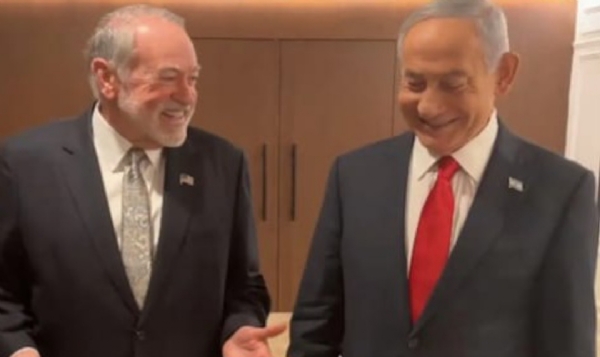
Jerusalem, 18 March (H.S.): Israeli Prime Minister Benjamin Netanyahu has publicly dismissed online rumours that he was killed in the escalating conflict with Iran, appearing in a fresh video alongside the United States ambassador to Israel, Mike Huckabee, to assert that he remains unharmed and fully in command.
The clip, released late Tuesday, follows days of viral speculation on social media platforms, including manipulated clips and “six‑finger” claims that Netanyahu has now explicitly mocked and rebutted.
New Video With US Envoy
In the latest recording, Netanyahu is seen walking and speaking with Ambassador Huckabee, who quips that US President Donald Trump had sent him to personally verify the Israeli leader’s condition. Netanyahu responds dryly, “Yes, Mike. Yes, I’m alive,” before the two exchange banter about their close working relationship. The video is evidently crafted as a deliberate counter‑narrative to conspiracy theories that circulated after Netanyahu’s reduced public appearances amid intense Israeli‑led strikes inside Iran.
Huckabee, in jest, says his name is not on any Israeli “punch card,” referring to Netanyahu’s darkly humorous description of a list of senior Iranian targets whose names he says are being “erased” one by one. Netanyahu, in turn, places Huckabee on the “list of the good guys,” praising joint US‑Israel operations against figures he brands as hardline clerics and nuclear‑armed extremists bent on attacking American cities and destroying Israel.
Death Rumours and ‘Six Fingers’ Claims
The rumours about Netanyahu’s supposed death gained traction after a previous video circulated online in which he appeared to have six fingers, prompting accusations that the footage had been digitally altered or generated with artificial‑intelligence tools. As the Iran‑Israel war intensified following the killing of Iran’s Supreme Leader Ali Khamenei and other senior figures, the absence of regular Netanyahu footage further fuelled speculation on messaging apps and social‑media fora.
Before the joint clip with Huckabee, Netanyahu had already posted a short message from what appeared to be a café, joking that he was only “dead for coffee” while displaying both hands and wiggling his fingers to prove they numbered exactly ten. That video, like the newer one with the US envoy, is widely interpreted as an attempt to project normalcy and control at a moment of heightened regional instability and internal unease.
The Israeli‑Iranian war, triggered by US‑Israeli strikes that killed Iran’s supreme leader and other top officials, has led to a rapid series of targeted operations against Iran’s security and military hierarchy. Israel has confirmed the killing of Ali Larijani, Iran’s influential security‑policy architect and secretary of its Supreme National Security Council, as well as Gholamreza Soleimani, commander of the Basij paramilitary force.
Iranian state‑linked outlets have since described Larijani as a martyr, acknowledging that he, his son, and his bodyguards were killed in an Israeli airstrike.
Analysts note that Netanyahu’s public reappearance alongside a senior US representative serves both domestic and international messaging purposes: it reassures sceptical opinion at home and abroad that Israel’s leadership remains intact, while simultaneously signalling unity with the United States as the conflict broadens across the Middle East.
Beyond the theatrical touch of the “punch card” metaphor, Netanyahu’s remarks underscore a broader narrative that Israel is systematically dismantling Iran’s strategic‑security establishment, from nuclear‑policy architects to internal‑security commanders.
By explicitly naming Larijani and Soleimani, the Israeli government seeks to magnify the psychological impact of the killings on Iran’s clerical and military elite, even as Teheran vows that its defences will not collapse following Larijani’s “martyrdom.”
For Netanyahu, the immediate tactical challenge is not only military but perceptual: he must deflect suspicions about his health or capacity to lead, while simultaneously projecting resolve in the face of Iranian retaliation and growing humanitarian scrutiny over the wider war.
The new video, stripped of any formal backdrop and framed as an informal conversation, appears calculated to project the image of a leader both physically present and mentally unflinching at a pivotal moment in the conflict.
---------------
Hindusthan Samachar / Jun Sarkar