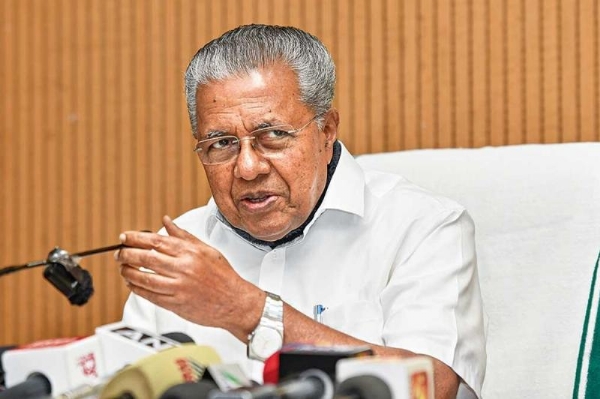
Thiruvananthapuram,13 March (H.S.):In a significant political development, the CPI(M) leadership in Kerala has indicated a change in its stance on the contentious issue of women’s entry to the Sabarimala temple. The party’s State Secretariat, which met in Thiruvananthapuram, discussed the issue in detail and reportedly recommended that the government adopt a position that protects traditional temple customs while avoiding alienation of believers.
Sources indicated that the State Cabinet, scheduled to meet later in the evening, is likely to take a decision in favour of safeguarding the long-standing practices of the Sabarimala temple and communicate the government’s revised position to the Supreme Court. The development comes as the apex court has reopened hearings in the Sabarimala women’s entry case and sought the Kerala government’s stand on the matter.
The State government is expected to file a fresh affidavit before the Supreme Court outlining its new position. The move follows a similar decision taken earlier by the Travancore Devaswom Board (TDB), which manages the Sabarimala temple. The board had resolved that traditional customs at the shrine should be protected and that its earlier support for the entry of women of all age groups be reconsidered.
Political observers note that the issue has gained renewed importance with the Assembly elections approaching in Kerala. Within the CPI(M), there has been growing consensus that a position perceived as hostile to religious sentiments could alienate large sections of devotees. The party leadership is therefore believed to have reassessed its earlier stance, which had strongly supported the Supreme Court’s 2018 verdict allowing women of all ages to enter the temple.
The Kerala government had earlier organised a global Ayyappa conference as part of efforts to engage with devotees and religious groups. Influential community organisations such as the Nair Service Society (NSS) and the Sree Narayana Dharma Paripalana Yogam (SNDP) have repeatedly demanded that the traditional customs of Sabarimala be preserved.
However, not all groups share the same view. The Kerala Pulaya Maha Sabha (KPMS), another prominent organisation associated with the Renaissance Protection Samithi, has maintained that the government should continue to support women’s entry to the shrine as a matter of gender equality and constitutional rights.
Meanwhile, the Indian Young Lawyers Association, one of the petitioners in the case, has informed the Supreme Court that the earlier verdict permitting women’s entry should remain in force. The association argued that the issue concerns the dignity and equality of women and that Sabarimala cannot be treated as an exception to constitutional principles.
The Supreme Court is expected to consider the submissions from various stakeholders before delivering its final judgment on the long-running and sensitive issue.
---------------
Hindusthan Samachar / Arun Lakshman
14 Mar 2026
Naveen Patnaik Congratulates Indian Women’s Hockey Team for Qualifying for 2026 World Cup
14 Mar 2026
Kerala govt to provide ₹14 Lakh compensation for Families of wildlife attack victims
Kerala govt to provide ₹14 Lakh compensation for Families of wildlife attack victims..