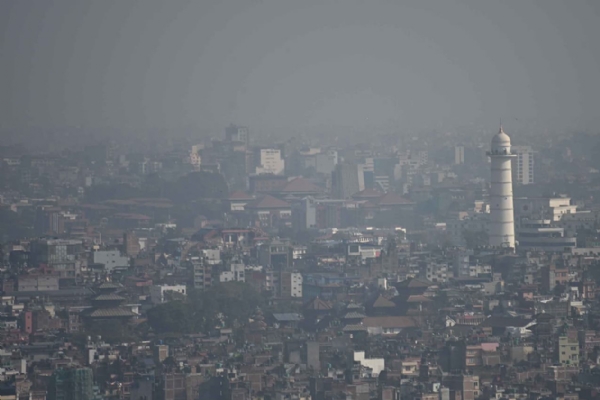
Kathmandu, 06 November (H.S.): Air pollution levels in Nepal’s Kathmandu Valley have begun rising with the onset of the dry season, pushing air quality into the ‘unhealthy’ category in several parts of the valley on Friday.
According to IQAir, a Switzerland-based air quality monitoring organisation, pollution levels remained unhealthy across several areas of the valley on Friday morning. The situation was similar on Thursday, and forecasts suggest that air quality is likely to remain at comparable levels until Sunday.
IQAir recorded an Air Quality Index (AQI) of 111 for the Kathmandu Valley on Friday morning. On Thursday, the AQI in the Baneshwar area of Kathmandu had climbed to 153. By 9:15 am on Friday, however, the reading in the same area had declined to 127.
According to the Kathmandu Metropolitan City’s air quality monitoring dashboard, several localities, including Swayambhu, Balaju, Teku, Dallu, Thapathali, Kshetrapati, Jadibuti, Asan, Kamaladi, Shantinagar, Chabahil, Lainchaur and Handigaun, recorded unhealthy air quality.
The metropolitan authorities have urged residents to refrain from activities that contribute to rising air pollution.
Under the Air Quality Index classification, an AQI reading between 101 and 150 is considered unhealthy for sensitive groups. These include people suffering from respiratory ailments, senior citizens, children and individuals already living with serious health conditions. When the AQI rises to between 151 and 200, air quality is classified as unhealthy for everyone, indicating a broader risk to public health.
PM2.5 refers to fine particulate matter with a diameter of less than 2.5 micrometres. It is considered one of the most hazardous components of air pollution because these tiny particles can bypass the body's natural defences in the nose and throat, penetrate deep into the lungs and even enter the bloodstream.
According to medical experts, exposure to such fine particles can increase the risk of several serious illnesses, including cancer.
The World Health Organization (WHO) recommends that the annual average concentration of PM2.5 in ambient air should not exceed 5 micrograms per cubic metre. For a 24-hour average, the recommended limit is 15 micrograms per cubic metre.
---------------
Hindusthan Samachar / Jun Sarkar

18 Aug 2026