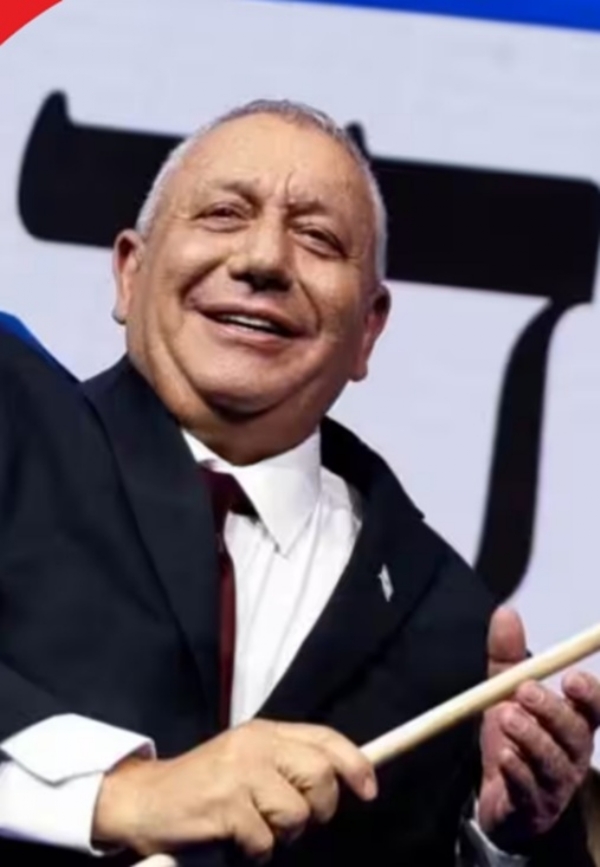
Jerusalem, 06 November (H.S.): The path towards the formation of a new government in Israel appeared to clear late Thursday after leaders of the Joint List, an alliance of Arab parties with 11 members in the Knesset, met President Isaac Herzog and submitted a letter formally recommending centrist alliance leader and former Israel Defense Forces (IDF) chief of staff Gadi Eisenkot for the post of prime minister.
The 66-year-old Eisenkot, who leads the Yashar Party, founded the party last year and entered the electoral contest this year. His prospects changed significantly following support from opposition blocs and Arab political parties, including the Joint List and Ra’am, after last week’s Knesset elections.
According to reports by The Jerusalem Post and The Times of Israel, the backing of these opposition groups and Arab political parties has given Eisenkot a significant advantage. The support takes his tally beyond the 61 seats required for a parliamentary majority in the 120-member Knesset. The Joint List has 11 members, while the Arab party Ra’am has eight. Eisenkot’s alliance secured 48 seats in the election.
Benjamin Netanyahu, who has held the office of prime minister for a cumulative period of around 19 years, failed to secure the numbers required to form a government. In the October 27 election, the bloc led by him won 53 seats. The political equation shifted further on Thursday when United Torah Judaism (UTJ), a party with seven members of parliament that had been part of Netanyahu’s right-wing alliance, announced that it was breaking away. This left Netanyahu’s camp with the support of only 46 lawmakers. UTJ has decided, for the time being, to sit separately in the Knesset.
Eisenkot has said that he intends to govern Israel as a Jewish state while upholding its democratic system. He has also maintained that Hamas will be treated as a terrorist organisation and that its military capabilities must be dismantled. He has called for changes to the rules governing military conscription and pledged to uphold the principles of the Declaration of Independence, which laid down the framework for citizens’ rights when the State of Israel was established.
The Joint List, whose leaders submitted the letter recommending Eisenkot to President Herzog, comprises three Arab parties — Hadash, Ta’al and Balad. Ra’am contested the election separately.
President Herzog said that representatives of parties comprising 67 elected members of the Knesset had recommended Eisenkot to form the next government. He is expected to formally entrust him with the task on Sunday. Following the consultations, Netanyahu’s Likud party appealed for unity and described its political opponents as a destructive bloc. According to Channel 12, the swearing-in ceremony for the new Knesset is scheduled for November 10. The election of a new Knesset Speaker is expected to take place after the members are sworn in.
Knesset Speaker Amir Ohana has said that he will schedule a debate to elect his successor if at least 61 lawmakers formally request it. Ohana belongs to the Likud party.
Arab party Ra’am has extended support to Eisenkot while stating that it would not interfere in defence matters. During his meeting with President Herzog, Ra’am leader Mansour Abbas refrained from explicitly describing Hamas as a terrorist organisation. However, he has repeatedly condemned terrorism and political violence, and has also said that Hamas should be disarmed and removed from power.
Eisenkot has made recognition of Hamas as a terrorist organisation a condition for parties seeking to join his prospective government. Abbas, meanwhile, expressed hope that Eisenkot would succeed in forming a good government.
### Netanyahu’s Longest Tenure as Prime Minister
Netanyahu’s departure from office now appears increasingly likely, bringing an end to what has been the longest cumulative tenure as prime minister in Israel’s history. He first served as prime minister from June 18, 1996, to July 6, 1999, completing a term of approximately three years. His second tenure lasted from March 31, 2009, to June 13, 2021, spanning more than 12 years. He returned to office on December 29, 2022, and has remained prime minister since then.
### Eisenkot Has Previously Led the IDF
Eisenkot has previously served as Chief of the General Staff of the Israel Defense Forces (IDF) and emerged as Netanyahu’s principal political challenger in the election.
He began his military career as an enlisted soldier in 1978 and went on to hold several senior command positions. From 2015 to 2019, he served as the IDF’s 21st Chief of the General Staff, becoming the first person of Mizrahi Jewish background to hold the position. He is also associated with the Dahiya Doctrine, a military strategy that has featured prominently in discussions of Israel’s approach to warfare.
After retiring from military service, Eisenkot entered politics in 2022. He subsequently founded the Yashar Party in September 2025 and contested this year’s election as its leader.
Born on May 19, 1960, in the city of Tiberias, Eisenkot is now poised to take on the responsibility of leading the country, subject to successfully forming a government.
---------------
Hindusthan Samachar / Jun Sarkar

18 Aug 2026