


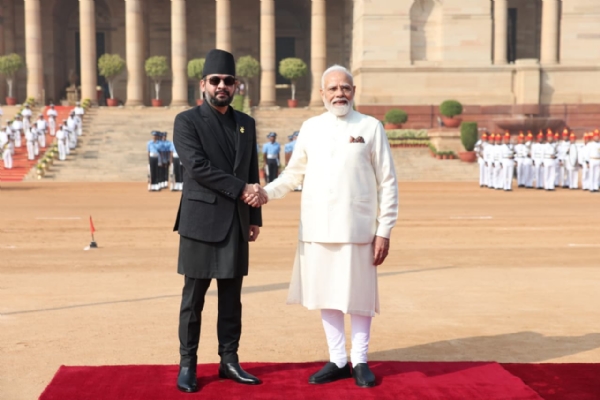
Kathmandu, November 24 (HS): The proposed electric railway project to connect Nepal's capital, Kathmandu, with the Indian border town of Raxaul has crossed a significant milestone, with the field location survey for the Kathmandu-Raxaul rail corridor now complete. The two countries formally announced the development during Nepalese Prime Minister Balendra Shah's visit to India.
According to the joint vision document issued by India and Nepal, the two Prime Ministers announced the completion of the field location survey for the proposed Raxaul-Kathmandu electric broad-gauge railway line. With the survey completed, the way has now been cleared for preparing the Detailed Project Report (DPR). However, the estimated construction cost and the project's investment and financing structure are yet to be finalised.
India and Nepal agreed on expanding railway connectivity between the two countries on April 7, 2018. Under the understanding, a new electric railway line was proposed to connect Raxaul, an Indian border town, with Kathmandu, the Nepalese capital. India was expected to undertake the financial management of the project.
Subsequently, the two countries signed a bilateral Memorandum of Understanding (MoU) on October 8, 2021, for the Final Location Survey. The survey was undertaken with India's financial and technical assistance.
India had completed the Final Location Survey in 2023 and sought feedback and suggestions from the Nepalese government. Railway Minister Ashwini Vaishnaw also informed the Rajya Sabha on March 20, 2026, that the Final Location Survey for the Raxaul-Kathmandu railway line had been completed. At the time, he had put the proposed route's length at 136 kilometres. However, according to the latest information released during Prime Minister Shah's visit to India, the survey report estimates the corridor's length at 140.79 kilometres.
According to the survey report, approximately 41 kilometres of the proposed railway line will pass through tunnels, while the remaining stretch will run along the surface. The project envisages the construction of 122 minor bridges and 101 major bridges, including 18 long and technically complex structures. The railway line will pass over these bridges.
During the Final Location Survey, Nepal's Ministry of Physical Infrastructure and Transport also put forward several important suggestions to India. Nepal recommended that the railway alignment be designed in a manner that would not affect the proposed Nijgadh International Airport or existing mining areas. It also sought clarity on how the proposed railway corridor would connect with the Kathmandu-Terai Fast Track.
The project's Detailed Project Report has not yet been prepared, and consequently, the total estimated construction cost remains undetermined. The investment and financing structure also remains to be finalised.
The Nepalese government is preparing to request India to undertake construction of the railway line through grant assistance. The next phase of the ambitious project will become clearer once the DPR is completed, construction costs are assessed and the financial arrangements are finalised.
---------------
Hindusthan Samachar / Jun Sarkar

18 Aug 2026