


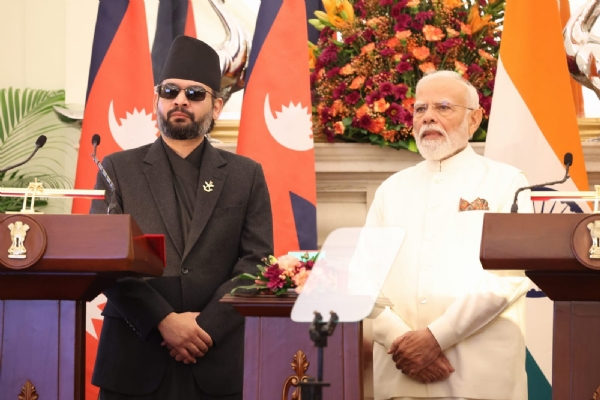
Kathmandu, November 24 (HS): Nepal may consider adopting India's successful infrastructure development framework, the ‘PM Gati Shakti’ model, to suit its geographical conditions and development priorities. The proposal gained prominence during Nepalese Prime Minister Balendra Shah's visit to India and has been included in the joint vision document endorsed by the two Prime Ministers.
The joint vision document, issued with the objective of building a ‘Prosperous Nepal and Developed India’, states that the two countries will cooperate in integrated infrastructure planning and the development of connectivity networks through mechanisms such as the PM Gati Shakti initiative. Nepal may consider adopting a similar framework in accordance with its geographical conditions and development requirements.
The joint document states: “The two sides will cooperate in integrated infrastructure planning and the development of connectivity networks through mechanisms such as the Prime Minister Gati Shakti (PM Gati Shakti) initiative, which Nepal may consider adopting in line with its geographical and developmental priorities.”
In India, the initiative is known as ‘PM Gati Shakti’. Nepal, however, may choose a different name for its framework, depending on its own requirements and priorities. India has long expressed interest in extending this model to Nepal. The proposal was first put forward by the Indian side during the visit of then Nepalese Prime Minister Pushpa Kamal Dahal ‘Prachanda’ to India on May 17, 2023.
India subsequently renewed the proposal during the tenure of Prime Minister K.P. Sharma Oli. However, the initiative did not make progress as the government at the time showed little interest in taking it forward. During Prime Minister Balendra Shah's recent visit to India, New Delhi once again incorporated the proposal into the joint vision document.
Nepal's Ministry of Physical Infrastructure and Transport is currently examining the feasibility of adopting the framework. The Nepalese government will take a decision on its possible implementation after considering the recommendations received from the ministry.
The Government of India launched the ‘PM Gati Shakti National Master Plan’ on October 13, 2021, with the primary objective of making infrastructure development across the country more integrated, systematic and cost-effective. Under the initiative, infrastructure related to roads, railways, airports, ports, waterways, public transport and logistics is planned in an interconnected manner.
The initiative is not a standalone, separately funded project for constructing roads, railway lines or airports. Rather, it is a national planning framework and digital system designed to coordinate projects undertaken by different ministries and government agencies. One of its key features is the ability to assess existing infrastructure and planned developments on a common digital platform before a new project is taken up.
For this purpose, a Geographic Information System (GIS)-based digital National Master Plan has been developed. It brings together information on roads, railways, airports, forest areas, rivers, industrial zones, electricity transmission lines, land and other infrastructure assets. This integrated approach helps improve coordination among ministries and departments while reducing project delays and additional expenditure.
In Nepal, inadequate coordination among different ministries and government agencies has long posed a major challenge to infrastructure development. In several instances, roads have had to be dug up again after construction to lay water pipelines or underground electricity cables. Such duplication increases public expenditure and causes inconvenience to residents.
The country also faces challenges arising from inadequate connectivity between industrial zones and road networks, as well as high freight transportation costs.
Against this backdrop, adopting a framework similar to PM Gati Shakti could help Nepal develop integrated plans for road, rail, energy, industrial and transport infrastructure projects. It could facilitate better coordination among projects, reduce construction costs and make freight transportation more efficient.
The Nepalese government is currently assessing the potential use of the model. A final decision will be taken after considering the ministry's recommendations, the country's geographical conditions and its development priorities.
---------------
Hindusthan Samachar / Jun Sarkar

18 Aug 2026