- Dr Mayank Chaturvedi
In Indian culture, spirituality and the Sanatan tradition, sannyasa is regarded as the highest and most difficult of the ashramas of life. The very meaning of sannyasa is the complete renunciation of worldly attachment, blood ties, family, likes and dislikes, and personal identity. According to the scriptures, the whole world is the sannyasi's family, and he becomes free from the bonds of his parents, brothers and kin of his purvashram. Yet, amid this stern detachment and scriptural discipline, there exists an emotional and eternal truth before which even the ordinances of law and the rules of sannyasa bow their heads, and that truth is the Maa, the mother.
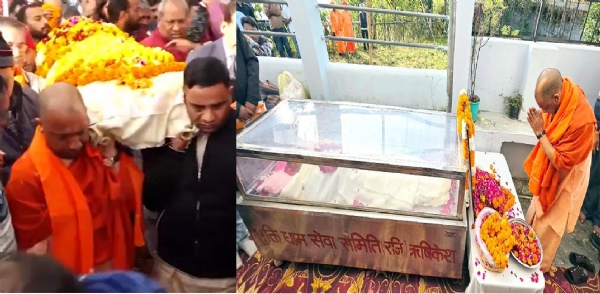
When Uttar Pradesh Chief Minister and Gorakshapeethadheeshwar Yogi Adityanath, on receiving news of the passing of his mother Savitri Devi, set aside all official work, reached his ancestral village of Panchur in Uttarakhand and, with moist eyes, shouldered his mother's bier, the entire nation was reminded of that historic and poignant scene of the eighth century, when Adi Guru Shankaracharya, the exponent of Advaita Vedanta, transcending all the traditions of sannyasa, performed the last rites of his mother Aryamba at Kalady in Kerala.
Maa: the first pulse of creation and the highest truth of the scriptures
The mother is the first unit of human existence. The moment a being opens its eyes on this earth, its first encounter with the divine is in the form of the mother. In the shade of the mother's anchal, a human being comes to know himself, and, nourished by her affection and milk, becomes capable of facing the challenges of this world. The praise of the mother sung in Indian literature, the Vedas, Upanishads, Aranyakas, Smritis and Puranas is rare in the literature of any other civilisation.
In the Taittiriya Upanishad (Shikshavalli, Anuvaka 11), a principal text of Vedic literature, when the guru gives his pupil the final and highest instruction of life on completion of his education, he says: Matridevo bhava. Pitridevo bhava. Acharyadevo bhava. Atithidevo bhava. In this mantra the first place is given to the mother. The father and the acharya come after her. This order is no coincidence; it reflects the profound psychological and spiritual understanding of Indian philosophy.
Among the Dharmashastras, in the Manusmriti (Chapter 2, Verse 145), Maharishi Manu declares plainly:
Upadhyayan dashacharya acharyanam shatam pita,
Sahasram tu pitrin mata gauravenatirichyate.
That is, one acharya exceeds ten upadhyayas, one father exceeds a hundred acharyas, and one mother exceeds a thousand fathers in glory. In the Vana Parva of the Mahabharata (the Yaksha-Yudhishthira dialogue), when the Yaksha asks Dharmaraja Yudhishthira what is heavier than the earth, Yudhishthira answers, Mata gurutara bhumeh, that is, the mother's place is heavier and greater than this vast earth. The Skanda Purana and the Padma Purana, too, state that the merit of all tirthas lies at the mother's feet.
Adi Guru Shankaracharya and the historic episode at Kalady
If anyone in India's spiritual history made the tradition of sannyasa most firm and well ordered, it was Adi Guru Shankaracharya. Born in the eighth century in the village of Kalady in Kerala to Shivaguru and Aryamba, Shankara resolved in childhood itself to take sannyasa. This event is described very movingly in Madhaviya's Shankara Digvijaya (regarded as the most authentic historical and spiritual account of Shankaracharya's life) and in Chidvilasa's Shankara Vijayavilasa.
When the boy Shankara sought permission for sannyasa from his widowed mother Aryamba, the loving mother's heart trembled. Hearing of the renunciation of her only child, she was distraught. According to the texts, after the episode of the crocodile seizing his leg in the Purna river, when the mother reluctantly gave Shankara permission, she asked for a promise. Aryamba said that wherever he might be after sannyasa, he must come at her last moment and perform her cremation with his own hands. The boy Shankara, without hesitation, promised his mother that he would surely be present at the end.
Years later, when Shankaracharya was on his digvijaya tour for the Sanatan Dharma across Bharatavarsha and was staying at the Sringeri Math, he sensed through his yogic power that the last moments of his mother Aryamba were near at Kalady. According to the rules of sannyasa dharma, a sannyasi should not visit the home of his purvashram, nor may he light the pyre at anyone's funeral, since a sannyasi has already performed his own pindadan and shraddha at the time of taking sannyasa. But before Shankaracharya, the word given to his mother stood higher than scriptural propriety.
He reached Kalady at once. Seeing her sannyasi son before her, Mother Aryamba felt supreme peace and breathed her last. When the time for the last rites came, the orthodox society of Kalady and the Namboodiri Brahmins strongly opposed Shankaracharya. Their argument was that a sannyasi has no right to perform cremation. Society gave Shankaracharya no help; no one assisted in lifting the bier, and no one gave him a path to the cremation ground.
History then witnessed that remarkable and moving scene, when Jagadguru Shankaracharya prepared a pyre of banana stems and dry wood in the courtyard (backyard) of his own house, carried his mother's mortal remains there on his own shoulder and, by his yogic power and the strength of mantras, kindled the fire and completed his mother's last rites. Even today, at Kalady in Kerala, the samadhi of Mother Aryamba stands at that spot, a testimony that no tradition of sannyasa can be greater than the debt owed to a mother (matri-rin).
Matri Panchakam and Devi Aparadha Kshamapana Stotram: poetry composed from Shankaracharya's tears
The unbearable pain of his mother's cremation and farewell was woven by Adi Guru Shankaracharya into five verses that have become immortal in Sanskrit literature as the Matri Panchakam. This plaintive cry from the heart of a sannyasi son at the time of the last rites could melt even a stone heart.
First verse:
Astam tavadiyam prasutisamaye durvarashulavyatha,
Nairuchyam tanushoshanam malamayi shayya cha samvatsari.
Ekasyapi na garbhabharabharanaklesasya yasyah kshamo,
Datum nishkritimunnatopi tanayah tasyai jananyai namah.
Its meaning is this: the unbearable pain at the time of childbirth, the wasting of the body, and the hardship of lying for a whole year on a bed soiled by the child's excreta, herself in the wet while putting the child to sleep in the dry: all this aside, however great and exalted a son may become, he cannot repay even a fraction of the suffering of bearing him in the womb for nine months. My repeated salutations to such a mother.
Second verse:
Gurukulamupasritya swapnakale tu drishtva
Yatisamuchitaveshm prarudo mam tvamuchchaih.
Gurukulamatha sarvam prarudatte samaksham
Sapadi charanayoste matarastu pranamah.
Here the meaning is: O Mother! When I was studying at the gurukul, on seeing me in a dream in the garb of a sannyasi, you wept loudly. Seeing your plaintive weeping, the entire gurukul wept before you. At the feet of such a loving mother, let my salutation be offered immediately.
Third verse:
Na dattam matas te maranasamaye toyamapi va
Swadha va no deya maranadivase shraddhavidhina.
Na japto matas te maranasamaye tarakamanuh
Akale samprapte mayi kuru dayam mataratulam.
The sense is: O Mother! Because of the rule of sannyasa, I could not give you even water at your last moment, nor shall I be able to offer you pindadan or swadha by the shraddha rites on the day of your death. As your life departed, I could not even chant the taraka mantra in your ears. O Mother, as I have arrived untimely, keep showering your boundless compassion upon me.
Fourth verse:
Muktamanistvam nayanam mameti
Rajeti jiveti chiram suta tvam.
Ityuktavatyastava vachi matah
Dadamyaham tandulameshu shushkam.
The meaning is: O Mother! In my childhood you used to call me with great love: You are my pearl, You are the apple of my eye, You are my king, and O son, may you live long. Today, into that same affectionate mouth, I offer these dry grains of rice as the rite of the last ceremony.
Fifth verse:
Ambeti tateti shiveti tasmin
Prasutikale yadavocha uchchaih.
Krishneti govinda hare mukunde
Tyaho jananyai rachito'yamanjalih.
That is: O Mother! At the time of giving birth to me, in that unbearable pain of labour, you cried aloud, O Amba!, O Tata!, O Shiva!, O Krishna!, O Govinda!, O Hari!, O Mukunda! To the mother who bore those sufferings to give me life, this is my humble tribute.
Similarly, while worshipping Shakti, Shankaracharya in the Devi Aparadha Kshamapana Stotram also expressed the guileless surrender of an innocent child to the Mother of the Universe: Na mantram no yantram tadapi cha na jane stutimaho... Param jane matas tvadanusaranam klesaharanam, and at the end proclaimed that timeless truth, Kuputro jayeta kvachidapi kumata na bhavati, that is, in this world a son may turn out to be a bad son, but a mother can never be a bad mother.
History comes alive again at Panchur in Uttarakhand
The memories of that eighth-century episode came alive again when Uttar Pradesh Chief Minister Yogi Adityanath, regarded as the most influential sannyasi-politician in present-day India, reached Uttarakhand to see his mother Savitri Devi for the last time and to join her final journey after her passing.
Yogi Adityanath is the peethadheeshwar of the Gorakshapeeth, the supreme seat of the Nath sampradaya. In the Nath tradition, too, the initiation into sannyasa is extremely stringent. After initiation, the sannyasi completely renounces the name, lineage, gotra and family relationships of his purvashram. After becoming Yogi Adityanath from Ajay Singh Bisht, he too followed this stern discipline of sannyasa to the letter for decades. But on Friday, 20 November, when news came from his ancestral village of Panchur, in the Yamkeshwar block of Pauri Garhwal district of Uttarakhand, of the death of his 91-year-old mother Savitri Devi, the son within the Chief Minister and the austere sannyasi awoke.
Yogi Adityanath immediately postponed all his official programmes and engagements and left for Uttarakhand without delay. On the morning of Saturday, 21 November 2026, when the last journey of Mother Savitri Devi began from Panchur village to Chandi Ghat in Haridwar, the entire country saw a deeply emotional and rare sight. Draped in the saffron robes of a sannyasi, Yogi Adityanath appeared very distressed and emotional beside his mother's mortal remains. He himself stepped forward, shouldered his mother's bier and took part in the rites of final farewell.
Rajdharma and matri-rin: a comparative reflection
To understand this step of Yogi Adityanath, it is most pertinent to compare it with the incident of 2020, when his father Anand Singh Bisht passed away. On 20 April 2020, his father breathed his last at the All India Institute of Medical Sciences (AIIMS) in Delhi. At that time, too, Yogi Adityanath was the Chief Minister of Uttar Pradesh, the most populous state in the country. He lacked neither resources, aircraft nor security arrangements. Had he wished, he could have reached his father's funeral in a few hours. But the circumstances of April 2020 were different, and he had to choose between two great duties. The entire country and the world were then in the grip of the unprecedented pandemic of the coronavirus (Covid-19). A strict lockdown was in force across the country and movement was completely restricted.
The responsibility for protecting the lives of Uttar Pradesh's 23 crore people rested on the Chief Minister's shoulders. Had the Chief Minister himself taken an exemption from the lockdown rules to attend the funeral, there was a risk of a crowd gathering and a wrong message of discipline reaching the public. Yogi Adityanath then wrote a deeply emotional letter seeking forgiveness from his mother and family, saying: I had a heartfelt wish to see my father in his last moments, but because of my sense of duty to keep the 23 crore people of Uttar Pradesh safe against the global pandemic, I am unable to do so. At that time he placed rajdharma and sannyasa dharma above personal grief.
By contrast, today there was neither any such pandemic emergency nor restrictions like a lockdown. This time it concerned the Maa without whom the very imagination of any living being is impossible. If the father gives shelter like the sky, the mother, like the earth, bears the whole of one's existence. When, after the fulfilment of rajdharma, the moment of the final farewell from his mother came in the evening of life, Yogi Adityanath followed the very path that Adi Guru Shankaracharya had shown centuries earlier.
The victory of the eternal truth
Indeed, this journey from Adi Guru Shankaracharya to Yogi Adityanath underlines that core element of Indian culture which values compassion above rule and gratitude above convention. Sannyasa does not mean the heart turning to stone; sannyasa is the expansion of compassion. And the first source of that compassion is always the mother.
If there is a mother, there is life; if there is a mother, there is this world. Whether a person becomes a sannyasi, a Jagadguru or the ruler of a vast state, at his mother's feet he always remains an innocent child. Whether it is the pyre kindled by Shankaracharya amid the verses of the Matri Panchakam in the courtyard of Kalady, or the footsteps of Yogi Adityanath shouldering his mother's bier from Panchur in Uttarakhand to the ghat at Haridwar, these two events will remind human civilisation for ages to come that if there is any place in this universe higher than the scriptures, traditions and the pinnacles of power, it is only the place of the Maa!
Hindusthan Samachar / Mayank Chaturvedi