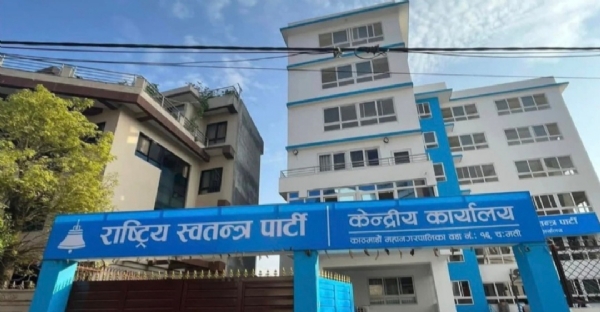
Kathmandu, 02 November (H.S.): Nepal’s ruling Rastriya Swatantra Party (RSP) is engaged in internal deliberations over whether to initiate impeachment proceedings against Supreme Court judges following questions raised about their conduct. However, the party has not yet reached a final decision on the course of action.
RSP spokesperson Jagadish Kharel said issues concerning the judiciary should be addressed through Parliament, describing it as the constitutional forum for resolving such matters.
“If the entire judicial sector is to be restructured, Parliament is the constitutional avenue for doing so. The process should move forward through Parliament,” he said.
Questions have been raised following revelations about alleged links and exchanges of messages between Supreme Court judges and controversial figure Inam Sapkota.
According to reports, information concerning communications and financial transactions involving Sapkota, the Chief Justice, other Supreme Court judges and senior police officials has emerged from his mobile phone and other electronic devices. There have also been reports that seven judges met Sapkota together.
Against this backdrop, the ruling RSP has been holding both formal and informal discussions on the possible courses of action.
Article 101(2) of Nepal’s Constitution provides two routes for initiating impeachment proceedings against the Chief Justice, Supreme Court judges, members of the Judicial Council, and heads and office-bearers of constitutional bodies.
The first option is for at least one-fourth of the total members of the House of Representatives to table an impeachment motion. The second is to initiate an investigation through the Impeachment Recommendation Committee. Under this procedure, at least three members of Parliament must submit a notice seeking impeachment. The committee then investigates the matter, and further action is taken on the basis of its findings.
Once impeachment proceedings are formally initiated in the House through the first route, the official concerned is barred from performing the duties of their office until the proceedings are concluded.
However, the Constitution does not clearly specify whether the official concerned can continue discharging their duties when the second route is followed — that is, when at least three lawmakers submit a notice seeking impeachment and the Impeachment Recommendation Committee begins its investigation.
RSP lawmakers are divided over which of the two constitutional options the party should pursue. Broadly, two positions have emerged during internal discussions: one favouring immediate and stringent action, and the other advocating a more cautious approach.
Lawmakers supporting the tougher position argue that at least one-fourth of the members of the House should immediately introduce an impeachment motion against the judges whose conduct has come under scrutiny.
An RSP lawmaker supporting this approach said, “An impeachment motion itself should be tabled. If we adopt a softer approach by opting for an investigation or other measures, the issue could gradually fade away.”
He added, “Now that the matter has come to light, adopting a lenient approach could divert our efforts to restructure the entire judicial sector from their intended course.”
However, there is also considerable support within the party for avoiding haste.
RSP lawmaker Madhukumar Chaulagain believes the party should examine all available evidence before deciding on an appropriate course of action.
“In the past, impeachment was used to serve political interests. That is not what we are doing,” he said.
According to him, there is a view within the party that any impeachment process initiated this time should be pursued in a manner that leads to a clear and conclusive outcome.
“Before moving an impeachment motion, we should examine and assess all the evidence and constitute a committee — the Impeachment Recommendation Committee. That is the position we support,” he said.
Under Nepal’s Constitution, an impeachment motion must secure the support of a two-thirds majority in the House of Representatives to be passed.
---------------
Hindusthan Samachar / Jun Sarkar

18 Aug 2026