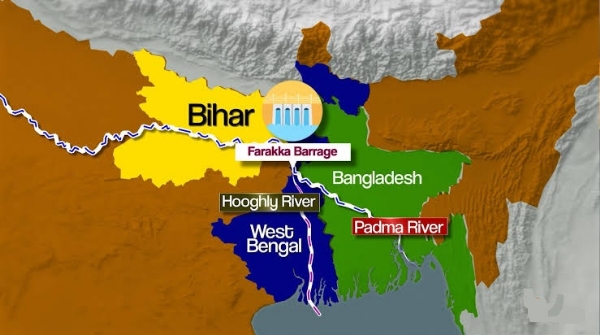
Dhaka, 02 November (H.S.): Nahid Islam, chief of Bangladesh’s National Citizen Party (NCP), has warned India over the sharing of Ganga river waters, saying that Bangladesh should not allow the movement of Indian goods through its territory or provide transit facilities if it does not receive its fair share of the river’s water. He also said his party was prepared to organise another long march to Farakka if necessary.
Islam also cautioned the ruling Bangladesh Nationalist Party (BNP), saying that if it continued to pursue discriminatory policies, it could face a political fate similar to that of the Awami League.
According to Bangladesh’s English-language newspaper The Daily Star, Islam made these remarks while addressing a national youth conference organised by Jatiya Jubo Shakti at the Krishibid Institution Bangladesh in Khamarbari, Dhaka, on Sunday. He said equitable water-sharing and border security should form the basis of Bangladesh’s relationship with India.
“If Bangladesh does not receive water, Indian goods will not be allowed into Bangladesh either. There will be no corridor and no transit,” Islam said. Opposing the provision of any unauthorised corridor or transit facilities to India, he emphasised that Bangladesh’s national interests must take precedence in bilateral relations.
With the Ganga Water Sharing Treaty set to expire in December, the NCP chief said any new agreement must guarantee Bangladesh’s share of the river water while also ensuring navigational facilities along the river. Referring to the historic Farakka Long March led by Maulana Abdul Hamid Khan Bhashani, he said his party was prepared to organise another long march towards Farakka if the situation demanded it.
Turning to domestic politics, Islam called for the immediate formation of a Constitutional Reform Council. He said the July National Charter must be implemented in accordance with the outcome of the referendum held in February.
Questioning the parliamentary committee constituted by the government to examine constitutional amendments, he argued that all relevant issues had already been discussed before the elections. He said the time had come to implement the decisions rather than reopen discussions on matters that had already been settled.
“Implement the referendum’s verdict or resign,” he warned the government.
The NCP chief alleged that the ruling BNP had confined the July uprising to a mere change of government instead of carrying forward its momentum towards broader political and institutional reforms. He cautioned that if the present government continued to adopt discriminatory policies, it could face circumstances similar to those encountered by the Awami League.
Islam also questioned the government’s progress on its electoral promise to create one crore jobs within 18 months. Alleging political interference in appointments to the Public Service Commission (PSC), he called for recruitment based strictly on merit.
He said the July movement had not been launched merely against the quota system but had also sought to secure merit-based opportunities and equal access for all. He urged the government to provide young entrepreneurs with loans, training and financial assistance to support their ventures.
Supporting textile industry workers demanding higher wages, Islam called for resolving labour disputes through dialogue rather than police action against protesters. He said the current minimum monthly wage of Tk 12,500 was inadequate in view of rising inflation and the increasing cost of living.
“We do not want to see the blood of any more workers shed in Bangladesh,” he said.
Islam also reiterated his demand for the resignation of the Home Minister and the Energy Minister over the country’s law-and-order situation and fuel prices. He announced that the NCP would organise a series of programmes across the country in November and December to press for the fulfilment of the outstanding demands of the July movement.
---------------
Hindusthan Samachar / Jun Sarkar

18 Aug 2026