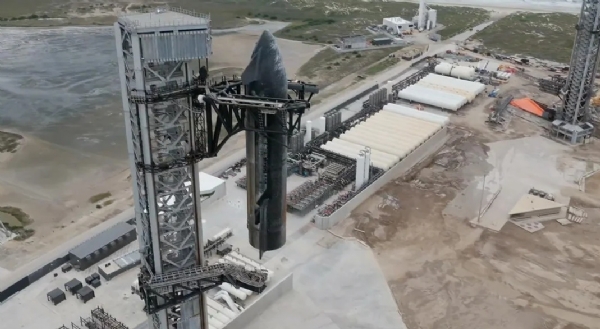
Washington, 15 November (H.S.): SpaceX's Starship rocket returned to Earth on Saturday after spending 22 hours in space, completing a historic recovery manoeuvre. Enduring intense heat during atmospheric re-entry, the spacecraft headed towards its launch site on the Texas Gulf Coast before turning upright in the final moments and being caught by two massive mechanical arms mounted on the launch tower.
According to a report by CBS News, SpaceX employees gathered nearby erupted into cheers and applause as the spacecraft completed the manoeuvre. Starship reignited three of its six methane-fuelled Raptor engines to turn itself upright and rapidly reduce its speed. It then hovered momentarily before the tower's robotic arms closed around it, securing the vehicle just before its engines shut down.
This is so incredible to see! One of the most incredible and historic engineering feats of all time has just happened right in front of our eyes. Congratulations to our teammates at SpaceX, and to everyone who supported the Starship programme, said SpaceX commentator Jessie Anderson.
The successful recovery marked the first time a Starship spacecraft had been retrieved directly from orbit. Previous test flights had ended with planned splashdowns in the ocean. The achievement represents a significant milestone in SpaceX's efforts to develop a fully reusable, orbit-class rocket. Company founder Elon Musk has said that the technology could substantially reduce the cost of transporting payloads to Earth's orbit, the Moon and, eventually, Mars.
Starship was launched on Friday from SpaceX's Starbase facility on the Texas coast, atop a Super Heavy booster. Standing 407 feet tall, the two-stage launch vehicle is the most powerful rocket ever built. At liftoff, its 33 first-stage Raptor engines generate approximately 16 million pounds of thrust.
During the mission, the Super Heavy booster successfully propelled the Starship upper stage towards orbit. However, the booster itself failed to return to the launch site for a planned recovery. A guidance-related problem forced it to make a splashdown in the Gulf of Mexico, where it exploded shortly before hitting the water.
Ahead of the 15th Starship test flight, SpaceX had successfully recovered the first-stage boosters used in three previous launches. The latest mission, however, achieved a historic first by bringing the Starship upper stage back from orbit and capturing it with the launch tower's mechanical arms.
---------------
Hindusthan Samachar / Jun Sarkar

18 Aug 2026