Can one person devote the entire energy of his life to a cause whose reward will never come to him as personal prestige, power or wealth? Can someone make his scholarship, talent, pen and organisational ability the vehicle of a larger national resolve?
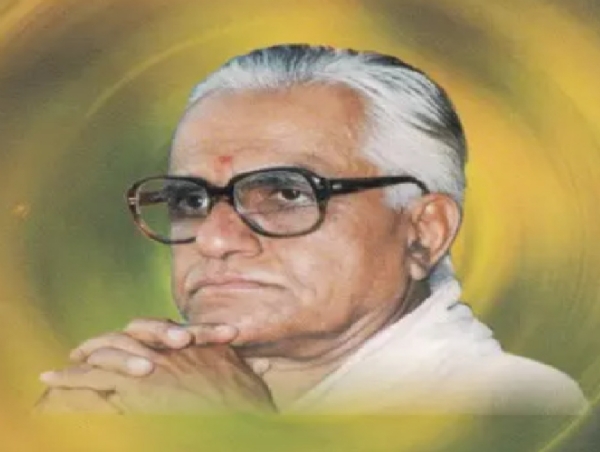
To find answers to these questions, one must read and understand the life of Hosangadde Venkataramaiah Seshadri, whom thousands of swayamsevaks affectionately and respectfully called “Seshadri ji”. His life shows that dedication to the nation is a kind of sadhana (spiritual discipline) in which a person rises above personal comfort, ambition and convenience and gives himself to the future of society.
Born in Bengaluru on 26 May 1926, Seshadri ji has his birth centenary observed in 2026. The occasion invites us to understand the intellectual discipline, scholarly effort and organisational austerity that, for several decades, shaped the discourse on questions of Indian cultural consciousness, the organisation of Hindu society and national identity.
Seshadri ji often said that the revival of a nation begins with its society’s self-awareness. In his intellectual outlook, India’s identity is deeply bound up with its sanatan cultural tradition, spiritual consciousness and Hindu way of life. To understand this idea, a study of his writings on Hindu life is also essential.
Seshadri ji’s brilliance showed from his student days. He took an MSc in Chemistry from the University of Mysore, graduating with a gold medal. In ordinary circumstances, many opportunities in universities, research and distinguished professional life lay open to him, but he chose a different direction. In 1946 he became a full-time pracharak (full-time worker) of the Rashtriya Swayamsevak Sangh (RSS). With this decision, his personal life was absorbed into the sadhana of national work.
To understand this decision, one must understand the India of that time. The country was moving towards independence. Fears of Partition were deepening. Society was passing through many contradictions along lines of caste, language, region and religious identity. Colonial rule had also influenced the interpretation of Indian history, education and cultural traditions. In such an atmosphere, Seshadri ji saw the organisation as a vehicle for social awakening and cultural self-confidence.
In his view, the basis of Indian nationhood lay not only in its geographical boundaries but also in a cultural unity that had developed over thousands of years. For that reason, he saw the organisation of Hindu society as tied to India’s cultural continuity and the strength of its national life. His life poses an important question: in what lies the highest use of talent? In personal achievement, or in devoting one’s abilities to society and the nation? Seshadri ji answered it through his conduct.
Expanding the organisation in Karnataka: two decades of austerity
From 1960 to 1980 he served as prant pracharak (provincial organiser) of undivided Karnataka. This period was important for the Sangh in terms of organisational expansion and social challenges. During the Emergency, restrictions on democratic rights, the ban on the Sangh and the arrest of its workers created grave conditions for the organisation. In those difficult circumstances, Seshadri ji tried to maintain organisational contact, the morale of workers and dialogue with society. A distinctive feature of his personality was that he linked organisational work with intellectual preparation. He knew that to influence a society over the long term, ideas and literature are needed alongside shakha, outreach and service activities.
For him, writing was a medium of social dialogue. In Kannada, his writing carried forward discussion among the local public on Indian history, cultural tradition and contemporary challenges. His ideas also reached English and Hindi readers. In 1980 he was made kshetra pracharak (regional organiser) for the southern region, which placed on him responsibility for organisational coordination across Karnataka, Andhra Pradesh, Tamil Nadu and Kerala. In 1987 he became the Sangh’s All-India Sarkaryavah (general secretary), a responsibility he discharged for about nine years. Thereafter, owing to health, he worked as Akhil Bharatiya Pracharak Pramukh (All-India head of pracharaks). He passed away on 14 August 2005 at Keshava Krupa in Bengaluru.
The tragedy of Partition and a different way of seeing history
To understand Seshadri ji’s intellectual contribution, his book The Tragic Story of Partition must be mentioned. Written on the Partition of India, it is an important document of his historical thinking. Its first English edition was published in 1982 by Jagarana Prakashana, Bengaluru. The book analyses the political events leading to the Partition of 1947, the separatist politics of the Muslim League, the decisions of the Congress and the social and political climate of the time. The first edition runs to 278 pages.
In the opening pages, Seshadri ji presents India’s historical unity as a cultural concept. His view is that India’s unity is inseparably bound up with its nature and national soul. He writes: “The unity of India is so fundamental in its nature and so sublime in its depths that it becomes an inseparable part of its national soul.” (H.V. Seshadri, The Tragic Story of Partition, p. 9, Jagarana Prakashana, Bengaluru, 1982)
This idea helps us understand the foundation of his national outlook. For him, India’s identity was not a concept created by a change of power. It was a cultural journey in which the experience of generations, pilgrimage traditions, philosophy, literature, language and values were joined together. On page 12, regarding Partition, he writes that the division of the country in 1947 created a situation in which separate political authority over parts of the motherland was accepted. In his analysis, Partition was a historical tragedy bound up with independence, whose political and cultural consequences demanded serious discussion.
Agreement or disagreement with his conclusion may have its own historical basis. What matters is that he tried to view Partition beyond the sequence of events, in terms of national psychology, the decisions of leaders and the organisational weaknesses of society. On page 51, criticising the Congress’s political direction of the time, he wrote that the duty of a national organisation is to remain firm in the interests and integrity of the whole nation, and that it should not be diverted from its national responsibility by pressure from any section. (The Tragic Story of Partition, p. 51, Jagarana Prakashana, 1982.) Here one aspect of Seshadri ji’s method emerges: he does not merely narrate an event and move on, but probes the political mindset and ideological tendencies at work behind it.
Conversion, social harmony and cultural identity
An important theme in Seshadri ji’s writing was the questions of religious identity and conversion. The mass conversions at Meenakshipuram in Tamil Nadu in 1981 sparked nationwide debate. After the incident, he set out his views in a book titled Warning of Meenakshipuram. A record of the book is available in Princeton University’s digital collection, listing H.V. Seshadri as author and Jagarana Prakashana, Bengaluru, as publisher.
His concern also centred on the social inequality within Hindu society and the distance it created. In his view, caste discrimination and social inequality weaken the unity of society, so social harmony (samarasata) must occupy a central place when discussing the organisation of Hindu society. Here an important aspect of his thinking emerges: the insistence on protecting cultural identity can yield meaningful social results only when society develops within itself an atmosphere of respect, equality and warmth. He viewed the role of maths (monastic institutions), saints, social organisations and educational institutions in this wider context. The phrase attributed to him on conversion, “change of religion is change of nationality”, is often quoted in interpretations of his views.
The Emergency and democracy: a document of resistance by the pen
An important chapter in Seshadri ji’s life concerns the Emergency. After the then Prime Minister Indira Gandhi imposed the Emergency on 25 June 1975, severe restrictions were placed on civil liberties, press freedom and political activity. The RSS was banned and thousands of swayamsevaks were arrested. In documenting the events of this period, Seshadri ji’s book Bhugilu receives special mention. A Kannada-language book, it compiles the conditions of the Emergency and the related developments.
The importance of his writing lies also in the fact that he viewed the political events of the time in the broader context of democracy, organisation and civic consciousness. For him, freedom meant not only liberation from foreign rule but also the freedom to express ideas in society, carry forward cultural traditions and play one’s role in national life. Seshadri ji’s writing therefore did not stop at Partition and the Emergency. He also wrote about figures and episodes in Indian history that gave direction to national self-respect and cultural consciousness.
His work on Chhatrapati Shivaji Maharaj, Yugavatar, is especially notable. In Shivaji’s personality he highlighted qualities such as organisational ability, indomitable courage, cultural self-confidence and commitment to the national interest. Another important book of his is RSS: A Vision in Action, whose first edition was published in 1988 by Jagarana Prakashana, Bengaluru. According to the book’s record, the first edition runs to 326 pages. It introduces the founding of the Sangh, its ideas, organisational growth and activities across various spheres of social life. Through it, Seshadri ji sought to bring the Sangh’s working method and social reach to a wide readership.
The central theme of the work is how the organisational process begun by Dr Keshav Baliram Hedgewar was carried forward into different spheres of social life. He views the efforts of Sangh swayamsevaks in education, service, social awakening and nation-building as part of a broad process of cultural revival. Here another facet of his personality emerges: he considered preserving ideas in books and putting them into practice through organisation to be equally important.
Seshadri ji also played an important role in systematically compiling and presenting the thoughts of Madhav Sadashiv Golwalkar, popularly known as Guruji, the second Sarsanghchalak (head) of the RSS. Particularly notable here is his book Sri Guruji, whose English edition was published in 1999 by Suruchi Prakashan, New Delhi. A clear thought lies behind this work: a tradition of ideas can be preserved only when one generation passes on its experience, thinking and intellectual wealth to the next. Seshadri ji took this responsibility seriously.
Responsibility greater than the prestige of office
When Seshadri ji became All-India Sarkaryavah in 1987, he faced the broad responsibility of coordinating organisational activities across the country. He discharged it for about nine years. During this time, the Sangh’s expansion, social outreach and organisational coordination across different fields were an important part of his work. A hallmark of his personality was that he saw office not as personal prestige but as a responsibility to be carried out. Seshadri ji’s life illustrates the Sangh’s organisational tradition of rotating responsibilities and collective leadership.
He continued to contribute as Pracharak Pramukh in his last years. Despite the difficulties of age and health, his attachment to the organisation endured, but the news of his death on 14 August 2005 sent a wave of grief through the Sangh Parivar and the social fields connected with him. He breathed his last at Keshava Krupa in Bengaluru. Many national leaders, including former Prime Minister Atal Bihari Vajpayee and L.K. Advani, paid tribute on his passing.
What Seshadri ji’s ideas mean for India today
The question arises: why do we need to remember Seshadri ji in 2026, on his birth centenary? Does his life carry a message for today’s generation? The answer lies in three main aspects of his life.
First, cultural self-awareness. The long-term strength of any society is tied to awareness of its history, traditions, languages and cultural heritage. Seshadri ji raised this theme repeatedly in his writing. In his view, India’s identity is deeply bound up with its sanatan cultural tradition. The Hindu way of life has shaped the philosophy, art, literature, festivals, social conduct and spiritual thought of this land.
Second, social harmony. His insistence on the unity of Hindu society underlines the need to rise above caste divisions. Without mutual trust, respect and participation in society, the idea of cultural revival will remain incomplete. For the new generation, this message carries particular weight: pride in one’s tradition comes with social responsibility.
Third, personal dedication to the nation. Seshadri ji showed through his life that education, talent and intellectual ability can be used for the wider good of society. Today, when the younger generation is moving towards careers, achievements and personal success, this aspect of his life inspires: a person can make an important contribution to society and the nation while remaining in his own field of work.
In his intellectual outlook, Hindutva is the basic foundation of India’s cultural identity. He presented this idea in the context of the sanatan tradition, philosophy of life and historical continuity. Views on this approach have varied in India’s intellectual world; even so, a study of his writing on Indian culture and national consciousness is important for understanding the Sangh’s tradition of thought.
One person’s life, an inspiration for many generations
On the occasion of Seshadri ji’s birth centenary, the S-VYASA University event offers a special context. The presence of Prime Minister Narendra Modi and RSS Sarkaryavah Dattatreya Hosabale makes the event all the more special for the Sangh Parivar. The participation, on 13 November 2026 in Bengaluru, in the university’s golden jubilee celebrations is in fact also a means of remembering the lives and working style of those dedicated Sangh pracharaks who gave their whole lives to reviving India’s cultural, spiritual and social consciousness.
Hosabale ji himself comes from a Karnataka background and worked in the organisation for a long time in Seshadri ji’s company. His address from this platform focused mainly on Seshadri ji’s personality, his unparalleled contribution to nation-building, his commitment to social harmony and his vision of placing the Indian knowledge tradition in modern contexts. The Sangh’s working method has always emphasised promoting constructive and service work in various spheres of society alongside individual character-building. The founding and growth of Prashanti Kutiram and the Swami Vivekananda Yoga Anusandhana Samsthana (S-VYASA) are also a result of this broad vision.
Established in 1975, this institution has for five decades been testing India’s yogic science against modern scientific standards and presenting it authentically at the global level. H.V. Seshadri ji contributed deeply to laying the intellectual foundation of the institution and offering it continuous guidance. This occasion indeed gives a national platform to the memory of a man who devoted his entire life to organisation, literature and cultural thought.
The true significance of his centenary today lies in this: that his books be read again, his ideas studied, and Indian society engage in serious discussion on questions of its cultural heritage. What can one person do? He can inspire thousands through his life. He can bring unseen episodes of history to light through his pen. He can try to unite different sections of society through an organisation. He can define sacrifice, discipline and dedication through his conduct. The life of H.V. Seshadri ji stands for these possibilities. He put gold-medal academic talent to the service of national work, lived as a pracharak, discharged the responsibility of Sarkaryavah, and preserved his ideas through literature for generations to come.
The most meaningful tribute on his centenary would be to take his books to libraries and universities, introduce the younger generation to his life, and develop a tradition of study and dialogue on questions of Indian history, culture and national identity, because nation-building is not the work of a single generation. It is a continuous journey carried forward by the dedication, thought and action of generations. Seshadri ji gave his whole life to this journey. His life inspires us with the lesson that when a person’s goal becomes larger than himself, his life remains a source of inspiration for society even after he is gone.
---------------
Hindusthan Samachar / Mayank Chaturvedi