Kathmandu, 09 October (H.S.):
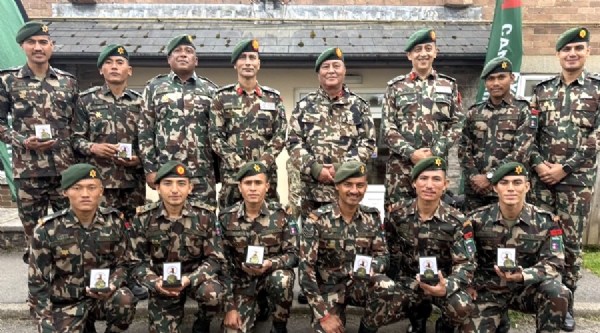
The Nepali Army has won a gold medal for the third consecutive year at the Cambrian Patrol Exercise, held in Brecon, Wales, in the United Kingdom. A total of 130 international teams from 35 countries participated in this year’s exercise.
Brigadier General Anup Shah, Military Attaché at the Nepali Embassy in London, said the Nepali Army had secured gold medals in the highly demanding exercise for three consecutive years, beginning in 2024. The event is regarded as one of the British Army’s premier patrolling exercises and was organised by the Headquarters of 160th (Welsh) Brigade.
A 10-member Nepali Army team is currently in the United Kingdom under the leadership of team manager Lieutenant Colonel Nishchal Pathak and patrol commander Lieutenant Praveen Pandey.
Held annually since 1960, the international competition has seen the Nepali Army participate since 2014. Over the years, the force has consistently delivered strong performances, establishing its reputation on the international stage.
The Nepali Army also won a gold medal at the exercise last year, when 117 teams participated, including 35 international teams representing 33 countries. Similarly, the army secured gold at the 2024 edition of the Cambrian Patrol Exercise, which featured 121 teams, including 38 international teams from 36 countries.
Before its recent run of consecutive victories, the Nepali Army had also won gold medals in 2017 and 2019.
According to the British Army, the exercise subjects participating personnel to demanding physical and mental challenges. It assesses a range of military competencies, including operational readiness, intelligence gathering, and the management of wounded and sick personnel.
Conducted in eight phases, the exercise requires teams to cover approximately 60 kilometres within 48 hours while carrying weapons, equipment weighing around 70 pounds (approximately 32 kilograms), and other essential military supplies. The demanding format tests participants’ endurance, tactical proficiency, teamwork and ability to operate under pressure.
---------------
Hindusthan Samachar / Jun Sarkar

18 Aug 2026