Kathmandu, 08 October (H.S.):
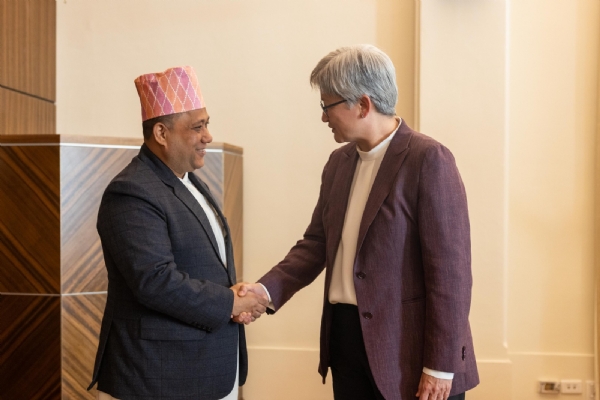
Nepal’s Foreign Minister Shisir Khanal and Australian Foreign Minister Senator Penny Wong on Thursday discussed various aspects of Nepal-Australia bilateral relations during a meeting in Melbourne, with both sides exploring ways to further strengthen ties and expand cooperation across areas of mutual interest.
According to Foreign Minister Khanal’s secretariat, the two ministers expressed satisfaction with the close, longstanding and cordial relations between Nepal and Australia. They also emphasised the need to further expand cooperation based on shared democratic values, mutual respect and strong people-to-people ties.
During the meeting, Australian Foreign Minister Penny Wong expressed deep condolences and sympathy to the families and communities affected by the devastating floods that recently struck Nepal. She said Australia stood with Nepal in its relief, early recovery and reconstruction efforts following the disaster.
Wong announced an additional A$15 million in assistance for flood-affected Nepal, taking Australia’s support beyond the A$11 million previously committed for the emergency response. The additional funding will support relief and early recovery efforts, including rebuilding damaged infrastructure, restoring access to essential services and strengthening early warning systems to reduce the risks and impacts of future floods.
Foreign Minister Khanal expressed gratitude to the Australian Government and people for their prompt and generous humanitarian assistance during the crisis. He said the solidarity extended during the disaster reflected the enduring goodwill and longstanding friendship between Nepal and Australia.
The two ministers also discussed the shared risks posed by climate change to Nepal and countries across the Pacific region.
Khanal urged Australia to use its international leadership role, particularly its co-presidency of the upcoming COP31, to highlight more effectively at the global level the disproportionate and severe impacts of climate change on the fragile Himalayan ecosystem.
He stressed the need to expand Nepal-Australia cooperation in climate adaptation, early warning systems, disaster risk reduction and preparedness, as well as the development of climate-resilient infrastructure.
The two ministers also discussed ways to deepen educational cooperation. They explored the possibility of establishing Australian-accredited Technical and Vocational Education and Training (TVET) institutions in Nepal, as well as potential avenues for Australian universities to establish satellite campuses in the country.
Referring to the contribution of Nepali students and the wider Nepali diaspora to Australia’s multicultural society and economy, Khanal urged favourable and fair consideration for genuine and eligible Nepali students amid recent changes to Australia’s student visa policies.
The meeting also accorded priority to strengthening the Nepal-Australia economic partnership. The two sides discussed opportunities to expand cooperation in trade, foreign direct investment, technology transfer, renewable energy, sustainable agriculture, tourism and labour mobility.
The ministers also discussed the possibility of establishing direct air connectivity between Nepal and Australia. Both sides noted that direct flights could significantly boost tourism, trade, investment and people-to-people contacts between the two countries.
Foreign Minister Wong reaffirmed Australia’s commitment to further strengthening its partnership with Nepal and continuing cooperation in priority areas.
The two sides agreed to maintain regular high-level exchanges and work closely to translate the understandings reached during the meeting into tangible outcomes. They also reiterated their commitment to further strengthening and diversifying Nepal-Australia relations for the mutual benefit of the peoples of both countries.
---------------
Hindusthan Samachar / Jun Sarkar

18 Aug 2026