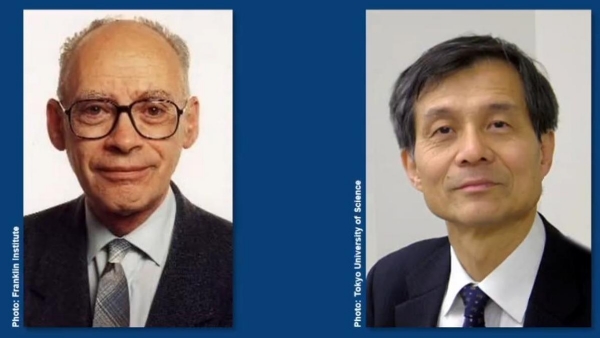
Stockholm, 07 October (H.S.): French scientist Henri B. Kagan and Japanese scientist Kenso Soai have jointly been awarded the 2026 Nobel Prize in Chemistry for their pioneering work on asymmetric organic synthesis, which helped shed light on one of chemistry’s enduring mysteries — how chemical reactions can be guided to favour one of two mirror-image forms of a molecule.
The Royal Swedish Academy of Sciences announced the award in Stockholm on Wednesday, honouring the two scientists “for the discovery of non-linear effects and autocatalysis in asymmetric organic synthesis.”
Kagan, affiliated with Université Paris-Sud in France, and Soai, professor emeritus at the Tokyo University of Science, will share the 12 million Swedish kronor prize equally. The laureates will receive their medals and diplomas at the Nobel Prize ceremony in Stockholm in December.
Their research addresses the phenomenon known as chirality, in which certain molecules exist in two forms that are mirror images of each other, known as enantiomers. Although the two forms have the same chemical composition, they can behave very differently when interacting with biological systems.
The distinction is particularly important in living organisms. Amino acids, for instance, occur in two mirror-image forms, but proteins in living cells predominantly use only one of them. This one-sided molecular arrangement is known as homochirality.
For more than a century, scientists have sought to understand how such chemical asymmetry could arise and, more importantly, how it could be reproduced and controlled in the laboratory.
According to the Nobel Committee, the discoveries of Kagan and Soai provided chemists with powerful tools for understanding and controlling asymmetric reactions, allowing them to amplify an initial preference for one molecular form until that form becomes overwhelmingly dominant.
Kagan made a decisive breakthrough in 1986 when he demonstrated that the relationship between a catalyst and the product formed in an asymmetric reaction need not be linear. His work showed that relatively small changes in a catalyst could produce disproportionately large differences in the amount of one enantiomer formed.
The discovery of these non-linear effects opened new possibilities for controlling chemical reactions with greater precision, with implications for the production of pharmaceuticals, fragrances and advanced materials.
Soai subsequently made major advances in the field of autocatalysis. In the 1990s, he worked towards developing an asymmetric chemical reaction in which the product itself could promote the formation of more of the same product. His research ultimately demonstrated how a very small initial imbalance between two mirror-image forms could be dramatically amplified.
In 2003, Soai succeeded in demonstrating an autocatalytic reaction capable of producing a strong preference for a single molecular mirror image, providing an important experimental demonstration of how chemical asymmetry can arise and reinforce itself.
The discoveries have particular significance for pharmaceutical chemistry. Two enantiomers of the same compound can have markedly different effects in the human body. While one may possess the desired therapeutic properties, the other can be less effective or potentially harmful. The ability to selectively produce the desired enantiomer is therefore a crucial part of modern drug development.
The Nobel Committee said the work of Kagan and Soai has helped provide an answer to a scientific puzzle that had challenged chemists for more than a century: how homochirality, or the predominance of one molecular handedness in living systems, could emerge spontaneously.
Kagan, 95, is a French chemist known for his influential work in organic and organometallic chemistry, asymmetric synthesis and asymmetric catalysis. Soai, 76, is a Japanese chemist whose research into asymmetric autocatalysis has played a major role in understanding how molecular chirality can be amplified.
The 2026 Chemistry Nobel is the third scientific Nobel Prize to be announced during this year’s Nobel week, following the awards in Physiology or Medicine and Physics. The Chemistry prize was announced by the Royal Swedish Academy of Sciences in Stockholm on Wednesday.
The Nobel Prizes were established from the fortune of Swedish inventor and industrialist Alfred Nobel, who stipulated in his will that the awards should recognise achievements that confer the “greatest benefit to humankind”. The prizes are awarded in Physics, Chemistry, Physiology or Medicine, Literature and Peace, while the Sveriges Riksbank Prize in Economic Sciences in Memory of Alfred Nobel was established later, in 1968.
---------------
Hindusthan Samachar / Jun Sarkar

18 Aug 2026