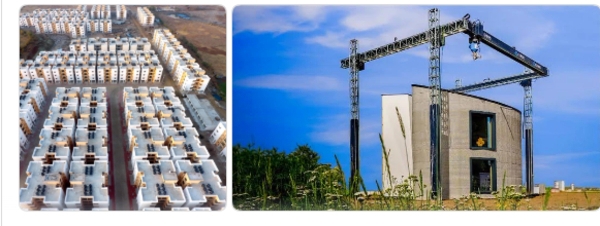
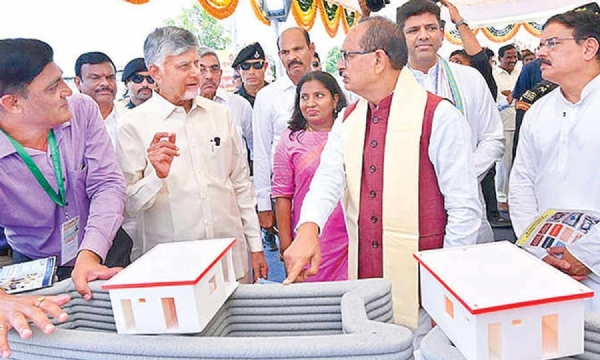
Guntur(Andhra Prades), 07 October (H.S.): Andhra Pradesh has begun a 177-house pilot using 3D concrete-printing technology, bringing automated construction into India's rural housing programme as the country prepares to build two crore additional rural houses under the Pradhan Mantri Awaas Yojana-Gramin (PMAY-G). Launched in Guntur district on October 4, the project involves an investment of about ₹14 crore and is targeted for completion within six months.
From Conventional Housing to Construction Automation
The Andhra Pradesh project marks a significant technology test within India's large-scale rural housing programme. Instead of relying entirely on conventional construction methods, the pilot uses computer-controlled 3D concrete printing to build houses layer by layer according to digitally prepared designs.
The project covers two locations in Guntur district - Burripalem and Obulnayudupalem. Of the 177 houses, 100 will have a built-up area of 25 square metres, while 77 barrier-free houses measuring 32 square metres are being constructed for persons with disabilities.
Technical support is being provided by the Council of Scientific and Industrial Research-Central Building Research Institute (CSIR-CBRI), including work related to design, construction materials, technical supervision and the application of 3D-printing technology.
Why the Scale of PMAY-G Matters
The importance of the experiment lies not only in the technology but also in the size of the housing programme into which it has been introduced.
The Centre has announced plans to construct two crore additional rural houses during 2024-25 to 2028-29 under PMAY-G, with an estimated outlay of around ₹3.06 lakh crore. The programme is expected to benefit nearly 10 crore people.
Since 2021-22, the government has set a target of around 2.13 crore rural houses under the programme. Around 1.95 crore houses have been sanctioned and more than 1.21 crore have been completed, making construction capacity, materials, labour availability and delivery timelines central to the next phase of rural housing.
The Andhra Pradesh pilot therefore places construction technology inside one of India's largest public housing programmes.
The Six-Month Construction Window
The Guntur project has been given a six-month completion target. The compressed construction schedule is an important part of the technology demonstration because 3D printing allows the structural components of a house to be produced through automated, digitally controlled processes.
The printer deposits concrete in programmed layers, reducing dependence on traditional manual masonry for the printed portions of the structure. This creates greater control over dimensions and construction sequences while allowing designs to be reproduced with consistency.
The technology does not eliminate the need for conventional construction work. Foundations, reinforcement, electrical systems, plumbing, doors, windows, roofing requirements and finishing activities still form part of the overall building process.
A Technology Test Under Indian Conditions
The Guntur pilot is also significant because construction technologies developed elsewhere have to work under India's specific conditions.
Housing in rural India involves different soil conditions, weather patterns, material availability, transportation challenges and workforce requirements. The use of locally appropriate concrete formulations and construction methods is therefore as important as the printing machinery itself.
CBRI's involvement gives the project a research and engineering dimension beyond the construction of individual houses. Material performance, structural strength, layer bonding and durability are among the technical issues that determine whether 3D-printed construction can move beyond demonstration projects.
Beyond Speed: Standardising Construction
The significance of construction automation extends beyond faster building.
A digitally controlled printing system can reproduce the same design repeatedly, offering greater standardisation in dimensions and construction patterns. For a large public housing programme, this can help create more predictable construction processes and improve quality control.
It also provides an opportunity to integrate digital design, material engineering and automated construction into a single workflow.
For rural housing programmes operating at national scale, such standardisation has direct relevance to project management and delivery.
The Labour Question
Construction is one of India's largest employment-generating sectors, particularly in rural and semi-urban areas. The introduction of automation therefore changes the nature of labour required rather than simply removing labour from construction.
3D-printed construction requires technicians, machine operators, engineers, material specialists and workers for foundations, finishing and building services. As the technology develops, construction workers will increasingly need skills related to digital equipment and automated building systems.
This creates a parallel requirement for training and certification alongside technology adoption.
The Cost Question
The Andhra Pradesh pilot is also expected to provide practical data on the economics of 3D-printed rural housing.
The ₹14-crore project will offer a field-level assessment of material use, labour requirements, equipment deployment, construction time and finishing costs. These are essential measurements before the technology can be considered for larger public housing applications.
]The most important outcome of the pilot may therefore be the data generated during construction rather than simply the number of houses completed.
A Large National Housing Market
India's rural housing requirement provides one of the world's largest potential testing grounds for construction technology.
Two crore additional PMAY-G houses have been planned for the current phase. Any technology that can demonstrate reliable construction, quality control and cost efficiency at scale will have relevance well beyond one district or one state.
For technology companies and construction researchers, India's housing programme offers a large real-world environment in which automated construction systems can be tested under diverse conditions.
From a Village Pilot to a Construction Technology Platform
The Guntur project is therefore better understood as a field test of an emerging construction system rather than simply a project involving 177 houses.
Its success will depend on measurable outcomes - construction time, material consumption, structural performance, finishing requirements, maintenance needs and overall cost.
These results can provide the evidence required to determine where 3D concrete printing fits within India's wider affordable housing strategy.
The Standards and Research Dimension
The expansion of 3D-printed construction also requires a stronger ecosystem of technical standards, material testing and regulatory frameworks.
Research institutions such as CSIR-CBRI have been working on construction automation, concrete formulations and 3D-printing applications. Such work is important because mass adoption requires building systems to meet established standards for strength, safety, durability and performance.
India's experience with the Andhra Pradesh pilot can contribute to this developing body of technical knowledge.
What This Means for Rural India
For rural communities, the immediate significance is straightforward: the technology is being tested in actual housing construction rather than confined to laboratory demonstrations.
For the government, it provides a new method to assess whether construction automation can support a housing programme operating at unprecedented scale.
For India's construction sector, it represents the convergence of digital design, material science, engineering and automation.
Andhra Pradesh as a Testing Ground
Andhra Pradesh has become the location for an important experiment in applying advanced construction technology to a public welfare programme.
The Guntur pilot places a globally emerging technology inside a distinctly Indian challenge - building large numbers of affordable, durable homes across rural communities.
The six-month construction programme will provide a practical measure of what 3D concrete printing can deliver under Indian conditions.
The Next Phase of India's Housing Revolution
India's rural housing programme is entering a phase where the scale of construction makes technology increasingly important. The Andhra Pradesh pilot brings automation directly into that challenge.
For Andhra Pradesh, it is a technology-led rural housing initiative. For India's construction sector, it is a field test of automation. And for the country's broader housing mission, it provides a new technological route towards building affordable homes with greater speed, standardisation and engineering control.
---------------
Hindusthan Samachar / Indrani Sarkar