Kathmandu, 05 October (H.S.):
Top leaders of Nepal’s major political parties have pledged to cooperate beyond the boundaries of the ruling and opposition camps on issues of national importance. The leaders said dialogue and cooperation among political parties are indispensable on matters concerning democracy, the Constitution, national identity and economic transformation.
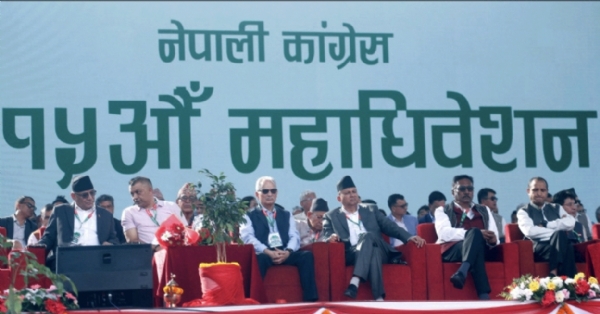
Addressing the inaugural session of the 15th General Convention of the Nepali Congress, leaders including ruling Rastriya Swatantra Party (RSP) chairman Ravi Lamichhane, Nepali Congress president Gagan Thapa, CPN coordinator Pushpa Kamal Dahal ‘Prachanda’, CPN-UML General Secretary Shankar Pokharel, former Prime Minister Dr Baburam Bhattarai, Rastriya Prajatantra Party (RPP) chairman Rajendra Lingden, Shram Sanskriti Party General Secretary Aren Rai and Janata Samajbadi Party-Nepal leader Sharat Singh Bhandari stressed the need to work together on national issues.
Most of the leaders, except those from the RSP, drew attention to the threats facing the existing political system, the Constitution, democracy and national identity. The RSP, however, said that if democracy came under threat, the people themselves would come forward to defend it.
Nepali Congress president Gagan Thapa said the responsibility of the Congress is to establish a meaningful connection between democracy and the everyday lives of the people. He said that if political rights are not linked to services, opportunities and economic development that citizens can experience in their daily lives, public faith in democracy will weaken.
Thapa said the Congress must serve as a bridge between the old and new generations, as well as between democracy and delivery.
“The Congress serves as a bridge between the old and new generations. It will also serve as a bridge between democracy and delivery. If the bridge collapses, trust will also collapse,” he said.
RSP chairman Ravi Lamichhane said that when questions concerning the country arise, differences between political parties and their flags become secondary. He stressed the need for all political forces to unite on issues of national interest.
“When it comes to the country and the nation, there is no distinction between party and flag,” he said.
Lamichhane also commented on the ongoing discussion surrounding the government. He said the government had been formed through a popular mandate and that there should be no talk of its collapse.
“This government will not fall, and when the government does not fall, those talking about bringing it down will themselves faint and fall,” he said.
Maoist leader Pushpa Kamal Dahal ‘Prachanda’ urged the Nepali Congress to bring together leaders and groups that remain divided within the party and move forward collectively. He said there was a need to make the Congress more united and urged its new leadership to make efforts to accommodate all sections.
Prachanda said that some tasks related to the peace agreement still remain unfinished. He warned that failure to complete those tasks could put the country at risk of slipping into another conflict.
“Some aspects of the peace agreement are still pending. If they are not completed, the country could once again move towards another conflict. Gagan Thapa will also have to complete this task,” he said.
CPN-UML General Secretary Shankar Pokharel recalled the history of leftist and democratic forces joining hands with the Nepali Congress during democratic movements. He said the UML remains ready to work together with the Congress.
He said the two parties should once again work together to safeguard democracy and transform the country.
“We fought together against the Rana regime, the Panchayat system and the rule of King Gyanendra Shah. Now it is time to work together again to protect democracy and change the face of the country. The UML is ready to work with the Congress to safeguard democracy,” Pokharel said.
However, he also posed a question to the Congress, asking how a party that had fought for democracy would now move forward to protect it.
Former Prime Minister Dr Baburam Bhattarai recalled the role played by the Nepali Congress in Nepal’s modern democratic movement. He said that despite changes in the country’s political system, the economic situation had not improved as expected.
Bhattarai stressed the need for clear, long-term development plans and called for political parties to compete over their ability to formulate and implement such plans for the country’s development.
RPP chairman Rajendra Lingden claimed that the country had gone off track. He said that those who point out problems with the existing system are subjected to criticism and attacks on social media, while merely changing the faces in power does not alter the underlying political tendencies.
“As long as this country does not return to the right track, I will continue to say it. These six months have shown that merely changing the people does not solve the problem,” Lingden said.
---------------
Hindusthan Samachar / Jun Sarkar

18 Aug 2026