Kathmandu, 31 October (H.S.): Police raids on media organisations and the detention of journalists in Nepal late on Friday have revived memories of the repression of the press during the country's monarchical rule.
The ruling Rastriya Swatantra Party (RSP) has strongly criticised the government's actions, while the incidents have raised serious questions about whether the party has lost control over the government or whether the police operations were carried out with its knowledge.
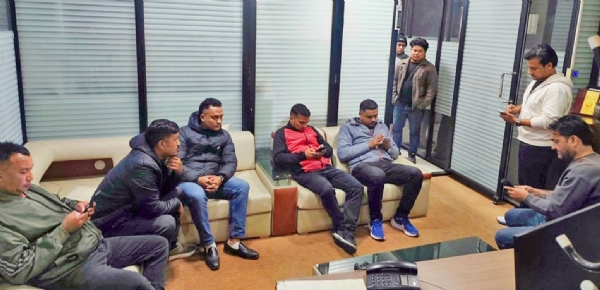
On Friday, police personnel entered the newsrooms of several media organisations and detained journalists, in a move that critics say runs counter to the constitutional guarantee of press freedom. Plainclothes officers deployed from the Cyber Bureau and the Crime Investigation Office took several journalists into custody, while others were also being sought. According to media representatives, some journalists became unreachable after the police began what they described as unusual efforts to detain media professionals.
The Prime Minister's Office maintained that it had no prior knowledge of the operations. However, sources close to Prime Minister Balendra Shah claimed that the initiative had come from Inspector General of Police (IGP) Dan Bahadur Karki. Karki has been accused of targeting journalists and media organisations that had published critical reports about him.
Police sources, however, said the IGP had issued instructions to subordinate officers after coordinating with members of the Prime Minister's team. The alleged plan involved detaining journalists, seizing their equipment and identifying the sources of news reports.
According to the accounts, Karki explicitly referred to instructions from the Prime Minister and the Home Minister while directing officers to carry out the operation. It has also emerged that he allegedly coordinated with influential members of the Prime Minister's Secretariat to prepare a list of media organisations and journalists to be targeted.
Although the IGP appeared to be leading the operations, sources claimed that several other individuals actively involved in running the government were also aware of and involved in the process.
Meanwhile, as the police operations intensified, the ruling RSP issued a strongly worded statement criticising the government's approach. The party said that using law enforcement as a pretext to intimidate the independent press, undermine the dignity of media organisations and restrict democratic institutions was incompatible with democratic conduct.
In a statement issued late on Friday night, RSP spokesperson and former Communications Minister Jagadish Kharel said detaining journalists by bypassing established legal and institutional procedures amounted to a blatant violation of the rule of law, particularly when authorised bodies responsible for regulating the media were already functioning. He said such actions could not be justified under any circumstances.
He further asserted that attempts to intimidate media organisations, subject them to psychological pressure or restrict their functioning under any pretext were unacceptable.
Referring to reports that some journalists had been detained and others were being sought over their news coverage, Kharel urged the concerned authorities to conduct an impartial, transparent and fact-based investigation, make the truth public without delay and ensure the immediate, respectful and unconditional release of any journalists being held unlawfully.
Expressing solidarity with the media fraternity, the former minister also urged journalists to continue their professional work with courage and an unwavering commitment to truth, facts and integrity, without succumbing to fear, intimidation or undue pressure.
Meanwhile, the Prime Minister's Office has denied any responsibility for Friday's operations. The incident has exposed tensions between the government and the ruling party, raising a larger question: despite the Cabinet being formed under the leadership of a senior party figure, has the RSP leadership lost its grip on the government?
The police action has drawn criticism from lawyers and media rights advocates. Leaders of the main opposition Nepali Congress, CPN-UML and other opposition parties have also condemned the operations.
Nepal Bar Association President Bijay Prasad Mishra said the incident brought back memories of the monarchical regime. It is inappropriate for the government itself to engage in such repressive acts, he said.
There is no example anywhere in the world of a government succeeding by arresting and persecuting journalists. This is not a good sign, he added.
Tikaram Bhattarai, former vice-president of the Nepal Bar Association and a senior advocate, described the raids on media organisations as an incident that went even further than the repression witnessed during King Gyanendra's rule.
In a Facebook post, Bhattarai said, This incident is unconstitutional, contrary to constitutional supremacy and the rule of law, and condemnable because it undermines democracy.
He further stated, The release of the arrested journalists is not the central issue. Every conscious citizen must raise their voice against such a government, its conduct and its attitude, and stand up for the protection of democracy.
On February 1, 2005, after King Gyanendra assumed direct control of the state, armed troops were deployed at media organisations and censorship was imposed on the publication and broadcast of news. Equipment belonging to several media outlets was also seized. Subsequently, the Supreme Court issued dozens of orders challenging the actions of the royal government. Since then, the conduct of the monarchy has frequently been invoked as a point of comparison whenever concerns about government repression of the media have resurfaced.
Citing constitutional and legal safeguards, Shiva Gaunle, former president of the Federation of Nepali Journalists, said police entry into newsrooms to identify the sources of news reports amounted to a complete breakdown of the constitutional order.
If the police have started entering newsrooms and arresting journalists in the name of identifying news sources, then the Constitution has effectively ceased to exist in this country. We can continue fighting to protect press freedom and freedom of expression, but our first priority now must be to fight to save the Constitution, Gaunle said.
The Press Council Nepal has also condemned the police action against journalists over their published reports.
In its statement, the council said, Against the backdrop of the statement issued by Police Headquarters, this incident raises serious questions about press freedom and the professional security of journalists.
The council urged the government, police administration and other concerned authorities to resolve disputes relating to news coverage through its established procedures rather than resorting to police intervention.
Raman Karna, secretary of the Supreme Court Bar Association, described the police action as an attempt to curtail freedom of expression and press freedom.
When the government uses the police to carry out such actions, it amounts to undermining the Constitution. If journalists have to face raids and detention simply for bringing facts to light, what meaning does the rule of law hold in this country? This is the height of authoritarian conduct, Karna said.
---------------
Hindusthan Samachar / Jun Sarkar

18 Aug 2026