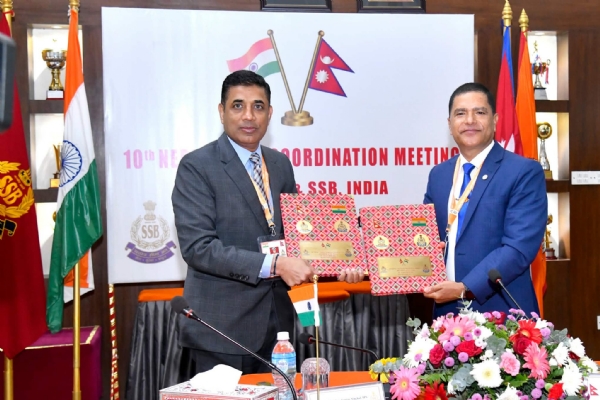
Kathmandu, 30 October (H.S.): Nepal and India have agreed to strengthen border security, technology-driven border management and bilateral cooperation, with plans to expand surveillance through CCTV cameras and drones.
The consensus was reached at the 10th Nepal-India Coordination Meeting, held in Kathmandu on October 28 and 29 under the leadership of Narayan Dutta Paudel, Inspector General of the Armed Police Force (APF), Nepal, and Sanjay Singhal, Director General of India's Sashastra Seema Bal (SSB).
The meeting reviewed progress on the decisions taken during the ninth coordination meeting. Both sides also agreed to enhance strategic, operational and field-level cooperation to curb illegal activities along the border and combat cross-border crimes. They reaffirmed their commitment to ensuring the timely exchange of information.
To ensure effective management of the Dasgaja, the no-man's-land between the two countries, the sides agreed to continue joint efforts to remove unauthorised cultivation, encroachments and illegal structures. They also resolved to strengthen coordination on the ground, in accordance with decisions taken by the relevant mechanisms, for the repair, maintenance and reconstruction of border pillars.
The two countries further agreed to maintain regular information-sharing to counter cross-border criminal networks, illegal smuggling, human trafficking, counterfeit currency and narcotics-related activities.
To prevent unauthorised entry by third-country nationals through the open border, both sides agreed to tighten checks and document verification at border posts, conduct joint patrols in the Dasgaja area and promptly share information about suspicious individuals.
Discussions were also held on modernising border management through technology. The proposals included installing CCTV cameras in the Dasgaja area, deploying baggage scanners and walk-through metal detectors at major border checkpoints, and increasing the use of drones by both countries within their respective territories.
The two sides also agreed to strengthen institutional cooperation to address security and social harmony challenges arising from the misuse of social media and the spread of misinformation. They decided to expand collaboration in modern technology and specialised training to tackle emerging border security challenges, while also organising regular study visits between the two security agencies.
The meeting also discussed holding a Joint Swift Water Rescue Exercise at the Disaster Management Training Institute of the Armed Police Force Nepal in Kurintar, Chitwan, as part of cooperation in natural disaster management.
To facilitate legitimate travellers, the two sides agreed to expand help desks at border checkpoints. They also decided to organise joint cultural programmes on sporting occasions, international days and major festivals to promote mutual trust and goodwill.
The Nepali delegation included senior officials of the Armed Police Force Nepal, along with representatives from the Ministry of Foreign Affairs, Ministry of Home Affairs, Department of Survey, Nepal Police and the National Investigation Department.
The Indian delegation comprised senior Sashastra Seema Bal officials and representatives of the Indian Embassy in Kathmandu, as well as the Ministries of External Affairs and Home Affairs.
The bilateral coordination meeting, which has been held alternately in Nepal and India since 2012, will convene for its 11th edition in India next year.
---------------
Hindusthan Samachar / Jun Sarkar

18 Aug 2026