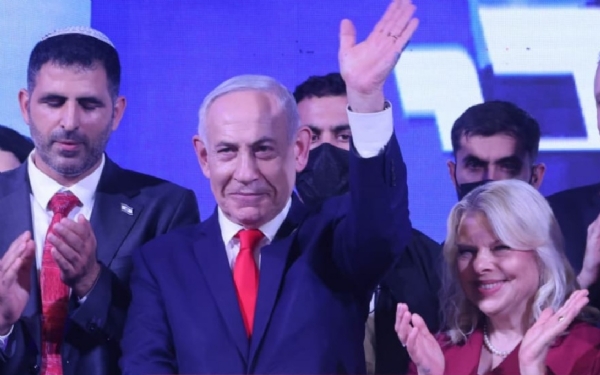
Jerusalem, 28 October (H.S.): Israeli Prime Minister Benjamin Netanyahu called early Wednesday for the formation of a strong, right-wing national government, warning against any coalition that depends on Arab parties. Speaking at the Likud party’s election headquarters, he said the exit polls had not established a conclusive outcome and urged supporters to wait for the final vote count.
According to The Jerusalem Post, Netanyahu told party workers and journalists that Likud had emerged as Israel’s largest party. He also claimed that the right-wing bloc commanded a decisive majority among Jewish and Zionist voters and those who support the Jewish state.
“We must form a strong, right-wing, national government,” Netanyahu said.
He cautioned against establishing a government that, in his words, relied on “anti-Zionist” Arab parties. He accused these parties of opposing Israel’s existence and criticising its soldiers, arguing that their participation in a governing coalition would be incompatible with efforts to build an alliance of people who serve in the military.
Netanyahu challenged politicians advocating a coalition of military service members, questioning how they could support such an arrangement while cooperating with Arab parties that he accused of opposing the Israel Defence Forces (IDF).
The prime minister also highlighted what he described as his government’s military achievements, while acknowledging that its objectives remained unfinished. He referred to an opportunity to work with US President Donald Trump to eliminate what he called the existential threat posed by Iran.
Netanyahu argued that Israel had significantly weakened its adversaries through military operations but maintained that further action was necessary to address the Iranian threat. His remarks placed security policy at the centre of his post-election appeal to supporters.
Meanwhile, Likud lawmaker Amit Halevi questioned the initial exit-poll projections that put Netanyahu’s bloc at around 50 seats. He argued that the estimates underestimated the bloc’s support and maintained that the final results could differ from the early projections.
Halevi described the election as a reflection of Israeli society’s response to the October 7, 2023, attacks and the three years of conflict that followed. The election has become a wider test of public confidence in Netanyahu’s leadership, particularly his handling of national security and the wars involving Israel.
Halevi also expressed concern about the projected gains made by Arab-led parties. He said his objections to their potential political influence were rooted not in their ethnicity but in what he characterised as their “radical ideology”.
The results have left the political landscape uncertain, with exit polls indicating that neither Netanyahu’s bloc nor the opposition has secured the 61 seats required for a majority in the 120-member Knesset. Arab-led parties could therefore play a significant role in determining the next government, although their participation in a coalition remains politically contentious.
Asked how Netanyahu would navigate the uncertainty and secure the formation of a government, veteran Likud member Meir Cohen offered a brief response: “I trust Netanyahu.”
With the final results still awaited, Netanyahu’s call for a united right-wing government signals his intention to remain at the centre of Israel’s political negotiations, even as the competing blocs face the challenge of assembling a viable parliamentary majority.
---------------
Hindusthan Samachar / Jun Sarkar

18 Aug 2026