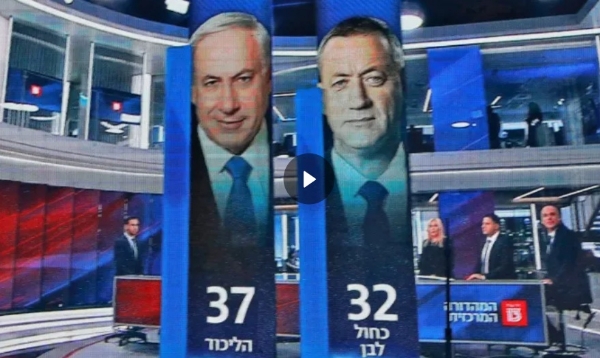
Tel Aviv, 27 October (H.S.):
Voting in Israel’s general election began at 7 a.m. local time on Tuesday, with polling stations scheduled to remain open until 10 p.m. The election, the first since Hamas’s October 7, 2023, attack and the subsequent wars in Gaza and across the region, is being closely watched internationally, as its outcome could determine whether Prime Minister Benjamin Netanyahu remains in power.
Netanyahu faces a major challenge from former Israel Defense Forces (IDF) chief Gadi Eisenkot, who leads the newly formed Yashar party. Opinion polls indicate that neither the governing bloc nor the opposition is assured of securing a majority in the 120-member Knesset, Israel’s parliament. A party or alliance needs at least 61 seats to command a parliamentary majority, raising the prospect of prolonged coalition negotiations.
According to Al Jazeera, voters expressed contrasting views in the run-up to the election, with some calling for political change while others backed Netanyahu’s continuation in office. Palestinians in Gaza, meanwhile, have expressed scepticism that a change in Israel’s leadership would significantly alter the realities of their lives under occupation.
Israel’s Proportional Representation System Makes Coalition Building Crucial
The Knesset has 120 seats, and Israel follows a system of proportional representation under which parliamentary seats are allocated to parties according to their share of the vote, subject to the electoral threshold.
Under this system, no single party is necessarily expected to secure an outright majority, making alliances between political parties crucial to forming a government. If no bloc can assemble the support of at least 61 lawmakers, negotiations could lead to a minority government or a political deadlock. If efforts to form a government fail, another election could eventually be called. In the meantime, Netanyahu’s government would continue in a caretaker capacity.
Netanyahu Seeks to Retain Power with Support from Right-Wing Allies
Netanyahu has been a central figure in Israeli politics for more than two decades and is leading a right-wing, religious coalition. To remain in office, he may once again need the support of far-right political allies, including leaders who advocate annexing the occupied West Bank and promoting the removal of Palestinians from Gaza.
His principal challenger, Eisenkot, is a former IDF chief who founded the Yashar party last year. The election marks the party’s first electoral contest.
Eisenkot’s political campaign has focused heavily on accountability for the security failures surrounding the October 7, 2023, Hamas attack. His son, an IDF soldier, was killed during the early months of the Gaza war. Eisenkot had also served in Netanyahu’s wartime cabinet before resigning in 2024 over disagreements about the government’s handling of the conflict.
Other prominent figures in the election include former prime minister Naftali Bennett and Avigdor Lieberman, leader of the right-wing Yisrael Beiteinu party. Both are seeking to influence the country’s political direction, adding to an already fragmented electoral contest.
With opinion polls suggesting that neither the Netanyahu-led coalition nor the opposition has a clear path to the 61 seats required for a majority, the election could usher in another period of complex political negotiations. The final outcome will determine not only the composition of Israel’s next government but also the direction of its security policy and approach to the region’s continuing conflicts.
---------------
Hindusthan Samachar / Jun Sarkar

18 Aug 2026