By Dharmendra Tewari
India's ambition to develop indigenous high-performance computing capabilities was on display at Semicon India 2026, held in New Delhi from September 17 to 19, where the AUM processor under development by the Centre for Development of Advanced Computing (C-DAC) emerged as a significant example of the country's work towards advanced computing and artificial intelligence. The exhibition brought together researchers, industry representatives, technology developers and policymakers working to strengthen India's semiconductor ecosystem. My visit offered a closer look at the efforts underway in chip design, computing systems and the specialised materials needed for semiconductor manufacturing.
The importance of these efforts extends beyond individual chips. As artificial intelligence becomes increasingly integrated into electronic devices and digital services, the demand for computing power is growing. India's established strengths in software and engineering provide a foundation for developing indigenous hardware and creating products for domestic and international markets.
During the exhibition, I visited stalls of Indian companies involved in chip development and design services. One representative, Neel, explained how the company helps customers translate their ideas into chip-based solutions. If you have ideas, we can hard-code your idea into an executable task in a chip, he told us.
Such services can help entrepreneurs, researchers and young innovators turn concepts into practical electronic products. Chips act as the processing core of electronic systems, executing instructions and coordinating with other circuit components. Their design influences a product's performance, power consumption and capabilities.
The exhibition also demonstrated the growing role of electronics in everyday applications, from household appliances to monitoring devices. Some systems can detect signs of driver drowsiness and alert users, showing how sensors and intelligent electronics can address practical needs. These applications offer opportunities for Indian companies as demand for connected and AI-enabled products expands.
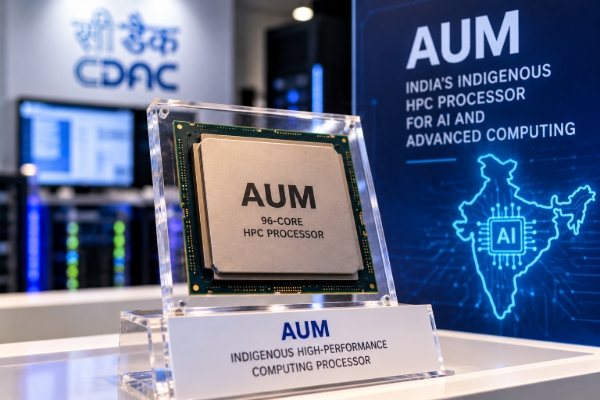
A more ambitious challenge is the development of processors capable of handling demanding computing workloads. At the C-DAC stall, scientists presented the development roadmap for AUM, an indigenous 96-core high-performance computing processor. They described it as being in an advanced stage of development.
During my interaction at the exhibition, Sunita Verma, a senior scientist from the Ministry of Electronics and Information Technology, explained that AUM is based on the Arm Neoverse V2 architecture and is being fabricated using a 5-nanometre process. The processor is intended to support workloads involving artificial intelligence, machine learning and scientific simulations.
The initiative forms part of India's wider effort to strengthen its semiconductor capabilities. The India Semiconductor Mission, launched in December 2021, marked an important step towards expanding the domestic semiconductor ecosystem. Indigenous high-performance processors could give Indian institutions and technology companies additional options for developing computing infrastructure suited to their requirements.
India's experience with restrictions on access to advanced supercomputing technology in the 1980s underlined the risks of dependence on external suppliers. More recently, disruptions in global chip supplies have demonstrated how shortages can affect industries reliant on electronic components. With semiconductor production concentrated in a limited number of countries, developing domestic capabilities has become an important economic and strategic objective.
C-DAC scientists also presented the PARAM Rudra server system in the context of India's indigenous computing ambitions. Developing processors alongside computing systems can help expand domestic expertise in hardware and software integration. A processor's practical performance depends not only on its architecture but also on memory, software and other system components. Building these capabilities together will be important for developing computing platforms for research, industry and other applications.
The potential applications extend to scientific research, engineering simulations, AI development and digital services. Greater access to domestic computing infrastructure could create opportunities for technology entrepreneurs and researchers working on new products. India's experience in software development and digital content creation provides a base for such initiatives, while sustained research and industrial investment will be needed to turn technological ambitions into competitive products.
My visit also highlighted an aspect of semiconductor development that receives less public attention: the materials and chemicals required to manufacture chips.
At the Centre for Materials for Electronic Technology (C-MET), Director General Dr. R. Rateesh showed me a small piece of hafnium. He explained the importance of material purity and the need to strengthen supply-chain security for substances used in semiconductor applications. Hafnium is used in certain advanced semiconductor materials, making expertise in its processing relevant to the industry.
I was told that a very small quantity of hafnium can cost more than Rs. 5 lakh. The interaction highlighted the importance of research into materials whose properties and purity can influence semiconductor manufacturing. I also saw an Indian company engaged in chemicals and metallurgy taking an interest in hafnium, pointing to opportunities for domestic industry in this specialised supply chain.
At the C-MET stall, I learnt about photoresist, a light-sensitive material used in photolithography to transfer circuit patterns onto silicon wafers. It is among the specialised materials required in chip manufacturing. Developing capabilities in such materials, alongside chip design and fabrication, is important to building a more resilient semiconductor ecosystem.
The exhibition offered a view of the different elements involved in India's semiconductor ambitions. Chip design, high-performance computing, materials research and electronic product development are interconnected parts of the same effort. Progress in one area must be supported by advances in others if the country is to build a sustainable domestic industry.
As AI-enabled devices become more common, demand for computing power is expected to grow. Indian companies and research institutions will need capable infrastructure to develop and deliver services for users at home and abroad. Indigenous processors such as AUM could contribute to this effort as development progresses towards practical deployment.
India's ambition should be to build on its strengths in software and engineering while developing the hardware and material capabilities needed for the next generation of electronics. Encouraging entrepreneurship, supporting research and creating opportunities for young innovators will be important in translating this ambition into products that can compete in international markets.
Semicon India 2026 offered a glimpse of the work being undertaken by researchers, companies and institutions towards this goal. The larger task is to sustain the momentum, develop indigenous technologies and build the industrial capabilities required to serve a growing global market for advanced computing and intelligent electronics.
(The author is a PIB officer. The views expressed are personal)
---------------
Hindusthan Samachar / Indrani Sarkar