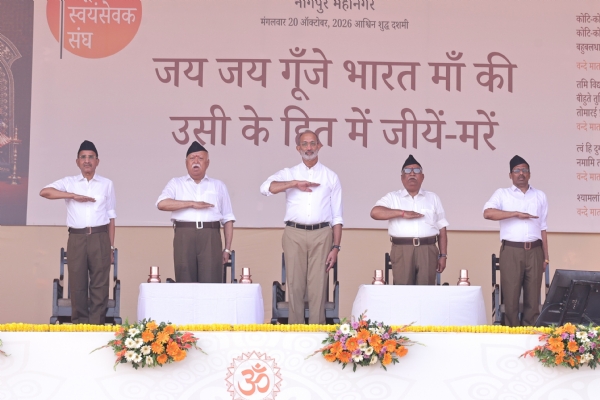
The core question of India’s civilisational identity is this: on what basis does a society of such diversity understand its unity, and how does it put that unity into practice? Amid differences of language, caste, creed, region, food and custom, what binds India into one thread? In his Vijayadashami address, Rashtriya Swayamsevak Sangh Sarsanghchalak Dr Mohan Bhagwat answered this question through swabodh and the Sanatan view of life.
In his view, recognising the swa (self) and practising swadeshi are linked to national unity, social harmony, personal conduct and the direction of development. Communities speaking different languages, following different modes of worship and living with different food habits and customs have lived here for centuries. In such a situation, the basis of unity cannot be to make everyone the same.
In Dr Bhagwat’s thinking, diversity is the natural and changing form of nature, whereas the unity of all existence is the eternal truth. The practical meaning of this outlook is therefore clear: diversity should be respected, there should be a spirit of preserving it, and the capacity to change arrangements that have become irrelevant with time should also be developed. Unity means maintaining warm and affectionate bonds amid differences.
The spirit of the Constitution and social conduct
The words “We, the people of India” in the Preamble to the Indian Constitution express the collective existence of citizens and their shared commitment to the nation. Dr Bhagwat stresses the need to strengthen this emotional unity further. According to him, the spirit of unity must also be established in social conduct. It is essential here to understand what swabodh means. Pride in a nation becomes lasting only when it is visible in the conduct of its citizens. Respect in social relations, discipline in public life, sanskar in the family, quality in the workplace and responsibility towards society are the practical forms of this consciousness.
In India’s history, the freedom struggle is an important example of this collective consciousness. Countless people rose above personal interests, fought for the country’s independence and gave their all. After Independence, the nature of the challenge changed. Now, to strengthen the nation’s unity, capability and standing, it is necessary to continuously develop citizens’ daily conduct, social participation and sense of national responsibility.
A thought that stands out in Dr Bhagwat’s address is that the effort now needed to take the country to the pinnacle of its capability and quality may exceed the austerity and dedication that were required to win freedom. This implies that nation-building is not a campaign that is completed once and for all, but a continuous process spanning generations.
Swabodh and swadeshi
Swadeshi is usually discussed in terms of using goods made in the country and achieving economic self-reliance. This is an important aspect, but a wider meaning emerges when it is linked with swabodh. Swadeshi conduct also includes awareness of one’s society’s needs, national interests, cultural values and quality of life. Dr Bhagwat welcomes progress in science and technology while stressing their judicious use.
Artificial intelligence, digital communication and scientific research have opened up vast possibilities in human life. They should be used only for education, health, production and public welfare. On the other hand, the same technology can also become a means of spreading confusion, deceiving people and promoting falsehood. Knowledge must therefore be accompanied by discernment, and capability by responsibility.
Dr Bhagwat’s emphasis is that small positive actions in life become habits, and habits gradually become part of one’s nature. It is therefore necessary to view the Panch Parivartan not as a programme limited to a single year but as a continuous process that changes lifestyles. Dr Bhagwat also stresses in his address that the level of dialogue and conduct in society should remain courteous and warm. When implementing any campaign, policy or social initiative, all parties, including the government and administration, should keep citizens’ dignity in mind. Avoiding turning differences into enmity, and keeping room for dialogue in resolving problems, is important for social stability.
The role of agitations should also be considered in this context. In a democratic society, it is natural to express dissent over problems and to demand reform. The usefulness of such efforts increases when they move towards solutions and observe constitutional limits. Likewise, the government and political leadership are expected to maintain order while remaining sensitive to citizens’ dignity and the requirements of justice.
Family, youth and discerning citizenship
The family, the education system and the social environment play an important role in strengthening the foundation of swabodh. In his address, Dr Bhagwat expressed concern that the traditional channels that carry the sense of right and wrong to the new generation are weakening. Social media and digital platforms have increased the availability of information, but not every piece of information is necessarily reliable or useful.
In this situation, it is essential to equip young people with independent thought, fact-based understanding and moral discernment. Obtaining information and evaluating it correctly are two distinct abilities. Dialogue in the family, value-based education in schools and responsible public conduct in society can contribute in this direction.
The address also mentions the participation of swayamsevaks and villagers in developing rural schools. It cites around 1,296 schools in 210 districts across 21 prants, where, with community participation, improvements were seen in student attendance, learning levels and parental involvement. This example reinforces the idea that citizen participation plays an important role in solving social problems.
From national unity to responsibility towards the world
The ultimate aim of swabodh is not to separate a society from the rest of the world but, while making it aware of its identity and capability, to equip it to contribute to wider human interests. Dr Bhagwat underlines the need to present India with a vision of development that balances science, technology, the environment, ethics and social responsibility.
Strengthening the foundation of swabodh also means not only remembering one’s past but accepting the responsibilities of the present. It is a process of developing quality in conduct from the individual to the family, from the family to society and from society to the nation. Indeed, it should also be understood here that swabodh is not an abstract philosophical concept. Its real meaning is to be alert to one’s nation, society and life, to maintain warmth amid diversity and to discharge responsibility in one’s daily actions. This, in truth, is the Bhagwat message of today.
---------------
Hindusthan Samachar / Mayank Chaturvedi