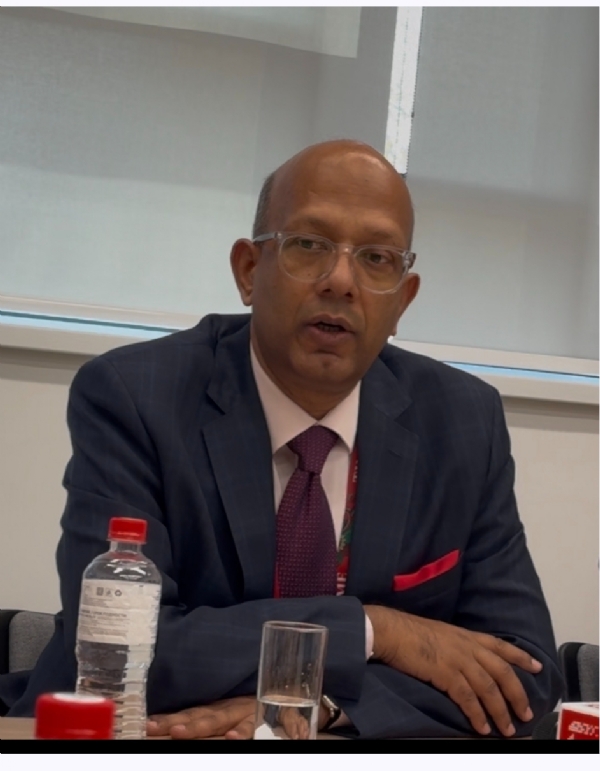
Kazan, 16 October (H.S.): Between 80 and 90 per cent of trade between India and Russia is currently being settled in local currencies, and the share could increase further in the coming years, Indian Ambassador to Russia Vinay Kumar has said.
Speaking in an exclusive interaction on the sidelines of the TIME Business Forum in Kazan, Kumar explained that the Reserve Bank of India (RBI) had issued the necessary directions for opening special vostro accounts to facilitate trade with interested countries. Several countries are using this mechanism, with Russia among them.
He said more than 20 special vostro accounts had been opened, with 19 Russian banks having established such accounts to facilitate trade settlements. However, he emphasised that the two countries would need to balance their trade to encourage greater use of the mechanism.
“A significant portion of trade settlements is already taking place in local currencies. The share fluctuates, but it is currently in the range of 80 to 90 per cent,” Kumar said.
During the Tatarstan–India Business Forum in Kazan, the ambassador also discussed bilateral trade, local-currency transactions and cultural cooperation.
Kumar said Russian regions were increasingly pursuing stronger commercial ties with the Indian market, supported by regional government incentives for small and medium-sized enterprises and resource-based industries. India has encouraged trade delegations from various Russian regions to visit the country, while Indian chambers of commerce, business representatives and cultural groups have been regularly participating in trade fairs and events in Russia.
The exchange of delegations has expanded, strengthening commercial links between individual regions in both countries. Kumar noted that the Tatarstan–India Business Forum was launched last year and was now holding its second edition.
The inaugural edition, held in 2025, brought together representatives from 20 Indian states and five Russian regions, resulting in the signing of 19 memorandums of understanding and agreements.
Emphasising the importance of Indian exports, Kumar said bilateral trade had grown significantly over the past few years, with Indian exports also recording an increase. He cited INNOPROM, Russia’s major industrial trade fair, as an example of expanding commercial engagement. The event’s first Indian edition was successfully held in New Delhi last month.
The ambassador also highlighted India’s efforts to further strengthen the popularity of Indian cinema in Russia. The cultural connection, which gained prominence through the films of Raj Kapoor and Amitabh Bachchan, is now entering a new phase focused on joint film production.
He said that, over the past three years, sustained efforts had been made to encourage visits by film personalities, promote cooperation between media organisations and support film and television production platforms. A film festival has also been included as a special segment of the Tatarstan–India Forum.
Kumar added that creative industries and social media influencers were playing an important role in bringing people from the two countries closer. Approximately 2,250 Indian youths participated in the World Festival of Youth held in Russia last month, further strengthening people-to-people connections.
Another speaker at the forum elaborated on joint film production, noting that several Russian films had been shot in India in recent years, while Indian films had also been filmed in Russia. Last year, two films shot in India were screened at the event, one of which had been produced for TMT, a television channel based in the region.
A Russian television series was also recently filmed in India. Several other projects are currently in post-production, while shooting permits have been granted for additional films to be filmed in the country.
Kumar also advised Indians considering employment opportunities in Russia to seek detailed guidance from the Indian Embassy before travelling, so that they could avoid potential difficulties.
He said Russia had reserved a 30 per cent quota for workers arriving from India. At present, approximately 29,000 Indians are working in Russia.
---------------
Hindusthan Samachar / Jun Sarkar

18 Aug 2026