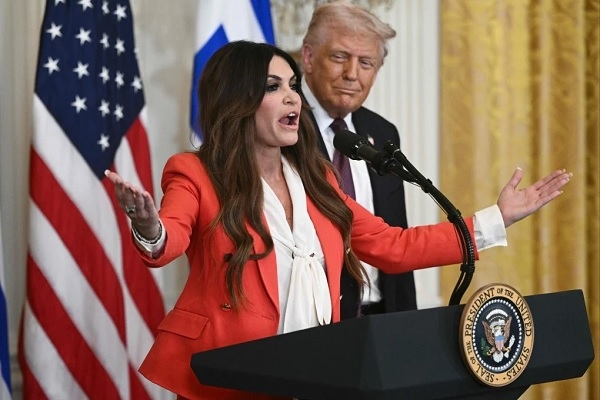
Washington, 14 October (H.S.): US President Donald Trump has decided to remove Kimberly Guilfoyle from her position as the US ambassador to Greece following a series of serious allegations against her. These include allegedly soliciting $100,000 from a Republican donor, promising him access to the US administration and pressuring the Greek government over purchases of American liquefied natural gas (LNG). Guilfoyle has rejected the allegations as false and vowed to defend her reputation.
According to Russia Today (RT), the Russian international news television network, White House Press Secretary Katie Zachariah told reporters on Tuesday that the administration had asked Guilfoyle to resign. Shortly afterwards, President Trump commented on the matter, saying that the ambassador had been doing a good job but that the administration was unhappy with the reports that had emerged about her.
Kimberly Guilfoyle was sworn in as the US ambassador to Greece in September last year. She had previously attracted public attention because of her engagement to Donald Trump Jr.
According to a report by The Wall Street Journal, Guilfoyle has been accused of using her diplomatic position to advance the interests of Greek energy businessman Alexandros Exarchou. The report alleged that she pressured several governments in the Balkans to purchase American LNG from Exarchou’s Aktor Group.
The allegations also include claims that Guilfoyle travelled to Davos aboard the businessman’s private jet. Her response to these specific claims and the findings of any independent investigation would be necessary to establish the facts.
According to the report, during a meeting with Greek officials in March, Guilfoyle allegedly warned that the government of Greek Prime Minister Kyriakos Mitsotakis could be brought down if he refused to purchase American LNG.
Greek Energy Minister Stavros Papastavrou subsequently denied that Guilfoyle had exerted pressure on his country or issued any threats against its government. However, the status of the other allegations detailed in the report remained unclear.
Guilfoyle has also been accused of taking credit for efforts to remove Romanian Prime Minister Ilie Bolojan from office. Romania reportedly supported the US-backed Vertical Gas Corridor project but declined to purchase additional American LNG because of the adequacy of its domestic gas reserves.
The controversy surrounding Guilfoyle intensified after Eric Deters, a Trump supporter and Republican donor, claimed in an interview with an American media outlet that Guilfoyle had asked him for $100,000 in 2024 to pay her credit card bill.
According to Deters, he was promised access to the Trump administration in return. He described the alleged arrangement as a transactional deal and levelled serious accusations against Guilfoyle.
The Wall Street Journal report also referred to a leaked recording in which Guilfoyle allegedly appears to tell an American businessman that she would help him make a substantial amount of money in exchange for arranging a dinner invitation in Davos in January. Independent verification of the allegations and details of any formal investigation have yet to emerge.
Meanwhile, following the decision to remove her from the post, Guilfoyle responded on social media, describing the recent allegations against her as false. She said she would vigorously defend her name, reputation and integrity. She also stated that she would not allow false accusations to define her decades of public service.
The developments have renewed scrutiny of US diplomatic appointments, private business interests and political donations. If substantiated, the allegations could raise serious questions about the use of American diplomatic positions to advance commercial interests and exert pressure on foreign governments over energy agreements.
---------------
Hindusthan Samachar / Jun Sarkar

18 Aug 2026