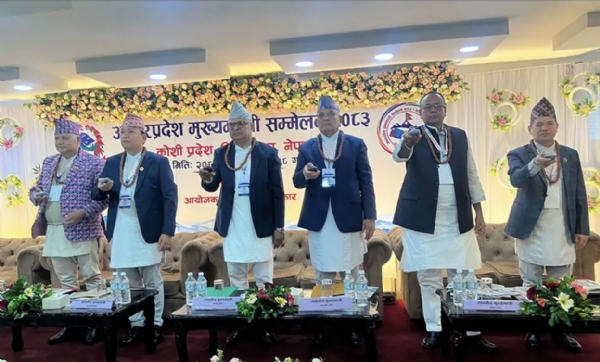
Kathmandu, 14 October (H.S.): Chief ministers of Nepal’s provinces have expressed dissatisfaction with the functioning of the federal government, accusing it of failing to transfer constitutionally mandated powers to provincial administrations. At an inter-provincial conference of chief ministers that began in Biratnagar under the initiative of the Koshi provincial government, they alleged that the federal government had neither enacted the legislation required to facilitate the division of powers nor provided adequate resources for provincial governments to discharge their responsibilities. Despite these shortcomings, they said, the functioning of provincial administrations was being questioned, placing the entire provincial governance structure under scrutiny.
The chief ministers alleged that delays in the transfer of powers by the federal government were increasing public disillusionment with the federal system. They maintained that the federal government’s centralised approach was the biggest obstacle to the effective implementation of federalism.
At the joint inauguration of the conference, the chief ministers of Koshi, Madhesh, Bagmati, Gandaki, Lumbini and Karnali provinces said, “We are not merely demanding powers; we are also prepared to fulfil our responsibilities. However, the federal system cannot succeed by weakening the provinces. Federalism cannot even be imagined without the provinces. Strong provincial governments are essential for prosperity.”
The chief ministers complained that, even nine years after the Constitution guaranteed exclusive and concurrent powers to the provinces, the federal government had yet to transfer these powers fully. As a result, provincial administrations were unable to provide public services in line with people’s expectations.
They pointed out that even exclusive provincial powers, including authority over the police, had not yet been transferred. Furthermore, the federal government’s failure to enact the necessary legislation had created difficulties in implementing laws and policies relating to several key sectors, including education, health, civil service administration and forests.
The chief ministers also alleged that the federal government’s lack of commitment had forced provincial administrations to depend on federal grants because of their limited financial resources. Despite this dependence, they said, the federal government had shown insufficient seriousness in implementing fiscal federalism.
The provincial leaders stressed that effective federal governance requires a clear division of constitutional powers, adequate financial resources and the timely enactment of enabling legislation. They maintained that strengthening provincial governments was essential to ensuring accountable administration, improving public service delivery and fulfilling the broader objectives of Nepal’s federal system.
---------------
Hindusthan Samachar / Jun Sarkar

18 Aug 2026