
- By, Kailash Chandra
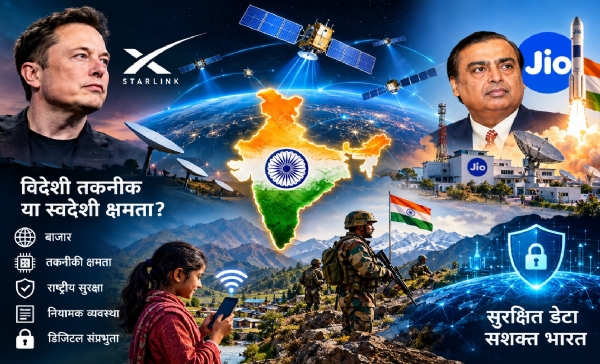
Technological competition in the world is no longer confined to markets, products and customers. Today, control over communication networks, artificial intelligence, semiconductors, space and digital infrastructure shapes a nation’s economic power, strategic security and policy autonomy. At such a time, it would be incomplete to read the emerging rivalry between India’s proposed low-Earth-orbit (LEO) satellite network and Elon Musk’s Starlink as merely a contest over internet services. At its heart lie questions of technological capability, regulation, national security and digital sovereignty, alongside the direct intervention of global market forces.
In October 2026, Musk’s sharp public remarks on Starlink’s approval and competition in India gave the debate a new dimension. Meanwhile, the figures associated with Reliance Jio’s proposed satellite plan point to the potential of India’s space and telecom sectors. To understand these developments, it is essential to keep a clear distinction between confirmed facts, proposed plans and the conclusions being drawn from them. It is equally necessary to examine the pressures exerted by global powers and the question of India’s technological self-reliance.
The Internet Battle Moves from Earth to Space
Until now, internet access in India has expanded mainly through mobile towers, optical fibre and terrestrial telecom networks. These have played a major role in bringing connectivity from cities to villages. Even so, providing reliable internet in many of the country’s remote mountain regions, islands, border posts and sparsely populated areas can be difficult and expensive. Satellite internet offers one alternative to this challenge. It transmits data via satellites placed in low Earth orbit. Because LEO satellites are comparatively close to the Earth, they can deliver lower-latency connectivity than traditional geostationary satellites.
This is why Elon Musk’s Starlink, Amazon’s Leo and other companies are investing in the sector. In India, the plans of Jio and of OneWeb, which is linked to the Bharti Group, give this competition a distinct national and industrial context. The question here is no longer limited to which company supplies internet. Who will own the network, who will control its operation, how will data and communications be kept secure, and who will have effective control over it in a crisis? All of these matters bear directly on India’s digital sovereignty.
Jio’s Plan: An Ambition Built on 1,600 Satellites
Reports from mid-2026 mention a proposed plan by Reliance Jio involving roughly 1,600 to 1,650 low-Earth-orbit satellites. Plans to set up around 20 to 23 ground stations in India have also been discussed. A network of this kind could serve many purposes. Its main potential uses include bringing broadband to remote villages and islands, strengthening communication links in border areas, providing backhaul connectivity for mobile networks, and offering alternative communication when terrestrial networks are disrupted during disasters.
Under a suitable technical and regulatory framework, the possibilities of mobile satellite services and direct-to-device connectivity could also be developed. One thing is clear from this: if an Indian company succeeds in developing its proposed space-based communication capability, it could open up new opportunities for the country’s telecom and space industries.
Media reports cite a target of September 2027 for Jio’s test launch, and a plan for around 90 to 100 satellites to provide initial coverage by about 2028. The stated goal thereafter is to deploy 400 to 450 satellites by 2030 and approximately 1,600 by 2035. However, in space projects, satellite manufacturing, launch availability, orbital deployment, ground stations, regulatory approvals and network testing are all interlinked. A delay at any stage could affect the timeline of the entire programme.
Even so, the importance of long-term planning is not diminished. If India’s private sector succeeds in building space-based communication networks, the country’s technological capability, its industrial supply chain and its options for future communication needs could all expand. This is the area in which the true outcome of the competition should be measured not by the victory or defeat of any single company, but by the technological capability built in India and the benefits that reach consumers.
Defence Payloads and the Question of National Security
The most sensitive aspect of this entire episode concerns defence and strategic communications. Government-level discussions have reportedly considered fitting defence-related payloads on some of Jio’s proposed satellites. If such an arrangement is developed and receives the necessary approvals, it could provide additional options for secure communications, connectivity in border regions and certain strategic requirements.
There is another side to this. A satellite network owned by an Indian company does not automatically become an approved military communication network for India’s armed forces. That would require security testing, technical integration, operational protocols and the relevant government permissions. Nevertheless, the subject raises a fundamental question: should India depend on foreign companies for its strategic communication needs?
The answer must be sought in a balance between national interests and practical requirements. India should have no hesitation in benefiting from foreign technology and global cooperation. But where critical national security is at stake, it is also essential to develop its own options, technical capability and freedom of decision-making. That is the essence of digital sovereignty. Indeed, digital sovereignty does not mean cutting oneself off from the world; it means retaining the ability to make one’s own critical decisions while remaining connected to it.
The Decisive Question for India
Jio’s proposed plan reflects an ambition to build domestic technological capability in India’s space-based communications sector. Its successful implementation could create new opportunities in telecommunications, satellite manufacturing, the industrial supply chain and strategic communications. It is essential for India to expand its domestic technological capability, keep standards related to national security robust, and make judicious use of opportunities for international cooperation.
The significance of the satellites placed in India’s skies goes beyond their number. The real question is how effective India’s role will be in deciding how this technology is operated, secured and steered in future. In the coming years, this question will become the test of India’s digital sovereignty and strategic self-reliance.
The problem with Elon Musk’s Starlink today is precisely this. It wants to begin internet services in India, but it is unwilling to ensure that every Indian’s data remains secure, or that the government can obtain information when needed about anyone communicating from or within India. How, then, can any government compromise on its national security? That is why we should choose the indigenous option, where trust remains intact.
(The author is a social activist and senior columnist.)
---------------
Hindusthan Samachar / Mayank Chaturvedi