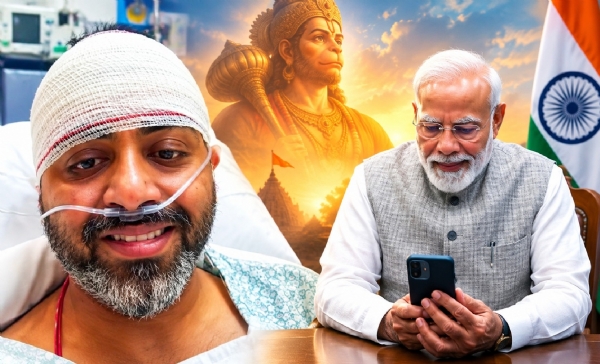
A moment of crisis always arrives unexpectedly. In such times, while one perceives much in the surroundings, the mind instinctively seeks an inner anchor, something to keep it steady amidst fear. Breathing quickens, the body endures pain and the future appears uncertain for a few fleeting moments. In such times, the memory of family, faith in doctors or the act of prayer becomes a source of strength for different people.
For Captain Smit, the Hanuman Chalisa became that very source of solace during such a trying time. In a conversation lasting nearly ten minutes with Prime Minister Narendra Modi, he shared that whenever he felt fear or pain, he would recite the Hanuman Chalisa. Even in that critical hour, the verses were on his lips. He held a firm belief that the Divine was protecting him.
To an outside observer, this might appear merely as an individual's religious experience; however, underlying it is the millennia-old spiritual ethos of Indian society, a mindset wherein remembering the Divine during a crisis steadies the mind, instills the courage to confront fear, and guides the individual back to their duty.
In Indian spiritual consciousness, Hanuman symbolizes strength, courage, service, dedication and protection. His persona is unique because, despite possessing extraordinary power, the focal point of his existence is not himself, but service to Shri Ram.
The episode in the Ramayana where he leaps across the ocean serves as the greatest example of this. Before him lay the vast, unfathomable ocean; the task seemed impossible. Hanumanji remained silent regarding his own capabilities. It was Jambavan who reminded him of his latent power, and it was then that Hanuman rose to leap across the ocean.
In life, too, fear often proves to be a greater challenge than the situation itself. When a person becomes aware of their own potential, faith and purpose, that same arduous path begins to appear different. The story of Hanuman is also a story of this very ‘self-realization.’
The Tale of Tulsidas and Fatehpur Sikri
One of the most famous legends surrounding the popularity of the “Hanuman Chalisa” involves the Mughal Emperor Akbar and Goswami Tulsidas. According to tradition, upon hearing of Saint Tulsidas’s renown, Akbar summoned him to the royal court and asked him to perform a miracle. Tulsidas, identifying himself merely as a humble servant of ‘Shri Ram,’ refused to claim any miraculous powers.
As the story goes, Akbar was displeased by this refusal and had Tulsidas imprisoned in Fatehpur Sikri. While in prison, Tulsidas meditated upon Bhagwan Hanuman and composed the “Hanuman Chalisa”.
The legend continues that following the composition and recitation of the ‘Chalisa’, an extraordinary havoc caused by monkeys broke out in Fatehpur Sikri. Chaos ensued throughout the palace and its premises. Eventually, Tulsidas was released and almost immediately, the monkeys’ rampage subsided.
While there may be differing views regarding the historical authenticity of this tale versus popular belief, its cultural impact on the Indian psyche is profound. The “Hanuman Chalisa” reached every household as a prayer to the “Sankatmochan” (the Reliever of Afflictions) and to this day, millions recite it during times of hardship.
When Tulsidas’s Suffering Gave Rise to ‘Hanuman Bahuk’
Another significant episode in the life of Tulsidas concerns the “Hanuman Bahuk”. According to tradition, during the final phase of his life, he was suffering from physical pain, specifically, intense agony in his arms. Amidst this suffering, he composed verses in praise of Lord Hanuman, which later became famous as the “Hanuman Bahuk”.
This composition offers a deeply moving portrayal of Bhagwan Hanuman’s colossal form, valor and compassion. In the tradition of ‘Bhakti’, this is regarded as an example of seeking refuge in God amidst suffering and drawing inner strength from faith.
An important insight emerges here: in the Indian tradition, ‘Bhakti’ does not encourage escapism; instead, it instills an inner courage that empowers the devotee to confront any crisis head-on. Maintaining mental composure amidst adversity and then returning to one's duties also plays a vital role in the life of a devotee.
A Tradition Extending to Captain Smit and His Two-Year-Old Son
There is another equally significant aspect to Captain Smit’s story. He recites the Hanuman Chalisa to his two-year-old son every morning.
This routine has continued even after his relocation from Mumbai to Dubai. A young child’s morning beginning with the verses of the Hanuman Chalisa symbolizes a cultural continuity that transcends geographical boundaries.
Today, Indian families reside in many countries across the globe. Passing on cultural memory to the next generation amidst new languages, lifestyles, and social environments presents a natural challenge. In this context, small domestic traditions become significant.
A child might listen to the ‘Ramayana’ or ‘Ramcharitmanas’ from their grandparents, a family might celebrate festivals with deep reverence or a father might recite the Hanuman Chalisa, ‘Ganesh Vandana’, ‘Shiva Stotra’ or ‘Ram Raksha Stotra’ to his young son daily. In essence, this represents the transmission of cultural memory alongside religious faith.
Hanuman’s Power Signifies More Than Just Valour
Hanuman’s popularity stems not only from his immense strength but also from the remarkable balance of power and humility in his personality. He is a scholar, a warrior, a messenger, a strategist and above all, a devoted servant.
A clarity of purpose is evident in every action of his, from leaping across the ocean and searching for Maa Sita to entering Lanka and retrieving the Sanjeevani herb. His power is not meant for personal display but for the fulfillment of duty; this is why Hanuman stands in the Indian consciousness as a symbol of the strength that challenges fear, stands firm in the face of adversity and remains free from ego even after achieving success.
The line from the Hanuman Chalisa, Sankat te Hanuman chhudavai, man kram vachan dhyan jo lavai (Hanuman liberates one from distress if one focuses on Him through mind, action, and speech), articulates this very faith for the devotee. While prayer may not yield a scientific or medical conclusion regarding the immediate alteration of circumstances, it certainly serves to steady the mind, foster patience, and provide the inner strength needed to confront difficult times.
From Crisis to Culture
Captain Smit’s experience reflects a dual aspect: turning to the Hanuman Chalisa during a moment of crisis and simultaneously, the tradition of reciting the same Chalisa to one’s child. The faith that provides strength during a crisis in one generation is passed on to the next as a cherished cultural value. This is the hallmark of Indian cultural tradition. Hanuman’s presence is felt everywhere, from temples to homes, from oral narratives to literature, and from rituals to daily life.
Times have changed, and the nature of crises has evolved. Modern humans fly aircraft, cross oceans, reside in foreign lands and lead lives surrounded by technology. Yet, the fundamental human experiences of fear, suffering, uncertainty and hope remain unchanged. In this context, the story of Hanuman remains as relevant today as ever. For it does not merely remind a person that they possess strength; it also teaches them the purpose for which that strength should be utilized.
Beyond Faith: An Inspiration for Life
There are two ways to understand Hanuman-ji: through worship and by drawing inspiration from his character. He embodies the message of combining strength with humility, knowledge with wisdom, valor with discipline and devotion with service. Perhaps this is why, when a frightened person recites the Hanuman Chalisa in a moment of crisis, the very act of uttering the words awakens a deep cultural memory. Tulsidas’s spiritual devotion, episodes from the Ramayana, values instilled by family and faith in the deity all converge to steady the mind.
It may take time for a crisis to resolve and circumstances need not change instantly. Yet, the true essence of any source of strength lies in enabling a person to hold themselves together, find courage within and take the next step amidst the adversity. Indeed, Hanuman represents precisely this kind of support, both as a deity invoked during times of trouble and as a character who inspires courage, service, duty and dedication in life. You are already familiar with the rest of the story of Flydubai Captain Smit Machhar!
---------------
Hindusthan Samachar / Mayank Chaturvedi