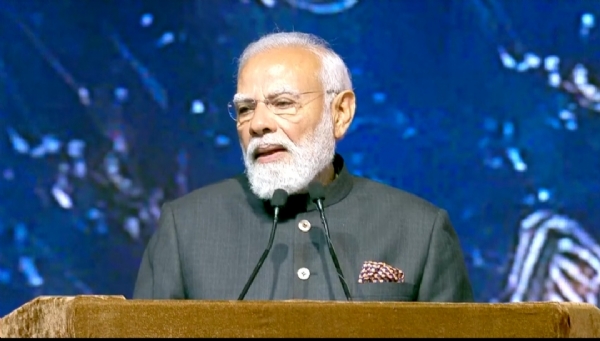
New Delhi, 03 January (H.S.): Prime Minister Narendra Modi on Saturday inaugurated the Grand International Exposition of the Sacred Piprahwa Relics of Bhagwan Buddha at the Rai Pithora Cultural Complex in New Delhi. The event, titled “The Light & the Lotus: Relics of the Awakened One,” marks a historic moment as the sacred relics return to India after 125 years.
Addressing an august gathering comprising Buddhist monks, dharma acharyas, Union Ministers, and dignitaries, the Prime Minister described the occasion as “a moment of divine fulfillment where India’s lost heritage has finally come home.”
A Return After 125 Years
The Prime Minister remarked that the homecoming of the relics symbolizes the restoration of India’s spiritual legacy after more than a century of separation. “For India, the sacred relics of Bhagwan Buddha are not merely artefacts; they are part of our revered heritage and an inseparable part of our civilisation,” he said.
Referring to the relics’ long journey abroad, PM Modi observed that their removal during a colonial era of subjugation represented not only political and economic slavery but also a loss of cultural and spiritual wealth. He expressed gratitude to the Godrej Group for its instrumental role in facilitating the relics’ return, ensuring they now rest once again in the land of Buddha’s karma and enlightenment.
A Message of Universal Oneness
Highlighting the global resonance of Buddha’s teachings, the Prime Minister said, “The wisdom and path shown by Bhagwan Buddha belong to all humanity.” He recalled the overwhelming devotion witnessed during the international tour of the sacred relics—in Thailand, where more than 40 lakh devotees came for darshan; in Vietnam, where 1.75 crore people paid homage; in Mongolia, where people queued for hours to touch Indian representatives; and in Russia’s Kalmykia region, where over 1.5 lakh devotees viewed the relics within a week.
“These events prove that Bhagwan Buddha belongs to everyone and unites us all,” PM Modi asserted, calling the relics “emblems of compassion, peace, and human unity.”
Personal Reflections and Sacred Journeys
Reminiscing on his own spiritual connection with Lord Buddha, the Prime Minister recalled his birthplace Vadnagar as a pivotal centre of Buddhist learning. He noted that Sarnath, where the Buddha gave his first sermon, is his karmabhoomi. He also recounted visiting major Buddhist pilgrimage sites across the world—including Lumbini in Nepal, To-ji Temple and Kinkaku-ji in Japan, Xi’an’s Giant Wild Goose Pagoda in China, Gandan Monastery in Mongolia, Anuradhapura in Sri Lanka, and Wat Pho in Thailand—each, he said, reflecting the timeless relevance of Buddha’s message.
He further emphasized symbolic gestures such as planting Bodhi tree saplings in several countries, including the botanical gardens of Hiroshima, where the tree stands as a message of peace and renewal.
India as the Custodian of Buddha’s Legacy
Underscoring India’s role as both guardian and carrier of Buddha’s teachings, the Prime Minister stated, “India is not only the custodian of Lord Buddha’s sacred relics but also the living carrier of his tradition.” He highlighted India’s enduring efforts to preserve and promote the Buddhist heritage—citing initiatives such as the reconstruction of stupas in Nepal after the devastating earthquake and the restoration of 11 pagodas in Bagan, Myanmar.
Within India, he noted that extensive excavations in Vadnagar, Gujarat, had uncovered thousands of ancient relics connected to Buddhism, which are now preserved in an experiential museum illustrating 2,500 years of heritage. He also mentioned the discovery of significant Buddhist sites in Baramulla, Jammu and Kashmir, with active preservation efforts underway.
Linking Heritage with Modernity
Prime Minister Modi outlined the government’s ongoing vision to integrate ancient Buddhist heritage with modern experiences. He detailed projects such as the Convention and Meditation Centre in Bodh Gaya, the Light and Sound Show at Dhamek Stupa in Sarnath, and the Buddha Theme Park in the same city.
Facilities in Shravasti, Kapilvastu, Kushinagar, Sanchi, Nagarjun Sagar, and Amaravati have also been upgraded to enhance global pilgrimage experiences.
A Buddhist Circuit is being developed to connect all these sacred sites with improved infrastructure and accessibility.The Prime Minister also mentioned the new Digital Experience Centre in Nalgonda, Telangana, reinforcing the government’s effort to blend tradition with innovation.
Pali Language and Cultural Continuity
Drawing attention to linguistic heritage, PM Modi announced that the Pali language, the original medium of Buddha’s teachings, has now been accorded the status of a classical language. He said this recognition would broaden access to the Dhamma, promote research, and ensure that Buddhist philosophy is preserved in its pure form for future generations.
A Call to the Nation
Concluding his address, the Prime Minister invited people across the country—especially students and youth—to visit the exhibition and receive the blessings of Bhagwan Buddha. “This exhibition is a great medium to connect the glory of our past with the dreams of our future,” he said.
Extending best wishes for the event’s success, he expressed hope that with the blessings of Buddha, the year 2026 will usher in an era of global peace, harmony, and spiritual awakening.
Union Ministers Gajendra Singh Shekhawat, Kiren Rijiju, Ramdas Athawale, and Rao Inderjit Singh, along with Lieutenant Governor of Delhi Vinay Saxena, were among the dignitaries present.
The exposition, organized under the Azadi Ka Amrit Mahotsav initiative, brings together for the first time the repatriated Piprahwa relics along with related materials preserved in the National Museum, New Delhi, and the Indian Museum, Kolkata.
Discovered in 1898, the Piprahwa relics hold immense archaeological and spiritual significance, being directly associated with ancient Kapilavastu, where Bhagwan Buddha spent his early life before renunciation. The thematic exhibition features immersive digital reconstructions, interpretive projections, and multimedia narratives, offering visitors an unparalleled experience of Buddhist art, heritage, and philosophy.
---------------
Hindusthan Samachar / Jun Sarkar


04 Jan 2026