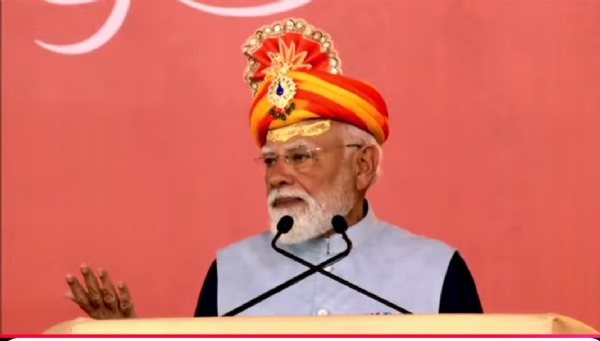
Somnath, Gujarat , 11 January (H.S.): Prime Minister Narendra Modi declared on Sunday that the invasions on Somnath were not driven by mere economic plunder but by a pernicious policy of appeasement, lamenting that such regressive forces regrettably persist in India today, having vehemently opposed the temple's post-independence reconstruction.
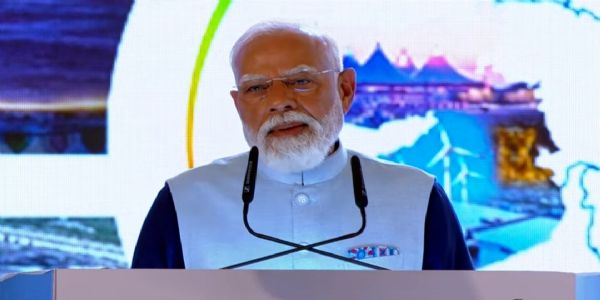
Addressing a massive rally at Sadbhavna Ground during the ongoing Somnath Swabhiman Parv celebrations, PM Modi articulated: This festival commemorates not acts of destruction but a resilient 1,000-year journey. Innumerable attempts were made to annihilate Somnath, mirroring centuries of foreign invaders' futile endeavors to eradicate India itself—yet neither Somnath nor India succumbed, for they are inextricably fused with the nation's sacred centers of faith.
The Prime Minister issued a clarion call for vigilance: Today, conspiracies against India unfold not through swords but subtler machinations, necessitating heightened caution. We must empower ourselves and vanquish every divisive force plotting our fragmentation. When we remain anchored to our heritage and faith, our civilizational roots deepen profoundly. I envisioned a thousand-year trajectory for India, and today, the renaissance of our culture instills unshakeable confidence in millions, fostering belief in a developed Bharat. India shall elevate its glory to unprecedented heights, scaling new pinnacles of progress. The nation stands ready, blessed by Somnath Temple's invigorating energy that sanctifies our resolves and draws inspiration from our storied legacy.
Evoking the temple's mythic resilience, PM Modi remarked: Mahmud of Ghazni to Aurangzeb overlooked that 'Som' in Somnath signifies nectar—the elixir of immortality. Each desecration spurred revival: Ghazni presumed obliteration, yet 12th-century reconstruction ensued; Alauddin Khilji ravaged it, only for Junagadh's king to rebuild in the 14th century; Sultan Ahmad Shah dared assault, Sultan Mahmud Vegda schemed mosque conversion; Aurangzeb's 17th-18th century reign saw profanation, countered by Ahilyabai Holkar's reconstruction. Somnath's chronicle is unequivocally one of triumph and perpetual rebirth.
PM Modi decried post-colonial hangovers: Regrettably, post-independence, those shackled by a slavish mentality disowned this legacy, mounting insidious efforts to erase it. When India shattered colonial chains and Sardar Vallabhbhai Patel vowed reconstruction, opposition surfaced; even then-President Dr. Rajendra Prasad's 1951 visit drew protests.
Commencing his address,PM Modi shared a personal reflection: Participating in this sacred Somnath Mahaparva at the hallowed Shri Somnath Temple marks an unforgettable, priceless milestone in my life. Today commemorates 75 years of the temple's reconstruction. A millennium ago, precisely here, what tumult prevailed? Your ancestors—and ours—staked their lives for faith, conviction, and Mahadev, offering everything. Invaders then fancied victory, yet a thousand years on, Somnath Mahadev's flag proclaims to the cosmos Hindustan's true power and prowess. Somnath Swabhiman Parv vividly mirrors the eternal faith, penance, and unbreakable resolve of billions of Indians.
Philosophically, he contrasted India's ethos: India never taught vanquishing others for victory but conquering hearts—a philosophy the world urgently needs. PM Modi urged prolonging celebrations through May 2027, honoring the dual milestones of 1,000 invasion years and 75 reconstruction years.
Earlier Sunday,PM Modi conducted a meticulous 40-minute puja at Somnath Temple, pouring water on the Shivling, offering flowers, and performing Panchamrit abhishek. Emerging, he interacted with priests and local artists, played the traditional Dhol (Chenda percussion instrument), and joined the ceremonial procession.
The Swabhiman Parv marks the 1,000th anniversary of the 1026 CE inaugural invasion, weaving spiritual reverence with nationalistic fervor amid throngs of devotees.PM Modi's discourse masterfully intertwined Somnath's tumultuous history—spanning Ghazni's plunder, Khilji's raids, medieval desecrations, and colonial-era neglect—with contemporary calls for cultural revival and self-reliance. He positioned the temple as an immortal symbol of India's phoenix-like resurgence, impervious to temporal tyrannies.
The event, resonating with chants and pageantry, amplified themes of unity, warning against divisive ideologies while projecting Viksit Bharat's visionary horizon. Attended by cultural luminaries and masses, it crystallized Modi's narrative of heritage as the bedrock for future ascendancy, ensuring Somnath's saga inspires generations anew.
Hindusthan Samachar / Jun Sarkar