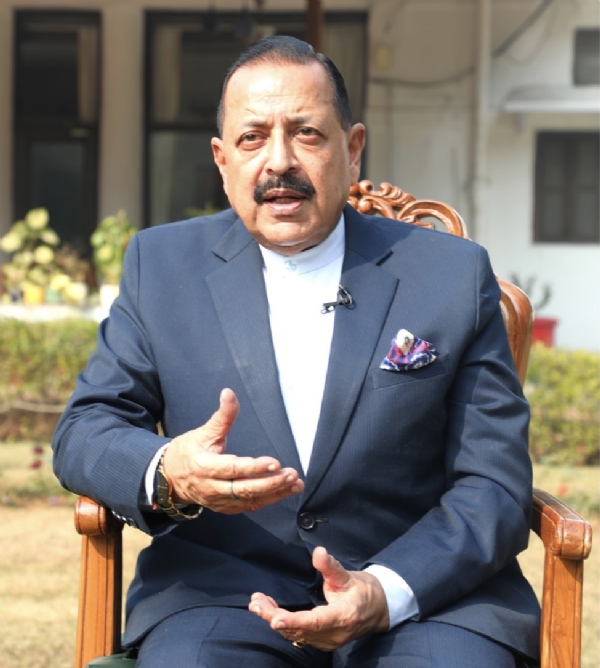
New Delhi, 28 December (H.S.):
Union Minister of State (Independent Charge) for Science and Technology, Dr. Jitendra Singh, has described the Safe Harnessing of Atomic Nuclear Technology for Industry and Innovation (SHANTI) Bill as one of the most transformative scientific reforms introduced by the Modi government.
Speaking in an interview on Sunday, Dr. Singh stated that the Modi 3.0 administration represents an era of structural reforms focusing on science, innovation, entrepreneurship, and the expansion of clean nuclear energy. He emphasized that the SHANTI Bill would dismantle six decades-old barriers in India’s atomic energy sector and open new opportunities in industry, medicine, research, and energy security.
“The Modi government will be remembered for breaking the old taboos that restricted India’s technological and economic future,” Dr. Singh remarked. He added that the SHANTI Bill places science-driven reforms at the very center of national transformation, a space which scientific reform had rarely occupied in past policy Did course.
Empowering Peaceful and Clean Atomic Energy
According to the Minister, the legislation is designed to promote peaceful, clean, and sustainable use of nuclear energy while ensuring national security, sovereignty, and public safety. He recalled that since the time of Dr. Homi Jehangir Bhabha, India’s nuclear program has been based on the peaceful application of atomic energy for power generation, healthcare, and development, and this Bill further strengthens that foundational philosophy.
Dr. Singh underlined that with the growth of artificial intelligence, quantum computing, and data-centric economies, uninterrupted 24×7 power supply will be vital — an area where nuclear energy can play a key role due to the intermittent nature of renewables like solar and wind energy.
Ambitious Targets for Nuclear Capacity
Highlighting India’s progress, the Minister noted that the country’s nuclear power generation capacity, which stood at around 4.4 gigawatts (GW) in 2014, has nearly doubled to 8.7 GW as of 2025. The government now aims to expand this capacity to approximately 100 GW by 2047, ensuring that nuclear power contributes around 10 percent of India’s total electricity and significantly supports the nation’s net-zero emission goals.
Dr. Singh also pointed to India’s accelerating advances in nuclear medicine, cancer diagnostics and treatment, and isotope-based applications, calling them a growing pillar of public health and human welfare.
New Era in Nuclear Innovation
India is also moving toward Small Modular Reactor (SMR) technology, which will be particularly suitable for urban, industrial, and economic corridors. The Minister observed that the SHANTI Bill has received wide-ranging support from the scientific community, industry leaders, innovation networks, startups, and other stakeholders, reflecting a national consensus on modernizing India’s nuclear sector.
He concluded by stating that the SHANTI Bill symbolizes the Modi government’s science-oriented reform agenda, designed to lay the foundation of a developed India by 2047.
“Science and technology,” Dr. Singh said, “are not just tools of progress—they are the driving force behind Prime Minister Modi’s vision of a self-reliant, innovative, and globally competitive India.”
---------------
Hindusthan Samachar / Jun Sarkar

28 Dec 2025