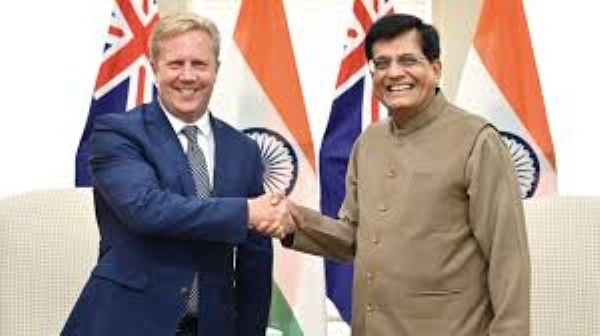
New Delhi, 22 December (H.S.): India and New Zealand announced the triumphant conclusion of negotiations for a landmark Free Trade Agreement on Monday, heralding a people-centric, jobs-driven partnership that eliminates tariffs on 100% of India's exports while unlocking unprecedented market access, skilled mobility, and agricultural innovation.
Launched on March 16, 2025, under the stewardship of Commerce Minister Piyush Goyal and New Zealand's Trade Minister Todd McClay, the pact emerged from five intensive rounds of talks, cementing India's third FTA this year and aligning seamlessly with Prime Minister Narendra Modi's Viksit Bharat 2047 blueprint.
India extended tariff liberalization across 70% of lines encompassing 95% of bilateral trade, fortifying sectors like textiles, pharmaceuticals, leather, engineering goods, and agriculture against global competition.
New Zealand delivered its most ambitious services package yet, spanning 118 sectors including IT, professional services, audiovisual, telecommunications, construction, and tourism, bolstered by Most-Favoured-Nation commitments in 139 sub-sectors.
A dedicated quota of 5,000 Temporary Employment Entry visas for Indian professionals—covering AYUSH practitioners, yoga instructors, chefs, and experts in IT, engineering, healthcare—pairs with 1,000 Work and Holiday visas, alongside post-study work rights up to three years for STEM graduates and four for PhD scholars.
Commerce Secretary Rajesh Agrawal hailed the accord as a new generation framework fusing tariffs, productivity, investment, and talent, with New Zealand pledging USD 20 billion in investments over 15 years to fuel India's manufacturing, infrastructure, and innovation under Make in India.
Agricultural collaboration spotlights Centres of Excellence for apples, kiwifruit, and honey, emphasizing productivity enhancement, research, and value-chain development while imposing quotas and minimum import prices to safeguard Indian producers.
Sensitive exclusions encompass dairy, coffee, milk products, onions, sugar, spices, edible oils, and rubber, complemented by duty-free inputs like wooden logs, coking coal, and metal scraps for India's manufacturing base.Pharma and medical devices gain expedited approvals via mutual recognition of GMP/GCP inspections from regulators like US FDA and EMA, alongside Geographical Indications protections for Indian wines, spirits, and goods.
Bilateral trade, valued at USD 2.4 billion in 2024 with services dominating at USD 1.24 billion, now poised for exponential growth through streamlined customs, SPS measures, and non-tariff barrier resolutions.
---------------
Hindusthan Samachar / Jun Sarkar